
Seattle Center Monorail, Washington
Historic rail siteTrain ridesRuns daily between Westlake Center and Seattle Center
The Seattle Center Monorail opened in March 1962 for the World's Fair, and its two original ALWEG trains, Blue and Red, still glide above 5th Avenue between Westlake Center and Seattle Center every day of the year.
- Opened March 24, 1962
- Original 1961 ALWEG trains
- Two-minute elevated ride
- Open every day
- Kids 5 and under ride free
- Pets welcome aboard
Seattle Center Monorail at a glance
- Hours
- Daily: Monday to Thursday 7:30 am to 9 pm, Friday 7:30 am to 11 pm, Saturday 8:30 am to 11 pm, Sunday 8:30 am to 9 pm; later on some event nights
- Admission
- One way: adults (19 to 64) $4, youth (6 to 18) $2, reduced rate $2, ages 5 and under free; round trip is double
- Train rides
- Two-minute elevated ride between Westlake Center and Seattle Center, every day
- Plan for
- About 2 minutes each way
- Best for
- Families pairing a classic ride with a Seattle Center day
- Best ages
- All ages
- Accessibility
- Westlake Station was upgraded in 2021 for capacity and accessibility; a Seattle Center Station renovation for accessibility is planned.
Hours and prices as the museum posts them, checked October 19, 2026. Confirm before you go.
Contact and directions
- Address370 Thomas Street, Suite 200, Seattle, WA 98109(opens in a new tab)
- Phone(206) 905-2620
- Websiteseattlemonorail.com(opens in a new tab)
Follow Seattle Center Monorail
Look inside the book
Taking the kids to Seattle Center Monorail? Bring Rally along.
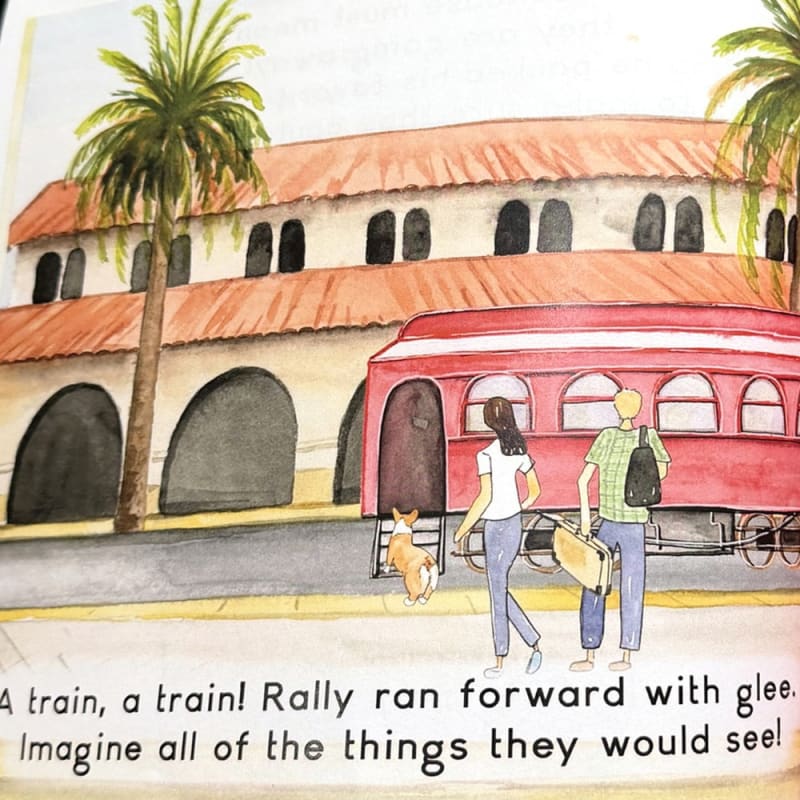
In Rally Takes the Train, a corgi's little legs can't manage the big train stairs, so Dad gives him a boost. It takes about five minutes to read, a good fit for the drive to Seattle.



Rally Takes the Train
Eight pages from the book
Turn the page
That's 8 of 25 pages
See who’s waiting at the station
Grandmommy and Papa are at the last stop. Get the full hand-painted book, $13.99 on Amazon.
See the full bookPage 1 of 8

Like it so far? See the full book
25 hand-painted pages, paperback, $13.99 with fast shipping from Amazon.
Every page is real watercolor on paper, painted by hand by Leslie Dunn. Nothing in this book was made with AI.
A World's Fair ride that never stopped running
Work on the monorail began in April 1961, built by Alweg Rapid Transit Systems, which won the job by offering to pay the entire construction cost itself. The guideway was finished in January 1962, and the two trains, built in West Germany in 1961, crossed the Atlantic to New York and then rode to Seattle on ordinary rail cars. Blue Train went up on the beam first in February 1962 and made its first test run on March 3.
The monorail opened to the public on March 24, 1962, nearly a month before the World's Fair began. It cost $3.5 million, and in the fair's six months it carried more than eight million riders, earning back its full cost and turning a profit before the fair closed. Afterward the system went to the Century 21 Corporation at no cost, and in 1965 the City of Seattle bought it for $600,000.
The city still owns the monorail, and since 1994 it has been run by Seattle Monorail Services, a private company. Taxpayers pay none of its operating costs: fares cover operations, help fund upgrades, and return revenue to the city each year. In 2021 the company completed $7 million in privately funded improvements at Westlake Station to add capacity and improve accessibility, and in 2026 a major renovation of the historic Seattle Center Station was in the works. The team of about 30 people calls the monorail its Little Train that Could and hopes to see it reach 100.
Two stations, two trains and a mile of concrete beam
The ride connects two stations: Westlake Center at 5th and Pine downtown, and Seattle Center, next to the Space Needle and MoPOP. There are no stops in between, and the trip takes about two minutes along roughly 0.9 miles of guideway. Each train has its own beam, carried on 68 Y-shaped columns, with concrete beam sections about 70 feet long and the tallest columns around 30 feet up.
Look closely at the trains and you can see how they work. Each one rolls on 64 rubber tires: 16 carry the weight on top of the beam and 48 grip the sides to keep the train lined up. Power comes at 700 volts DC through copper-headed contact rails on the beams, picked up by carbon shoes and fed to GE motors in eight bogies under each train. When the monorail opened in 1962 the guideway ran a little past today's Westlake terminal.
Don’t miss
- Blue TrainThe first of the two trains to reach Seattle, placed on the beam in February 1962 and test run on March 3 of that year.
- Red TrainBlue Train's 1961 twin, built by ALWEG in West Germany and still in daily service on its own beam.
- The front seatsSeattle Monorail Services encourages kids to sit up front near the driver for a view straight down the guideway.
- The Y-shaped columnsSixty-eight concrete columns carry the twin beams above 5th Avenue, some about 30 feet high.
- Seattle Center StationThe 1962 terminal beside the Space Needle, slated for a major modernization to improve accessibility and safety.
A short ride kids ask to do twice
At two minutes each way, the monorail is the right length for even the smallest rider, and it lands you right at Seattle Center, next to the Space Needle and MoPOP. The crew encourages kids to sit up front near the driver, and children 5 and under ride free. A round trip is simply two one-way fares, so it is easy to ride there and back just for fun.
Pets are welcome aboard too, so the family dog can come along. Trains run every day from early morning into the evening, and later on Fridays, Saturdays and big event nights.
Plan your visit: tips for Seattle Center Monorail
- Ticket machines take credit cards and contactless payment only; no cash.
- Buy mobile tickets online to skip the machine line, but reduced fares are sold only at the machines.
- Youth with a valid Youth ORCA card ride for $0 when they tap at the faregate.
- Check the schedule for extended hours on big concert and event nights.
- School groups (K to 12) get $1.50 one-way fares if they register three business days ahead.
A city-owned train with a private crew
The City of Seattle owns the monorail, and Seattle Monorail Services, led by owners Tom and Tina Albro, has operated it since 1994. Its roughly 30 employees come from Seattle and from countries around the world, and more than a third have been at the monorail for over five years. The company gives school groups tours of the system and supports local nonprofits such as Treehouse, which serves foster children. Riding is the best support: fares keep the trains running.
More rails within an hour of Seattle Center
The Issaquah Valley Trolley, about 16 miles east, runs a 1925 Lisbon streetcar, and the Northwest Railway Museum in Snoqualmie is about 25 miles away. For a longer outing, the Great Northern and Cascade Railway in Skykomish is about 46 miles. See every train museum in Washington for more ideas.
- Pacific Northwest Railroad ArchiveBurien, WA · about 11 mi
- Issaquah Valley TrolleyIssaquah, WA · about 16 mi
- Northwest Railway MuseumSnoqualmie, WA · about 25 mi
- Washington State History Museum railroad exhibitsTacoma, WA · about 26 mi
- Great Northern & Cascade RailwaySkykomish, WA · about 46 mi
- Mount Rainier Scenic RailroadElbe, WA · about 60 mi
Bring Rally along: a train book for the drive

The monorail rides about 30 feet above 5th Avenue, and the crew invites kids to sit up front by the driver. I love that, because the page in our book my kids always point to is Rally gazing out the arched train window at the ocean, saying hello to a white bird. From up on that beam a little one could wave at the Space Needle the same way. Our coloring pages are a good way to settle down after a busy day at Seattle Center.
Free for train families
Print the Rally coloring pages before you go
Watercolor coloring pages from the book, free to print. Tuck a few in a folder with crayons for the drive or the wait for the next train.
Get the free coloring pages
A train story for the ride homeRally Takes the Train is a five-minute rhyming picture book about a corgi's first train trip to see his grand-paw-rents. Hand-painted in real watercolor. $13.99 on Amazon, for ages 0 to 8.
Buy on Amazon (opens in a new tab)More for train families
- Train museums in Washington: every museum by town, with a map
- Train museums in every state: search by town or near you
- Christmas train rides in Washington
- Halloween train rides in Washington
- Every Amtrak route with kids
Work or volunteer at Seattle Center Monorail?
We want this page to be the best introduction to your museum on the web. Send new hours, event dates, corrections or photos to kelsey@rallytakesthetrain.com and we will update it. You are welcome to share this page with your members.
Sources
- Seattle Center Monorail official website(opens in a new tab)
- Seattle Center Monorail on Facebook(opens in a new tab)
- Seattle Center Monorail on Instagram(opens in a new tab)
- Seattle Center Monorail on X(opens in a new tab)
Everything on this page comes from the museum’s own website and social pages and, for history, Wikipedia, checked October 19, 2026.
Seattle Center Monorail: 20 questions riders ask
How much does the Seattle Center Monorail cost?
As of October 2026, one-way fares are $4.00 for adults ages 19 to 64, $2.00 for youth ages 6 to 18, and $2.00 at the reduced rate for seniors 65 and up, riders with disabilities or Medicare cards, U.S. military with ID, and ORCA LIFT holders. Children 5 and under ride free. A round trip costs twice the one-way fare.
What are the Seattle Center Monorail hours?
As of October 2026, the monorail runs every day: Monday through Thursday 7:30 am to 9 pm, Friday 7:30 am to 11 pm, Saturday 8:30 am to 11 pm, and Sunday 8:30 am to 9 pm. Hours are extended on many big event nights, so check the schedule page or call (206) 905-2620 for recorded information.
Where does the Seattle Center Monorail go?
The monorail runs between two stations: Westlake Center in downtown Seattle at 5th and Pine, and Seattle Center, next to the Space Needle and MoPOP. It travels along 5th Avenue on an elevated guideway of about 0.9 miles and makes no stops in between.
How long is the Seattle Center Monorail ride?
The trip takes about two minutes each way. Trains run back and forth all day, so waits are usually short, and a round trip including the walk through each station easily fits into a few minutes of a Seattle Center outing.
How do I buy Seattle Center Monorail tickets?
Buy tickets from the ticket vending machines at Westlake Center or Seattle Center, which accept credit cards and contactless payment only, or buy full-fare mobile tickets online to skip the line. Reduced fare tickets are sold only at the machines, and you may be asked to show ID.
Can I use an ORCA card on the Seattle Center Monorail?
Yes. Go straight to a faregate with a yellow ORCA reader and tap once when entering. As of January 1, 2026, riders paying with ORCA E-purse no longer get a free transfer and pay the monorail fare each trip. Youth with a valid Youth ORCA card ride for $0. ORCA questions go to King County Metro at 206-553-3000.
When did the Seattle Center Monorail open?
The monorail opened to the public on March 24, 1962, nearly a month before the Seattle World's Fair began. Construction started in April 1961, the guideway was finished in January 1962, and Blue Train made its first test run on March 3, 1962.
Who built the Seattle Center Monorail?
Alweg Rapid Transit Systems built the monorail, winning the contract by offering to underwrite the entire construction cost. The two trains were built by ALWEG in West Germany in 1961, shipped to New York and carried to Seattle on traditional rail cars. The system cost $3.5 million and paid for itself during the fair.
Are the Seattle Center Monorail trains the originals?
Yes. The monorail still runs its two original trains, Blue Train and Red Train, built in 1961 for the 1962 World's Fair. Each runs on its own beam and rolls on 64 tires, with GE motors and Rockwell gearboxes powered by 700 volts DC from contact rails on the guideway.
How many people rode the monorail during the 1962 World's Fair?
More than eight million riders took the monorail during the six months of the 1962 World's Fair. That ridership easily covered the $3.5 million construction cost, and ALWEG recovered its full initial investment and made a profit before the fair ended. Today it carries over two million passengers a year.
Who owns the Seattle Center Monorail?
The City of Seattle owns the monorail. After the fair it was handed to the Century 21 Corporation at no cost, and the city bought it in 1965 for $600,000. Since 1994 it has been operated by Seattle Monorail Services, a private company that covers operating costs from fares and returns revenue to the city.
Is the Seattle Center Monorail good for toddlers?
It is a great fit. The ride lasts about two minutes, children 5 and under ride free, and the crew encourages kids to sit up front near the driver. It also drops you right at Seattle Center, next to the Space Needle and MoPOP, so it is easy to build a whole day around it.
Can I bring my dog on the Seattle Center Monorail?
Yes. Seattle Monorail Services says it welcomes pets aboard, which makes the monorail an easy way to bring the family dog between downtown and Seattle Center. Keep your pet close in the station and on the train, especially on busy event days.
Is the Seattle Center Monorail wheelchair accessible?
Westlake Station received $7 million in privately funded improvements in 2021 that increased capacity and improved accessibility. A major renovation of the historic Seattle Center Station, aimed at accessibility and safety, was announced in 2026. Call (206) 905-2600 for current access details at each station before your trip.
Does the Seattle Center Monorail offer group discounts?
Yes, for large groups. Discounted prepaid group tickets start at 200 one-way trips or 100 round trips, with prices stepping down from $4.00 to $3.75 and $3.25 one way as volume grows. Groups register through the form on the monorail website, and staff reply within three business days.
Are there school group rates for the Seattle Center Monorail?
Yes. As of October 2026, K to 12 school groups traveling together pay $1.50 one way or $3.00 round trip per student, with chaperones at the same rate up to one adult per four students. Register at least three business days ahead and bring your confirmation. Seattle Monorail Services also offers system tours to school groups.
Does the Seattle Center Monorail run late for concerts and events?
Often, yes. The monorail posts extended hours for major events, with trains running as late as midnight or 12:30 am on many concert nights. Check the schedule page before you go, or call (206) 905-2620 for recorded information on that day's hours.
How does the Seattle Center Monorail work?
Each train straddles its own concrete beam. Sixteen load tires ride on top in eight bogies, and 48 guide tires run along the sides to keep the train aligned. Power at 700 volts DC flows from copper-headed contact rails through carbon shoes to the GE motors. The beams rest on 68 Y-shaped columns.
Is there parking at the Seattle Center Monorail?
The monorail does not list its own parking. Many visitors park near one station and ride to the other, using the monorail as the link between downtown and Seattle Center. Westlake Station is at 5th and Pine, and Seattle Center Station sits beside the Space Needle.
What train museums are near the Seattle Center Monorail?
The Pacific Northwest Railroad Archive in Burien is about 11 miles away, the Issaquah Valley Trolley about 16 miles, and the Northwest Railway Museum in Snoqualmie about 25 miles. The Washington State History Museum in Tacoma, with railroad exhibits, is about 26 miles south.
Keep exploring
More family train guides from Rally
- DirectoryRailway Museum Directory650 train museums in all 50 states, with hours, tickets and train rides.
- HolidayChristmas Train RidesSanta trains and holiday light rides, sorted by state and town.
- OctoberHalloween Train RidesPumpkin trains and not-too-spooky rides for little ones, by state.
- NovemberThanksgiving Train RidesHoliday weekend train trips the whole family can share.
- AmtrakAmtrak With KidsWhich Amtrak routes work best with babies, toddlers and big kids.
- Plan a tripTrain Trips With KidsEvery Amtrak route, stop by stop, planned for families.