
Research Lesson for 4th Grade: Integrate Two Sources About Old Trolleys
A two-day 4th grade research workshop. Students read short passages from two real trolley museum guides, take notes by category, solve a puzzle about which museum came first by rereading exact words, and write an informative paragraph that integrates both sources and lists them. Includes three printables.
- Grade
- 4th Grade
- Subjects
- Reading informational text, Writing (research), Social studies (history)
- Time
- Two sessions: 50 and 50 minutes
- Structure
- Research workshop, two days
- Prep
- 15 minutes: copy the Two Sources, Research Notes and Write It Up pages (one each per student), write the research question on chart paper, preview both guides and have them open on the screen, and set out two colors of highlighter per pair
- Grouping
- Whole class for minilessons, partners for reading and notes, independent writing
- Book
- Not used in this lesson
- CCSS RI.4.9
- CCSS W.4.7
- CCSS W.4.8
 Need the book? Get the paperback on Amazon (opens in a new tab) or earn a free classroom copy.
Days 4-5 of the 4th Grade train unit
Builds on: Days 1 to 3 (4A) studied verse. Here students read informational prose, the kind of writing they compared with poetry on Day 1.
Leads to: Day 6 (4C) uses a museum guide in a new way: as a source of real numbers for multi-step math.
Learning objective
Students read two museum guide passages on the same topic, take notes sorted into categories, identify where the sources agree, differ or add new information, and write an informative paragraph that integrates both sources and lists them.
I can take notes from two sources on the same topic, notice what each one adds, and write a paragraph that combines them and names my sources.
Vocabulary to teach
Materials
- The Seashore Trolley Museum guide (rallytakesthetrain.com/museums/seashore-trolley-museum-kennebunkport-maine) and the Connecticut Trolley Museum guide (rallytakesthetrain.com/museums/connecticut-trolley-museum-east-windsor), open on a screen
- Two Sources printable (one per student): Source A and Source B, short passages from the two guides with source lines
- Research Notes printable (one per student): five note categories for each source and a same, different or only one column
- Write It Up printable (one per student): lines for an informative paragraph, a sources list and a checklist
- Chart paper with the research question: How did people save old trolleys, and how do trolleys run?
- Highlighters in two colors per pair
Before you teach
- Read both guides yourself and find the passages printed on the Two Sources page. The guides are written for adults, so you will read the passages aloud while students follow along.
- Notice the three dates before Day 2: Seashore rail fans bought trolley #31 in 1939 and incorporated in 1941; the Connecticut group organized in October 1940. Do not resolve this on Day 1; it is the Day 2 warm-up.
- Pair a stronger reader with a developing reader for the note-taking. Each partner still fills their own Research Notes page.
- Many students have never seen a trolley. Have a photo from either guide ready to show during the launch.
Lesson plan
Research workshop, two days. W.4.7 and RI.4.9 ask students to build knowledge from more than one source, and that takes reading time, note-taking time and writing time. Splitting it over two days lets notes come first and the integrated paragraph come second, which is how short research really works.
The book: The book is not used. If students ask, it makes a good contrast: a story can spark a question, but researchers answer it with informational sources.
Source A comes from this guide and Source B from the Connecticut Trolley Museum guide; both passages are printed on the Two Sources page. Or find a verified museum near your school in the field trip planner.
Day 1 50 minutes
- Post the research question. Show a trolley photo from one of the guides and teach trolley and source directly.
- Open both guide pages on the screen so students see they are real sources about two different museums.
- Ask partners what they already know or wonder about streetcars. Record two wonderings under the question.
Look for: Students who think a trolley is a kind of bus; the photo of the pole and wire usually settles it.
- Show the Research Notes page and its five categories: when it began, who saved the trolleys, what they rebuilt, the collection, how a trolley runs.
- Read the first two sentences of Source A aloud. Think aloud as you decide which category each fact belongs in and write a note of five words or fewer.
- Teach paraphrase: cover the source, say the fact to a partner, then write it. Students try one more fact with you.
Look for: Notes that are copied sentences; ask the student to say it in fewer words first.
- Hand out the pages (2 minutes). Read Source A aloud while students follow and highlight facts in color 1.
- Partners sort the highlighted facts into the Source A boxes, each writing on their own page.
- Confer with three or four pairs. Ask: Which category is this? How could you say it in fewer words?
- Read Source B aloud while students highlight in color 2.
- Students start the Source B notes on their own and finish with their partner in the last 5 minutes.
- Collect the pages or have students clip them in their folders for Day 2.
Day 2 50 minutes
- Write 1939, October 1940 and 1941 on the board. Ask partners to find each date in the sources and decide which museum came first.
- Let the disagreement happen, then send them back to the exact words: saved and bought, organized, incorporated.
- Agree that both sources can be right: Seashore fans saved a trolley first, and the Connecticut group organized and incorporated a museum. Teach incorporated.
Look for: Students who go back to the text to settle the argument instead of picking a side.
- Partners mark each category S (same), D (different) or O (only one source) in the table.
- Each student fills the two lines at the bottom of Two Sources: one fact only one source gives, and one fact both agree on (both groups rebuilt track so old cars could run again).
- Ask which category only one source answers (how a trolley runs: only Source A explains the wire and the pole). Make clear that a fact from one source is still usable as long as you name it.
- Model an integrated sentence about the rebuilt track using both and also, with (Source A) and (Source B) at the end.
- Students write one integrated sentence of their own at the bottom of Research Notes and read it to a partner.
- Students write one informative paragraph on Write It Up: a topic sentence that answers the question, at least three paraphrased facts, the integrated sentence, and a concluding sentence.
- Under the paragraph they list both sources by guide name and rallytakesthetrain.com.
- Confer with students whose notes were thin on Day 1 first.
- Partners trade paragraphs and check them against the checklist.
- One or two students read the integrated sentence aloud.
Short on time? To finish in one 60-minute session, have partners split the sources (one takes A, one takes B) and swap notes, so reading and notes take about 20 minutes after a 5-minute launch and the 7-minute notes minilesson. Then run the date puzzle in 5 minutes, model one integrated sentence, and give 18 minutes to write; skip the S, D or O table and the partner check.
Finished early? Find one more fact in either full guide that fits a category, add it to your notes, and add it to your paragraph with its source.
What to listen for
| If children say or do this | Try this |
|---|---|
| The two sources disagree about which museum was first, so one of them must be wrong. | Send the student back to the exact verbs (bought, organized, incorporated) and ask what each date actually describes. |
| Integrating means writing everything from Source A, then everything from Source B. | Show a paragraph built that way and ask where a reader learns what the two museums have in common. Then point to a sentence with both. |
| If only one source gives a fact, it cannot go in the paragraph. | Researchers use it and name the source. The (Source A) tag tells the reader where it came from. |
Differentiation
Extra support
Pre-highlight the key facts in both passages and let the student take notes in three categories instead of five. Give a paragraph frame: "People saved old trolleys because ___. (Source A) In Connecticut, ___. (Source B) At both museums, ___. Today, ___."
Multilingual learners
Preteach trolley, volunteer, rebuild and source with the photos in each guide. Provide frames: "Source A says ___. Source B says ___. Both sources ___." Students may take notes in the home language and write the paragraph in English. Key language use: Inform.
Extension
Add a third source: choose another verified museum guide about streetcars and add a row of notes. Or write a short explanation of why both museums can describe themselves with a first or oldest claim, quoting the exact words each guide uses.
Check for understanding
Success criterion: Writes an informative paragraph that answers the research question with accurate facts from both sources, includes at least one sentence that integrates them, and lists both sources.
| Level | What you see |
|---|---|
| 3Meets (level 3) | Paragraph answers the question with three or more accurate, paraphrased facts from both sources, includes a sentence that combines them, and lists both sources correctly. |
| 2Approaching (level 2) | Uses facts from both sources but keeps them in separate halves with no integrated sentence, or copies long phrases, or lists only one source. |
| 1Beginning (level 1) | Uses only one source, changes facts, or does not yet answer the research question. |
Family connection
Send home the half-page note in the printables. The text is below so you can paste it into a newsletter or app.
English
Ask your child what a trolley is and how it gets its power. Over two days we read two guides to real trolley museums, one in Maine and one in Connecticut, and learned how volunteers saved old electric streetcars and rebuilt track so they could run again. Your child took notes from both sources and wrote a paragraph that combines them and names each source. For 5 minutes at home, ask your child to tell you one fact from each source and one thing both sources agree on. Free train museum guides are at rallytakesthetrain.com/train-museums.
Español
Pregúntele a su hijo o hija qué es un tranvía y de dónde saca su energía. Durante dos días leímos dos guías de museos reales de tranvías, uno en Maine y otro en Connecticut, y aprendimos cómo unos voluntarios salvaron tranvías eléctricos antiguos y reconstruyeron las vías para que volvieran a funcionar. Su hijo o hija tomó apuntes de las dos fuentes y escribió un párrafo que las combina y nombra cada fuente. En casa, por 5 minutos, pídale un dato de cada fuente y algo en lo que las dos estén de acuerdo. Hay guías gratis de museos de trenes en rallytakesthetrain.com/train-museums.
Teacher tips
- The 1939, 1940 and 1941 dates are a gift. Resolving what looks like a contradiction by rereading the verbs teaches careful reading better than any worksheet.
- Teach the word both as an integration signal. When students see both, also or while in their own paragraph, two sources are usually working together.
Standards alignment
| Standard | Text |
|---|---|
| CCSS RI.4.9 (opens in a new tab) | Integrate information from two texts on the same topic in order to write or speak about the subject knowledgeably. |
| CCSS W.4.7 (opens in a new tab) | Conduct short research projects that build knowledge through investigation of different aspects of a topic. |
| CCSS W.4.8 (opens in a new tab) | Recall relevant information from experiences or gather relevant information from print and digital sources; take notes and categorize information, and provide a list of sources. |
Check codes against your state's version of these standards. How we build and review lessons.
Keep exploring
Choose two museum guides about the same kind of train, such as two trolley museums or two steam railroads. What does one guide tell you that the other does not?
Teach it with the real book
4.9 stars on Amazon
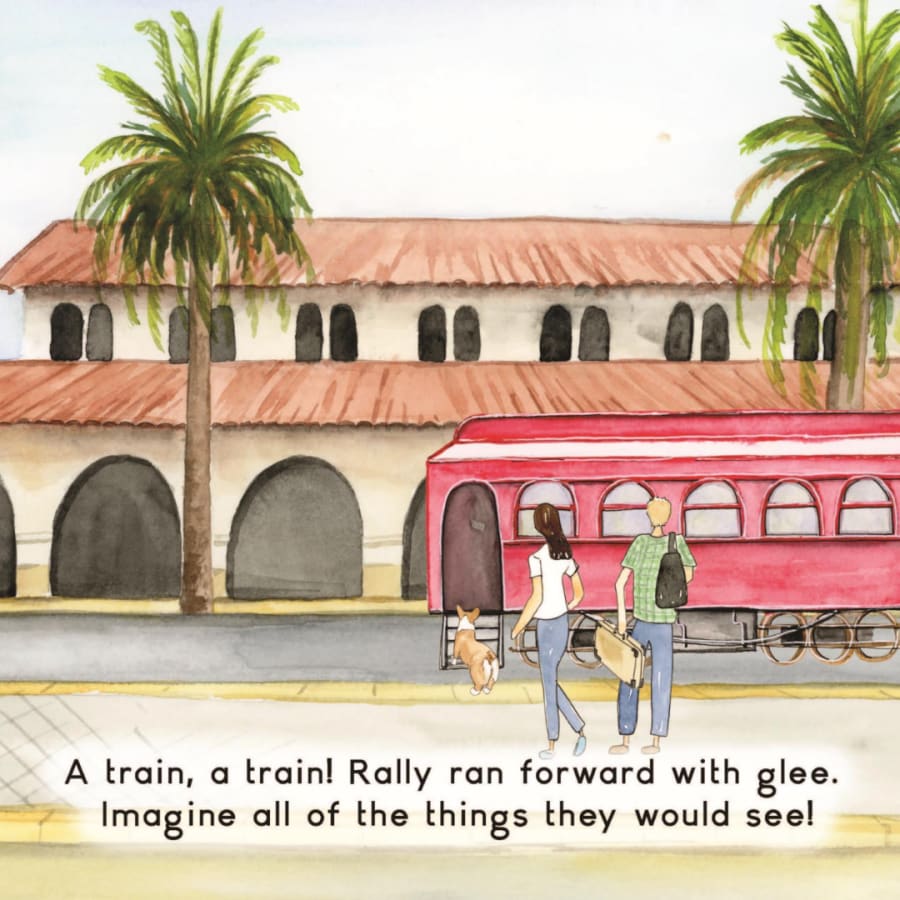
Rally Takes the Train is a rhyming, hand-painted picture book about a corgi's first train ride, from the big station stairs to a dark tunnel to the people waiting at the end of the line. Children ask for it again and again, and every unit here opens with it.
Questions teachers ask
Why are notes and writing split across two days?
Day 1 is reading and note-taking only: a launch, a minilesson on short sorted notes, then Source A and Source B read aloud with highlighting. Day 2 opens with the date puzzle, compares the notes, models one integrated sentence and gives 20 minutes to write. Keeping notes and writing apart is how short research works, and it stops students from copying sentences straight into a paragraph.
Which two trolley museums are the sources, and why these two?
Source A comes from the Seashore Trolley Museum guide and Source B from the Connecticut Trolley Museum guide. Both passages are printed on the Two Sources page with source lines. The pair works because both groups saved old trolleys and rebuilt track, yet each passage adds something the other lacks, and their dates look like a contradiction until students reread the exact verbs.
Do the two sources really disagree about which museum came first?
It looks that way. Seashore rail fans bought car #31 in 1939 and incorporated in 1941; the Connecticut group organized in October 1940 and is recognized as the oldest incorporated museum of its kind. Both statements are true: one group saved a trolley first, the other organized and incorporated a museum first. Do not settle it on Day 1. It is the Day 2 warm-up.
What do the five note categories do for 4th grade note-takers?
When it began, who saved the trolleys, what they rebuilt, the collection and how a trolley runs give every fact a place to go, so students decide what a fact is about before they write it. The categories also line the two sources up side by side, which makes the S, D or O marking on Day 2 quick and shows where the sources agree, differ or stand alone.
How do I stop students from copying whole sentences into their notes?
Teach the cover-and-say routine in the Day 1 minilesson: cover the source, say the fact to a partner, then write it in five words or fewer. When you confer and see a copied sentence, ask the student to say it in fewer words first. Notes that are already paraphrased make the Day 2 paragraph much easier to write in their own words.
Can a fact from only one source go in the paragraph?
Yes. Only Source A explains how a trolley runs (the pole on the roof reaches a wire overhead), and students should still use it. Researchers include a fact from one source as long as they name where it came from, which is what the (Source A) tag at the end of the sentence does. Students who think every fact needs both sources often leave out the most interesting one.
What counts as an integrated sentence here?
One sentence that uses facts from both sources together, usually with both, also or while, and ends with both source tags. The Day 2 model is about the rebuilt track: both groups rebuilt track so old cars could run again. A paragraph that gives all of Source A and then all of Source B uses two sources but does not integrate them.
Are the museum guides too hard for 4th grade readers?
The full guides are written for adults, so students do not read them independently. You read the printed passages on the Two Sources page aloud while students follow and highlight, and both guides stay open on the screen so students see they are real sources. Pair a stronger reader with a developing reader, but have each partner fill in their own Research Notes page.
What if students have never seen a trolley?
Many have not. During the 7-minute launch, show a trolley photo from one of the guides and teach trolley and source directly. Some students think a trolley is a kind of bus; the photo of the roof pole and the overhead wire usually settles it. Then record two of their wonderings about streetcars under the research question.
What should the sources list under the paragraph look like?
Two lines, one per source, naming the guide and the site: Seashore Trolley Museum guide, rallytakesthetrain.com, and Connecticut Trolley Museum guide, rallytakesthetrain.com. That matches the source lines on the Two Sources page. The checklist on Write It Up asks for both, and a list with only one source is an Approaching marker on the check.
How does this research week sit between the poetry days and the math day?
Days 1 to 3 studied verse, and here students read informational prose, the kind of writing they compared with poetry on Day 1. On Day 6, the math lesson uses a museum guide in a new way: as a source of real numbers. Students who have just learned to cite a guide are ready to treat it as data.
Related lessons
Main Idea and Key Details: Taking Notes From a Real Museum Guide
A two-day 3rd grade close reading lesson.
Should We Save the Old Train? Argument Writing with Museum Evidence
A three-day 5th grade writing workshop that closes the train unit.
Freight Trains and the Economy: Why Places Trade
A two-session 4th grade C3 inquiry.
Teaching with Rally Takes the Train
Every lesson is free for classroom and homeschool use. Add the paperback to your classroom library, or review a lesson to earn a free copy if you are a credentialed teacher. Keep the journey going in about 650 free train museum guides, plan a visit with the field trip planner, or browse all lessons for educators.