
Opinion Writing Lesson for 2nd Grade: Steam Train or Streetcar?
A three-day writing workshop. Children study a short mentor paragraph and three pages of Rally Takes the Train, gather facts about a steam engine and streetcars from the Southern California Railway Museum guide, debate with a classmate, then plan, draft and revise an opinion piece with two reasons, linking words and a conclusion.
- Grade
- 2nd Grade
- Subjects
- Writing, Speaking and listening, Social studies (history)
- Time
- Three sessions: 45, 40 and 40 minutes
- Structure
- Writing workshop, three days
- Prep
- 20 minutes: write the window seat mentor paragraph on chart paper, pre-cut the fact cards (one set per pair) or plan 5 extra minutes for cutting, copy the Opinion Planner and My Opinion Piece (one per child), mark the guide passages you will read, and flag pages 10, 13 and 17 in the book
- Grouping
- Minilesson on the carpet each day; partners for the fact sort and the debate; independent writing at tables with conferring; whole-class share
- Book
- Pages 10, 13, 17
- CCSS W.2.1
- CCSS SL.2.1
 Need the book? Get the paperback on Amazon (opens in a new tab) or earn a free classroom copy.
Days 5-7 of the 2nd Grade train unit
Builds on: Days 3-4 (2A), where children learned to find facts fast with a museum guide's headings, captions and fact box.
Leads to: Day 8 (2C): children use another guide's ticket prices to solve money problems about a museum visit.
Learning objective
Students write an opinion piece that introduces the topic, states an opinion about riding a steam train or a streetcar, gives at least two reasons supported by facts from a museum guide, connects them with linking words and ends with a concluding statement; they also state, listen to and respond to a classmate's opinion in a respectful conversation.
I can write my opinion, give two reasons with linking words, and finish with a conclusion.
Vocabulary to teach
Materials
- Rally Takes the Train by Kelsey Lizee Cecil: get the paperback on Amazon (opens in a new tab) or earn a free classroom copy
- The Southern California Railway Museum guide at https://www.rallytakesthetrain.com/museums/southern-california-railway-museum-perris on a screen, with the passages you will read marked (or find a verified museum near your school in the field trip planner (rallytakesthetrain.com/lessons/train-museum-field-trips))
- Chart paper with the window seat mentor paragraph (text in Before you teach)
- Fact Sort printable, one per pair, cards pre-cut if possible
- Opinion Planner printable, one per child (Day 2)
- My Opinion Piece printable, one per child (Days 2 and 3)
- Glue sticks, and four colored pencils per child for marking the parts
Before you teach
- Copy this mentor paragraph onto chart paper before Day 1 and leave room to underline: "Where is the best seat on a train or a bus? I think it is the window seat. One reason is that you can watch everything go by, like water, birds and houses. Another reason is that you can lean on the wall if you get sleepy. Also, you are the first one to see the station. That is why I always ask for the window." It teaches the parts on a different topic, so the steam train or streetcar thinking stays with the children.
- Pre-cut the fact cards if you can. Cutting eight cards costs second graders 5 to 7 minutes you need for talk.
- Plan conferences in advance: list four children to see on Day 2 (likely the ones who stall) and four different children on Day 3.
- Read the guide yourself first. It is written for adults; mark the scrapyard story, the 1956 founding, the 1,000 miles of track, the steam engine and the weekend rides.
Lesson plan
Writing workshop, three days. Second graders need more than one sitting to plan, draft and revise a piece with every part W.2.1 asks for. Each day opens with a 10 to 12 minute minilesson on one part, followed by a long stretch of writing while you confer, and a short share.
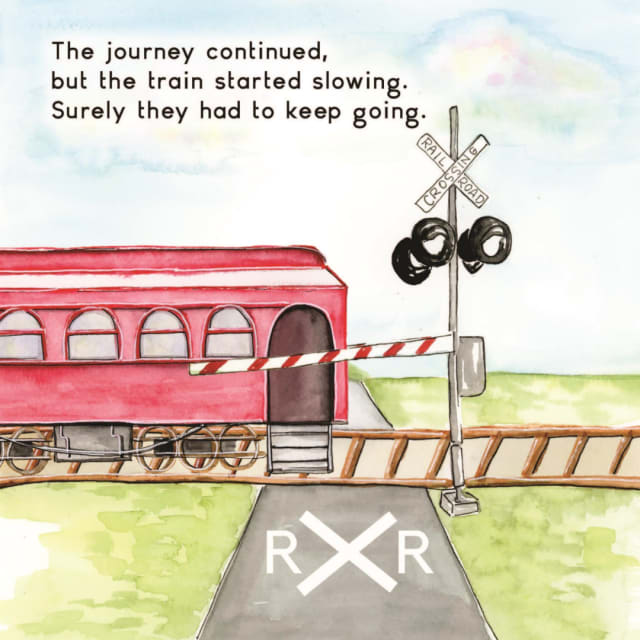
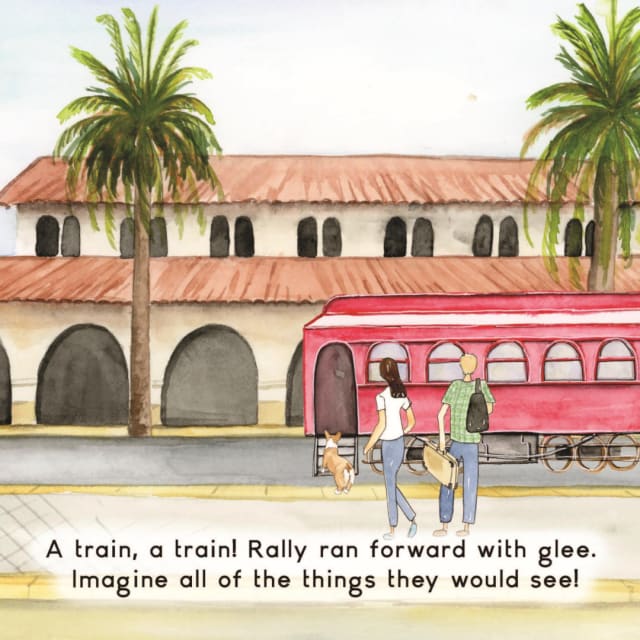
Using the book: Pages 10 and 13 show Rally's opinions and a reason that changes one (Day 1 minilesson); page 17 is a model ending that looks forward (Day 3 minilesson). Each revisit takes about 2 minutes.
On Day 1 the class reads short passages about the museum's streetcars and its steam engine; those facts become the reasons children write with. Or find a verified museum near your school in the field trip planner.
Day 1 45 minutes
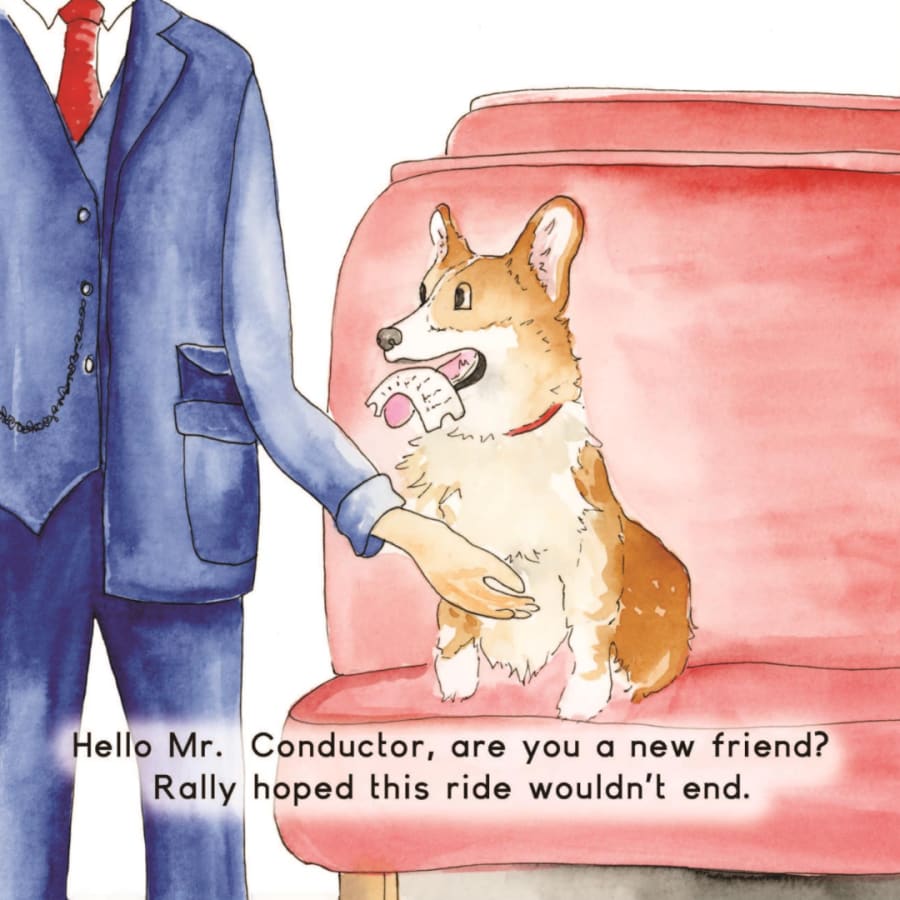
- Connection: open the book to page 10 and read, Rally hoped this ride wouldn't end. Ask what Rally thinks of the ride and what reasons he might have. Then page 13: he was scared of the dark tunnel, saw the light and heard cheers, and changed his mind. Opinions come with reasons.
- Teaching point: opinion writers tell the topic, say what they think, give reasons and use linking words like because and also to hook each reason to the opinion.
- Demonstrate with the window seat paragraph on chart paper. Read it, then underline the opinion, each reason, each linking word and the conclusion in four colors as children name them.
- Active engagement: read four sentences and children show thumbs up for opinion, flat hand for fact. Trains run on tracks. Trains are the best way to travel. Streetcars run in city streets. A streetcar ride would be more fun.
- Read aloud from the guide: in the 1950s, buses were replacing the Red Cars and Yellow Cars, the streetcars of Los Angeles, and old cars were stacked four high in a scrapyard. In 1956 fourteen rail fans met and agreed to build a trolley museum to save them. Pacific Electric once covered the Los Angeles region with more than 1,000 miles of track.
- Read the Don't miss part: Ventura County Railway No. 2, the museum's operating steam engine, pulls trains during special events and on select weekends. Then: every weekend you can ride the museum railway on a real trolley or behind a locomotive, as many times as you like.
- Teach directly: a trolley is another name for a streetcar. A steam locomotive burns fuel to boil water, and the steam makes it move. A streetcar runs on electricity.
- Partners sort the eight fact cards onto the Steam train and Streetcar sides of the T-chart and glue them down (8 minutes).
- Post three talk rules: one voice at a time, look at the speaker, ask a question before you disagree.
- Children stand on the side of the room for their choice, steam train or streetcar, then pair with someone from the other side.
- Each partner states an opinion and one reason from the T-chart. The listener answers with I agree because, or I see it differently because, and a reason. Switch partners once and repeat.
- Let children change sides if a reason convinces them. Ask one child who switched to explain what changed their mind.
Look for: Reasons that name a fact from the guide (you can ride as many times as you like) rather than because it is cool.
- Each child tells a neighbor their opinion and their strongest reason in one sentence.
- Collect the T-charts. Tell writers that tomorrow they will plan and draft.
Day 2 40 minutes
- Connection: hold up one fact card, Trolley rides every weekend. A fact is not a reason yet.
- Teaching point: a fact becomes a reason when you say why it makes you choose. Think aloud once: "Trolley rides every weekend. So what? So I could go any Saturday and ride again and again. That is my reason."
- Show how the linking word carries it: I would rather ride the streetcar because you can ride it every weekend. Also, ...
- Active engagement: partners pick one card from their own T-chart and say it as a reason with because.
- Children fill in the Opinion Planner (about 7 minutes): introduction and opinion, two reasons with at least one fact card, and the linking words they plan to use.
- Children start drafting on My Opinion Piece. The prompt: Which would you rather ride at the Southern California Railway Museum, the steam train or the streetcar?
- Confer with the four children on your list: ask what they are working on, teach one thing, and leave them with a next step. After 10 minutes, pull a small group who need the sentence frames on the planner.
- Give a 3-minute warning; children mark where they stopped with a star.
Look for: Pieces that list two facts with no opinion, or an opinion with because I like it. Send the writer back to the so what question.
- Two children read one reason aloud. The class names the linking word and the fact behind it.
Day 3 40 minutes
- Connection: read page 17 of the book, Then Rally knew the best day was still ahead. The story ends by looking forward, and the reader is left with a feeling.
- Teaching point: an opinion piece ends with a conclusion that says the opinion again in a new way, so the reader remembers it.
- Compare two endings on the board: The end. and That is why I always ask for the window. Children explain which one does the job.
- Active engagement: partners say a conclusion for their own piece out loud before writing it.
- Children finish the draft and write the conclusion.
- Revise with the self-check: underline the opinion, reasons, linking words and conclusion in the same four colors as the mentor paragraph. Any color missing is the next thing to write.
- Confer with four new children, focusing on whether each reason uses a fact.
- Three or four writers with different opinions read their pieces to the class. Listeners respond with one reason they heard and one question.
- Everyone else reads to a partner, who names the strongest reason they heard.
Short on time? If you lose a day, fold Day 3 into Day 2: teach the conclusion minilesson in 5 minutes at the start, give 25 minutes to plan, draft and write the ending, and swap the author's chair for partner reading. Keep the Day 1 fact sort and debate, since that is where the reasons come from.
Finished early? Writers add a third reason, or a sentence that answers the other side: Some people might say ___, but ___.
What to listen for
| If children say or do this | Try this |
|---|---|
| "My reason is because I like it." | Ask why you like it. Point to the T-chart and ask which fact makes the ride better for you. Liking is the opinion; the fact is the reason. |
| Child writes three facts about streetcars with no opinion. | Read it back and ask, so which would you rather ride? Have the child write that sentence first, then add because before one of the facts. |
| "A conclusion is The End." | Show the mentor's last line next to The End. A conclusion says the opinion again in new words; it is still part of the writing. |
Safety: The museum guide reminds families that it is a working railroad. Teach the rail safety rule: stay off tracks, cross only at marked crossings, and always stop, look and listen.
Differentiation
Extra support
Provide sentence frames on the planner: I would rather ride the ___ because ___. Also, ___. That is why ___. Let children dictate the first reason to you, then write the second on their own. Accept a four-sentence piece that has every part.
Multilingual learners
Use photos from the guide to teach steam train, streetcar and trolley before reading. Pair children with a partner who shares the home language for the debate, then have them say their opinion in English with the frame I think ___ because ___. Key language use: Argue.
Extension
Children add a third reason and a sentence that answers the other side, or read a second verified museum guide and write an opinion about which museum the class should visit, with reasons from both guides.
Check for understanding
Success criterion: Writes an opinion piece that introduces the topic, states a clear opinion, gives at least two reasons (at least one based on a fact from the guide), uses linking words and ends with a concluding statement; takes part respectfully in the debate.
| Level | What you see |
|---|---|
| 3Meets (level 3) | All five parts are present; reasons are clear and at least one uses a fact from the guide; linking words connect the reasons; the child listens and responds to a classmate with a reason. |
| 2Approaching (level 2) | States an opinion and gives reasons but is missing one part (often the introduction or conclusion), or reasons are not joined with linking words. |
| 1Beginning (level 1) | States an opinion with one reason or none, or lists facts without an opinion; needs prompting to take turns in the conversation. |
Family connection
Send home the half-page note in the printables. The text is below so you can paste it into a newsletter or app.
English
Steam train or streetcar? Your child spent three writing days answering that question. We read about a real museum in California that saved old streetcars from a scrapyard and still runs a steam engine, debated with classmates, then wrote an opinion piece with two reasons, linking words like because and also, and a conclusion. At home, try a 5-minute opinion chat: which is better, breakfast for dinner or dinner for breakfast? Ask for two reasons. Free train museum guides are at rallytakesthetrain.com/train-museums.
Español
¿Tren de vapor o tranvía? Su hijo o hija pasó tres días de escritura respondiendo esa pregunta. Leímos sobre un museo real en California que salvó tranvías antiguos de un depósito de chatarra y que todavía tiene una locomotora de vapor, debatimos con los compañeros y luego escribimos un texto de opinión con dos razones, palabras de enlace como porque y también, y una conclusión. En casa, prueben una charla de opinión de 5 minutos: ¿qué es mejor, desayuno para la cena o cena para el desayuno? Pidan dos razones. Hay guías gratuitas de museos de trenes en rallytakesthetrain.com/train-museums.
Teacher tips
- Let children change their minds during the debate. A child who switches sides after hearing a strong reason has just shown you they understand what a reason does.
- Leave the glued T-charts on the tables on Day 2 and Day 3. A child who says they have nothing to write can almost always start from a fact card they already sorted.
Standards alignment
| Standard | Text |
|---|---|
| CCSS W.2.1 (opens in a new tab) | Write opinion pieces in which they introduce the topic or book they are writing about, state an opinion, supply reasons that support the opinion, use linking words (e.g., because, and, also) to connect opinion and reasons, and provide a concluding statement or section. |
| CCSS SL.2.1 (opens in a new tab) | Participate in collaborative conversations with diverse partners about grade 2 topics and texts with peers and adults in small and larger groups. |
Check codes against your state's version of these standards. How we build and review lessons.
Keep exploring
Pick a museum guide that has more than one kind of train. Which one would you rather ride, and what are two reasons from the guide?
Teach it with the real book
4.9 stars on Amazon
Rally Takes the Train is a rhyming, hand-painted picture book about a corgi's first train ride, from the big station stairs to a dark tunnel to the people waiting at the end of the line. Children ask for it again and again, and every unit here opens with it.
Questions teachers ask
Why does opinion writing take three days here?
Second graders need separate time to gather reasons, draft and revise. Day 1 (45 minutes) builds the reasons: a minilesson, facts from the museum guide sorted on a T-chart, and a debate. Day 2 (40 minutes) is planning and drafting with 25 minutes of writing time. Day 3 (40 minutes) teaches conclusions, then revision and an author's chair. Squeezing it into one sitting usually produces a list of facts.
What is the window seat paragraph and why not model on trains?
It is a short mentor paragraph about the best seat on a train or bus, printed in the before-you-teach notes. It has an introduction, an opinion, three reasons with linking words and a conclusion. Modeling on a different topic shows every part without handing children a ready-made steam train or streetcar piece they would simply copy.
Which pages of the book come back, and for how long?
Pages 10 and 13 open the Day 1 minilesson: Rally hopes the ride won't end, then fears the tunnel and changes his mind once he sees the light, so opinions come with reasons. Page 17 opens Day 3 as an ending that looks forward. Each look back takes about two minutes, and nobody rereads the whole book.
Where do the fact cards come from?
Six of the eight cards come from the Southern California Railway Museum guide: the Red Cars and Yellow Cars saved from a scrapyard, more than 1,000 miles of track, rides every weekend, and steam engine Ventura County Railway No. 2 pulling trains on select weekends. Two are general facts you teach directly: a steam engine burns fuel to make steam, and a streetcar runs on electricity.
What does the debate add, and is it worth 13 minutes?
It is where SL.2.1 lives, and it is the best rehearsal for writing. Children stand on the side of the room for their choice, pair with someone from the other side, give one reason, and answer with I agree because or I see it differently because. Children who say a reason out loud twice write it much more easily on Day 2.
A child keeps writing because I like it. What now?
Ask the so what question from the Day 2 minilesson. Point to the T-chart, have the child pick a fact card, and ask why that fact makes the ride better for them. Liking is the opinion, and the fact plus the why is the reason. Have them say it aloud with because before writing it down.
What should I look for in conferences on Days 2 and 3?
On Day 2, see the four writers you listed in advance, usually those likely to stall, and check that they have an opinion and at least one reason from a fact card. After 10 minutes, pull a small group who need the planner's sentence frames. On Day 3, see four different writers and focus on whether each reason actually uses a fact.
How do the four colors work in revision?
In the Day 1 minilesson you underline the opinion, reasons, linking words and conclusion of the mentor paragraph in four colors. On Day 3 children underline their own piece in the same colors. Any color that is missing is the next thing to write, so writers find their own gaps before you point them out, and the finished pieces are quick to score.
What do I cut if I lose one of the three days?
Fold Day 3 into Day 2: teach the conclusion minilesson in five minutes at the start of Day 2, give 25 minutes to plan, draft and write the ending, and replace the author's chair with partner reading. Keep the Day 1 fact sort and debate, because without those reasons the writing turns into lists or because I like it.
Can a strong writer go further than two reasons?
Yes. Ask for a third reason and a sentence that answers the other side, such as Some people might say steam trains are louder, but the sound is part of the fun. Another option is reading a second verified museum guide and writing about which museum the class should visit, with a reason from each guide.
Related lessons
Reading a Real Museum Guide: Text Features That Find Facts Fast
Over two short sessions, children closely read one page adapted from the Steamtown National Historic Site guide about Big Boy No.
Story Map: Characters, Setting, Big Events and the Central Message
A two-session read-aloud lesson that opens the 1st grade train unit.
Should We Save the Old Train? Argument Writing with Museum Evidence
A three-day 5th grade writing workshop that closes the train unit.
Teaching with Rally Takes the Train
Every lesson is free for classroom and homeschool use. Add the paperback to your classroom library, or review a lesson to earn a free copy if you are a credentialed teacher. Keep the journey going in about 650 free train museum guides, plan a visit with the field trip planner, or browse all lessons for educators.