
Story Elements Lesson for 1st Grade: Map Rally's Trip and Find the Central Message
A two-session read-aloud lesson that opens the 1st grade train unit. Children hear Rally Takes the Train once with three planned stops and build a class story map of characters, setting and big events. On Day 2 they revisit two pages to name the central message, fill in a story map and retell it to a partner.
- Grade
- 1st Grade
- Subjects
- Reading literature, Speaking and listening
- Time
- Two sessions of about 35 minutes (Days 1 and 2 of the unit)
- Structure
- Interactive read-aloud over two short sessions
- Prep
- 15 minutes: read the book once yourself and mark pages 3, 11 and 13, draw a large story map on chart paper with a Central message strip, assign carpet partners, and print one story map and one retell checklist per child. Optional: print the true story page for a later center.
- Grouping
- Whole class on the carpet with turn and talk; on Day 2, independent and partner work at tables with a small group
- Book
- Whole book, read aloud
- CCSS RL.1.3
- CCSS RL.1.2
 Need the book? Get the paperback on Amazon (opens in a new tab) or earn a free classroom copy.
Days 1-2 of the 1st Grade train unit
Builds on: This lesson opens the unit and is the only time the whole book is read aloud.
Leads to: Day 3 (1B) starts from the rhymes children heard today, and the class story map stays up for the rest of the unit.
Learning objective
Students describe the characters, setting and major events of Rally Takes the Train using key details, retell the story in order to a partner, and state its central message with a detail from the story that shows it.
I can tell who is in a story, where it happens and the big events, and I can tell the lesson the story teaches.
Vocabulary to teach
Materials
- Rally Takes the Train by Kelsey Lizee Cecil: get the paperback on Amazon (opens in a new tab) or earn a free classroom copy
- Chart paper story map with five boxes (Characters, Setting, Beginning, Middle, End) and a strip along the bottom labeled Central message
- Sticky notes and a marker by your chair
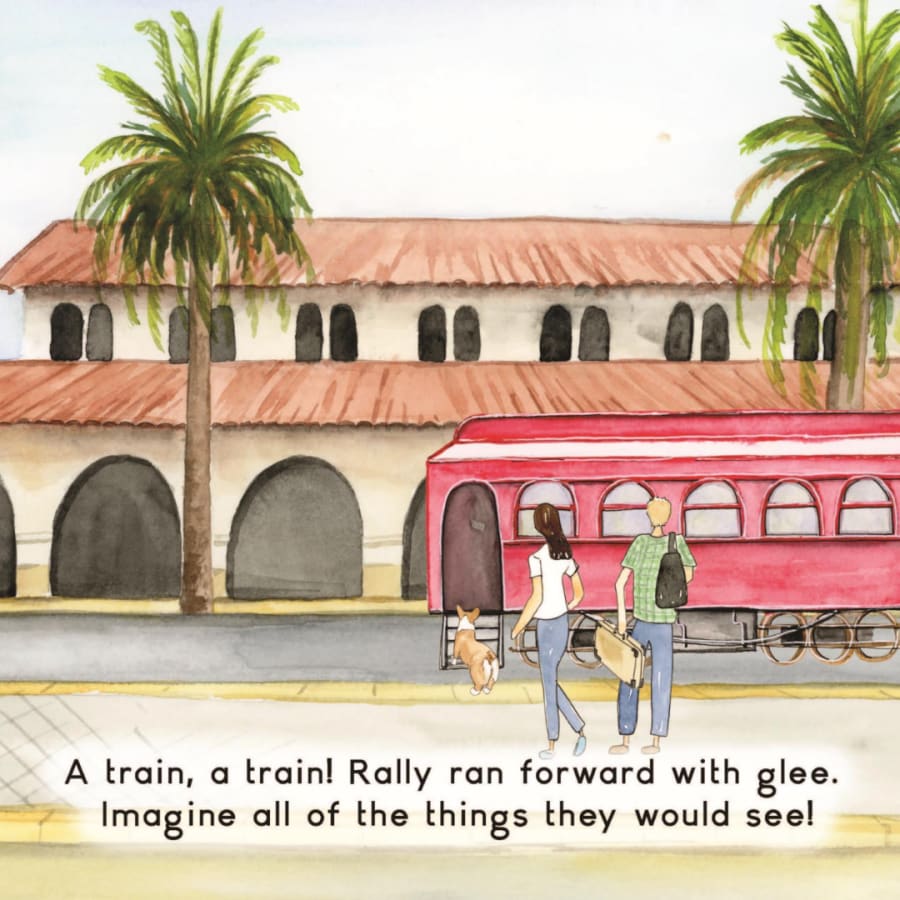
- Story map printable, one per child: the picture of Rally's family walking to the station (page 3) at the top, a five-box story map, and two write-in lines for the central message
- Retell checklist printable, one per child: a six-item checklist for a partner retell, two drawing boxes (Rally at the start of the tunnel, Rally at the end) and write-in lines
- Optional: true train story printable, one per pair, with a short Zooliner passage from the Washington Park & Zoo Railway guide and a five-box story map
Before you teach
- Practice the read-aloud once. Reading straight through takes about 4 minutes; the three stops add about 5 more, so keep each turn and talk to 60 to 90 seconds. That keeps the carpet time near 30 minutes with a stretch in the middle, about the limit for most first graders.
- Assign carpet partners before Day 1 so turn and talk does not eat your time.
- Make the story map chart big enough to stay up for the whole unit. Children will use its words for spelling on Day 2 and can map later read-alouds the same way.
- For the Day 2 small group, copy pages 3, 11 and 17 small enough to cut into picture cards (one set per child in the group).
Lesson plan
Interactive read-aloud over two short sessions. Characters, setting and big events are easiest to talk about while the whole story is fresh, so Day 1 is one full reading with three planned stops. The central message needs the whole story first, so Day 2 looks back at two pages instead of rereading.
Using the book: Day 1 is the unit's one full read-aloud (about 4 minutes of reading plus three short stops at pages 3, 11 and 13). Day 2 looks back at pages 11 and 17 only.
Day 1 35 minutes
- Gather children facing the blank story map chart, sitting next to their carpet partners. Show the cover and let two or three children say what they notice about the dog and the train.
- Give one purpose for listening: notice who is in the story, where it happens and the biggest thing that happens to Rally.
- Read from the first page to page 3 without stopping, letting the rhymes carry the rhythm.
- Stop 1, page 3 (about 90 seconds): partners tell each other who is in the story and where they are. Take two answers (Rally, Mom and Dad; a train station with palm trees, early in the morning) and jot them on sticky notes for the chart.
- Read on to page 11. Stop 2: point to the tunnel. Partners say how Rally feels and which words show it (he wished he was back in his bed).
- Read pages 12 and 13. Stop 3: ask what changed for Rally. Listen for scared to happy, and for the light as the reason.
- Read to the end without stopping, then give everyone 10 quiet seconds to think of a favorite part. Have the class stand, stretch and sit back down before the chart.
Look for: Partners who answer from the words and pictures, not only from their own trips. Ask: where in the book did you see that?
- Move the Stop 1 sticky notes into the Characters and Setting boxes.
- Ask for the big events and write one short phrase in each box: Beginning, the family walks to the train; Middle, the dark tunnel scares Rally; End, Rally sees the light and his grandparents greet him.
- When a child offers a small detail (the pretzel, the furry glitter on page 7), ask the class: "Would the story change if we left it out?" Write it on a side list called Fun details so the idea is still honored.
- Read the finished chart chorally while you point to each box.
- Partners walk to their seats together and retell the story with five fingers: who, where, beginning, middle, end. Partner A goes first, then switch.
- Listen in on four or five pairs and note who skips the middle. They become your Day 2 small group.
- Leave the chart up; it is where Day 2 starts.
Day 2 35 minutes
- Show page 11, then page 17 (about a minute; this is a look back at two pages, not a second reading).
- Ask how Rally feels on each page and what helped him in between. Record the change on the chart: scared in the dark, then happy with his family.
- Teach central message in one sentence: the big lesson the author wants readers to learn, one that can help in our own lives. Write a class version on the chart strip, such as: new things can feel scary, but if you keep going, something good can be waiting.
- Partners think of a time something new felt scary, like a new school or a new game, and whether the message fits.
- Take two or three ideas. Any child may pass.
- Hand out the story map printable as children move to tables (2 minutes).
- Children write or draw one key detail in each box and write a central message on the lines. The class chart stays up for spelling, and the book sits on the ledge so children can check a picture.
- Meet with the small group you noted on Day 1 and build the map with the picture cards (see Differentiation).
Look for: Middle boxes that name the tunnel rather than a fun detail.
- Partner A retells from the story map and ends with the message; Partner B ticks the retell checklist and names one thing done well. Switch.
- Children finish the sentence on the checklist page: Rally changed from ___ to ___ because ___.
- Collect the checklists. They show you quickly who left out the middle or the message.
Short on time? If you lose a day, teach Day 1 through the class story map, then replace the five-finger retell with the 8-minute Day 2 look back at pages 11 and 17 and the class central message. Children fill in their own story map and do the checklist retell at a literacy center later in the week; skip the shared talk.
Finished early? Children draw a new last page showing what Rally does with his grandparents, and label the setting.
Optional museum extension: Later in the week, read the true Zooliner story on the optional printable aloud and let partners map it with the same five boxes. It shows that true stories have the same parts. Open the Washington Park & Zoo Railway guide.
What to listen for
| If children say or do this | Try this |
|---|---|
| Retells every page in order, including the pretzel and the glitter. | Ask whether the story would change if we left that out. Put the detail on the Fun details list and ask for the next big event. |
| Gives a summary as the message: the message is that Rally rode a train. | Say that is what happened, and the message is what the story teaches us. Ask how Rally changed and what helped, then try a sentence that could help someone in our class. |
| Names the setting as the train only. | Turn to pages 3 and 13 and ask where and when: a station early in the morning, then a train by the ocean. A setting can change during a story. |
Differentiation
Extra support
Give a story map with the Characters and Setting boxes filled in and three picture cards cut from pages 3, 11 and 17 to glue in the Beginning, Middle and End boxes. The child then dictates or writes one key detail and chooses the central message from two choices read aloud.
Multilingual learners
Teach character, setting and message with the class chart and gestures, and give frames: "The characters are ___. The story happens at ___. First ___. Then ___. At the end ___. The story teaches ___." Let partners who share a home language plan the retell in that language first. Key language use: Narrate.
Extension
Children write a second central message the story could teach (for example, people who care can help us with hard things, like Dad's boost on page 4) and find a key detail that supports it. If you use the optional Zooliner page, they compare the messages of the two stories.
Check for understanding
Success criterion: Describes the characters, setting and major events of the story using key details, retells it in order, and states a central message with a detail that supports it.
| Level | What you see |
|---|---|
| 3Meets (level 3) | Names the characters and setting, gives a key detail for the beginning, middle and end, retells in order, and states a central message with a detail that shows it ("He was scared in the tunnel, but then he saw the light"). |
| 2Approaching (level 2) | Names the characters, setting and most major events, but misses a key detail, mixes up the order, or states a message without a supporting detail. |
| 1Beginning (level 1) | Names some characters or retells favorite fun details (the pretzel, the fur) instead of major events, and does not yet state a central message. |
Family connection
Send home the half-page note in the printables. The text is below so you can paste it into a newsletter or app.
English
Our class started a two-week train unit with the picture book Rally Takes the Train. Your child learned the parts of a story: characters, setting, the big events at the beginning, middle and end, and the central message, the lesson a story teaches. Rally is scared in a dark tunnel but keeps going and finds something good. After any story or show this week, ask three quick questions: Who was in it? Where did it happen? What was the lesson? Free train museum guides to look at together are at rallytakesthetrain.com/train-museums.
Español
Nuestra clase empezó una unidad de dos semanas sobre trenes con el libro Rally Takes the Train. Su hijo o hija aprendió las partes de un cuento: los personajes, el lugar, los sucesos importantes del principio, el medio y el final, y el mensaje central, es decir, la lección que enseña el cuento. Rally tiene miedo en un túnel oscuro, pero sigue adelante y encuentra algo bueno. Esta semana, después de un cuento o un programa, hagan tres preguntas rápidas: ¿Quién salía? ¿Dónde pasó? ¿Qué lección nos deja? Hay guías gratis de museos de trenes para ver juntos en rallytakesthetrain.com/train-museums.
Teacher tips
- First graders often retell every page. The question "would the story change if we left it out?" is the fastest way to move them from every detail to big events, so keep using it all year.
- Accept more than one central message if the child backs it up with a key detail from the story. The detail is what shows understanding.
Standards alignment
| Standard | Text |
|---|---|
| CCSS RL.1.3 (opens in a new tab) | Describe characters, settings, and major events in a story, using key details. |
| CCSS RL.1.2 (opens in a new tab) | Retell stories, including key details, and demonstrate understanding of their central message or lesson. |
Check codes against your state's version of these standards. How we build and review lessons.
Teach it with the real book
4.9 stars on Amazon
Rally Takes the Train is a rhyming, hand-painted picture book about a corgi's first train ride, from the big station stairs to a dark tunnel to the people waiting at the end of the line. Children ask for it again and again, and every unit here opens with it.
Questions teachers ask
Why does Day 1 stop at pages 3, 11 and 13 and nowhere else?
Each stop feeds one part of the class story map. Page 3 gives the characters and setting: Rally, Mom and Dad at a station with palm trees, early in the morning. Page 11 is the dark tunnel, where partners name how Rally feels and which words show it. Page 13 is the turn from scared to happy because of the light. Keep each turn and talk to 60 to 90 seconds so the reading with stops stays near 15 minutes.
What goes in each box of the class story map?
Characters: Rally, Mom and Dad. Setting: a station early in the morning, then a train by the ocean, since a setting can change. Beginning: the family walks to the train. Middle: the dark tunnel scares Rally. End: Rally sees the light and his grandparents greet him. The Central message strip along the bottom stays blank until Day 2. Make the chart big enough to stay up for the whole unit.
A child keeps adding the pretzel and the glitter. What should I say?
Ask the class, "Would the story change if we left it out?" If not, write it on a side list called Fun details, so the idea is honored but stays off the map, then ask for the next big event. Children who retell favorite details instead of major events sit at the Beginning level on the check, so jot their names along with anyone who skips the middle.
Why wait until Day 2 to teach central message?
A message depends on how the main character changes, and children can only see that once they know the whole story. Day 1 builds the map while the story is fresh. Day 2 opens with an 8-minute look back at two moments, Rally scared in the dark and Rally happy with his family, names the message in one sentence and writes a class version on the chart strip.
What if a child says the message is that Rally rode a train?
That is a summary, not a message. Say: that is what happened, and the message is what the story teaches us. Ask how Rally changed and what helped him, then have the child try a sentence that could help someone in the class, such as: new things can feel scary, but good things can be waiting. Accept a different message if the child backs it with a key detail.
Who joins the Day 2 small group, and what do they do?
The children you heard skip the middle during the Day 1 five-finger retell. While the class writes story maps, they sit with you at the back table. Their map has Characters and Setting filled in, and they glue picture cards of the walk to the station, the tunnel and the arrival into the Beginning, Middle and End boxes. Each child dictates or writes one key detail and picks a message from two choices.
What does the retell checklist tell me at the end?
Partner B ticks six items while Partner A retells from the story map: characters, setting, beginning, middle, end, and the message with a key detail. Then they switch. Collect the checklists as children finish, and in a minute you can see who left out the middle or the message. The closing sentence, Rally changed from ___ to ___ because ___, shows whether a child links the change to the light.
Our literacy block is only 25 minutes. Can this still work?
Yes, with a small shift. Day 1 runs about 35 minutes, so teach the read-aloud with stops and the class map in one sitting, then move the six-minute five-finger retell to the next morning. On Day 2, run the look back and shared talk in one sitting and the story map with the checklist retell in another. Keep carpet time near 30 minutes or less.
How does this lesson set up the rest of the unit?
It is the only full reading of the story, so later lessons lean on it. Day 3 phonics starts from rhymes children heard today. The light investigation on Days 6 to 8 opens with Rally's dark tunnel, and the then and now inquiry on Days 9 and 10 uses the family's walk to the station as a picture of travel today. Leave the story map chart up for all ten days.
What is the true Zooliner story page for?
It is optional, for later in the week. Read the short passage from the Washington Park & Zoo Railway guide aloud: local schoolchildren voted for the train's look, it first ran in 1958, and children across Oregon sold dollar shares to help pay for a longer track. Partners map it with the same five boxes, which shows that true stories have characters, a setting and big events too.
Related lessons
Train Story Sequencing: Beginning, Middle and End
A free kindergarten retelling lesson taught over three short days.
Rhyme or Same Spelling? Build Word Families from Rally's Rhymes
A 30-minute explicit phonics lesson.
Whose Story Is It? Point of View and a Conductor's Narrative
A three-day 3rd grade point of view lesson.
Teaching with Rally Takes the Train
Every lesson is free for classroom and homeschool use. Add the paperback to your classroom library, or review a lesson to earn a free copy if you are a credentialed teacher. Keep the journey going in about 650 free train museum guides, plan a visit with the field trip planner, or browse all lessons for educators.