
Point of View Lesson for 3rd Grade: Retell Rally's Train Trip as the Conductor
A three-day 3rd grade point of view lesson. On Day 1 the class hears Rally Takes the Train once, with four planned stops about who is telling the story, and fills in a point of view chart. Over two writing workshop days, students plan, draft and revise a first person narrative as the train's conductor.
- Grade
- 3rd Grade
- Subjects
- Reading literature, Narrative writing
- Time
- Three sessions of 45 minutes: the read-aloud and point of view chart on Day 1, then two writing workshop days
- Structure
- Interactive read-aloud, then a two-day narrative writing workshop
- Prep
- 20 minutes across the three days: flag pages 2, 10, 11 and 13; draw the four-column anchor chart; copy the point of view chart for Day 1 and the mentor story and story planner for Day 2; set out lined paper for drafts
- Grouping
- Whole class on the carpet for the read-aloud and minilessons, partners and independent writing at tables, short conferences with the teacher
- Book
- Whole book, read aloud
- CCSS RL.3.6
- CCSS W.3.3
- CASEL: Social awareness
 Need the book? Get the paperback on Amazon (opens in a new tab) or earn a free classroom copy.
Days 1-3 of the 3rd Grade train unit
Builds on: This is the unit opener and the only day the class hears the whole book read aloud.
Leads to: 3B, where students switch from a story with a narrator to a real museum guide and find the main idea of an informational text.
Learning objective
Students explain who tells Rally Takes the Train and how the narrator's view differs from Rally's and from their own, then write a short first person narrative of the trip from the conductor's point of view with an event sequence, time words, dialogue and a closing.
I can tell who is telling a story, explain how my point of view is different, and retell a story as a different character using "I."
Vocabulary to teach
Materials
- Rally Takes the Train by Kelsey Lizee Cecil: get the paperback on Amazon (opens in a new tab) or earn a free classroom copy
- Chart paper for a four-column anchor chart: Narrator, Rally, Conductor, Me
- Point of view chart, one per student (printable, Day 1): a crop of page 10 and a table with rows for pages 2, 8, 10, 11 and 14
- Mentor story, one per student or projected (printable, Day 2): a short conductor narrative written for the lesson, with three noticing boxes
- Conductor's story planner, one per student (printable, Days 2 and 3): Beginning, Middle and End boxes, a time word bank, a dialogue line and a self-check list
- Lined paper for drafts
- Optional: the San Francisco Railway Museum guide for early finishers
Before you teach
- Flag pages 2, 10, 11 and 13 with sticky notes and practice the read once. With stops it takes about 15 minutes, so the class is off the carpet by minute 19.
- Draw the anchor chart before students arrive. It stays up for both writing days.
- Decide writing partners before Day 2. Pair a confident writer with a student who benefits from telling the story aloud first.
- Keep a class list on a clipboard on Days 2 and 3. Plan to confer with five or six writers a day, starting with anyone whose Day 1 chart mixed up the narrator and Rally.
Lesson plan
Interactive read-aloud, then a two-day narrative writing workshop. RL.3.6 is easiest to notice while the story is fresh, so the one full reading of the book carries planned stops about who is telling it. The W.3.3 narrative needs time to plan, draft and revise, which one period cannot give third graders.
Using the book: Day 1 is the only time the class hears the whole book. Stop on pages 2, 10, 11 and 13. On Days 2 and 3 the book stays in the classroom library so writers can check pages 10 to 16 on their own, but it is not read aloud again.
Day 1 45 minutes
- Write two sentences about the same small event on the board, one with I and one with she or he (a spilled cup of juice works). Ask partners which sentence the person it happened to would say, and which one someone else would say.
- Show the cover and give the listening job: notice who is telling Rally's story and whose thoughts we get to hear.
- Point to the empty anchor chart columns: Narrator, Rally, Conductor, Me.
- Read the whole book at a natural pace (about 4 minutes of reading). Stop only on the four flagged pages and keep each stop to about a minute; partners talk, two ideas go on the chart, and you turn the page.
- Page 2 (Rally sees the suitcase and packs): ask whether the book says I packed or he packed, and who is doing the thinking. Partners turn and talk for 30 seconds. Record under Narrator: uses he, tells us Rally's thoughts.
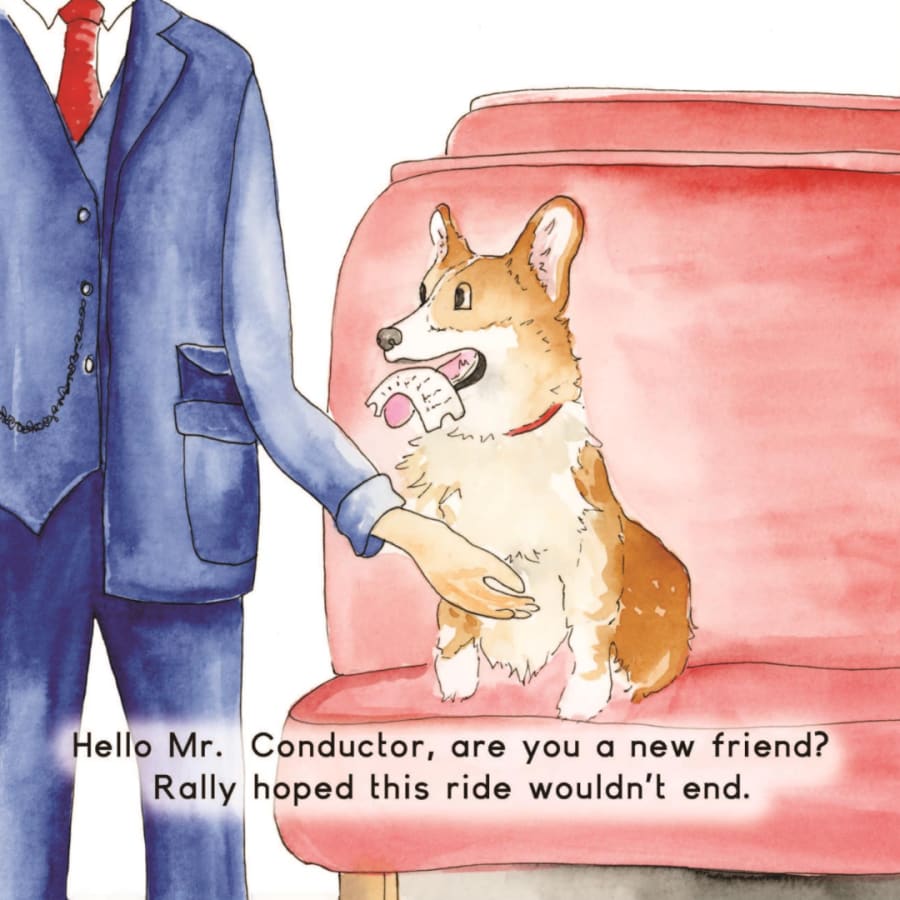
- Page 10 (the conductor in the blue suit takes the ticket from Rally's mouth): the conductor never speaks in the book. Partners guess one thing he thinks when a corgi hands him a ticket. Write two ideas under Conductor.
- Page 11 (the dark tunnel; Rally wishes he were back in bed): students show thumbs at chest if they would feel the same, thumbs to the side if not. Two students explain. Write under Me: our views can be different from Rally's.
- Finish the book, then turn back to page 13 and say its moment aloud as the conductor: "When we came out of the tunnel, I heard cheering and saw that corgi's ears go up."
Look for: Students who still answer Rally when asked who tells the story. Jot their names for Day 2 conferences.
- Send students to their seats with whiteboards (about a minute). Nineteen minutes is long enough on the carpet for most third graders.
- Teach point of view, narrator, first person and third person directly, pointing to the chart as you define each word.
- Write the page 13 moment three ways in a column: as the narrator (third person), as Rally (first person) and as the conductor (first person). Students copy the pronouns that changed onto their whiteboards and hold them up.
- Pass out the point of view chart (about a minute) and put page 10 on the document camera.
- Partners fill in the page 2 and page 8 rows together, talking before they write.
- Each student fills in the page 10, 11 and 14 rows alone, then writes one way their point of view differs from Rally's at the bottom.
- Collect the charts and sort them into three piles (got it, mixed up narrator and Rally, not yet) to plan Day 2 conferences.
Day 2 45 minutes
- Connection: remind students that yesterday a narrator outside the story told Rally's trip. Today each of them becomes the conductor and tells it with I.
- Teaching point: a first person narrator can only tell what he sees, hears, does and thinks. Project the mentor story and read it aloud once.
- Demonstration: underline the I, me and my words with the class, then circle one detail only the conductor would know (checking his pocket watch).
- Active engagement: partners rehearse aloud how their conductor's story will begin, at the moment he takes Rally's ticket.
- Link: writers plan first on the story planner, then start a draft on lined paper.
- Students spend about 8 minutes on the planner: Beginning (the ticket, page 10), Middle (the tunnel and the light, pages 11 to 13), End (slowing down and the station, pages 14 to 16).
- Writers then draft on lined paper. Expect 6 to 12 sentences by the end of Day 3, not today.
- Confer for 3 to 4 minutes at a time, starting with students whose Day 1 charts mixed up the narrator and Rally. Ask what the conductor sees that Rally cannot.
- If four or more writers are stuck at the start, pull them to the back table for 5 minutes with the sentence starters from the support plan.
Look for: Drafts that slip into Rally's thoughts (for example, the conductor wishing he were back in bed). Ask whose feeling that is in the book.
- Two writers you chose during conferences read their beginnings aloud.
- Listeners name the detail that only the conductor would notice, and you add it to the anchor chart under Conductor.
Day 3 45 minutes
- Project the mentor story again. Students point out the time words (first, then, a few minutes later, finally) and the one line in quotation marks.
- Demonstrate a revision on a plain sentence you write on the board: add a time word at the front and turn a sentence into a short line of dialogue with quotation marks.
- Partners find one spot in their own draft where a time word or a spoken line would help, and mark it with a star.
- Writers finish the draft with a closing sentence that shows how the conductor feels at the end of the trip.
- Students revise with the self-check list on the planner, checking off each item and fixing what is missing.
- Pull a small group for 6 to 8 minutes on punctuating dialogue, using sentences from their own drafts.
- Keep conferring with writers you did not reach on Day 2.
- Partners read their whole stories to each other (about 4 minutes) and name the detail that showed the conductor's point of view.
- Two or three volunteers read to the class. Listeners tell how the conductor felt at the end and which words showed it.
- Collect stories and planners for the check.
Short on time? If you lose a day, keep Day 1 whole and fold Days 2 and 3 into one 45-minute workshop: a 7-minute minilesson that uses the mentor story for first person and time words together, 30 minutes to plan and draft, and an 8-minute partner share. Skip the dialogue small group and accept a 6-sentence draft with three events, one line of dialogue and a conductor-only detail.
Finished early? Write the tunnel moment again in first person as Rally and compare it with the conductor version, or retell the Muni No. 1 trip from the San Francisco Railway Museum guide as the mayor.
Optional museum extension: For a writer who finishes early, the guide's caption about Muni No. 1, the streetcar Mayor James Rolph Jr. piloted out Geary Street on December 28, 1912 while 50,000 people turned out to cheer, is a short true event to retell as the mayor or as a child in the crowd. Open the San Francisco Railway Museum guide.
What to listen for
| If children say or do this | Try this |
|---|---|
| The narrator is Rally, because the book tells us what Rally thinks. | Point to he and his on page 2. Ask what word Rally would use if he were telling it. Explain that a third person narrator can still tell a character's thoughts. |
| A conductor story says the conductor was scared in the dark and wished he were back in bed. | Ask whose feeling that is in the book. The conductor rides through this tunnel every day, so what would he notice or feel? Help the writer swap in a conductor feeling. |
| My point of view is the same as Rally's, so I have nothing to write in the I think column. | Accept the agreement, then ask for one thing the student would notice on that page that Rally would not, such as the conductor's watch or the crossing lights. |
Differentiation
Extra support
Give sentence starters on the planner: "I am the conductor. This morning I...", "When we went into the tunnel, I...", "At the last stop, I saw...". Accept 5 to 6 sentences, or let students tell the story aloud to an adult first and then write the first and last sentences.
Multilingual learners
Teach I, me and my against he, him and his with a two-column picture card, and give frames: "I see ___." "I hear ___." "I feel ___ because ___." Students may plan in their home language and write key sentences in English. Key language use: Narrate.
Extension
Write a second, short version of the tunnel moment from Rally's point of view in first person, then explain in two sentences how the two narrators notice different things.
Check for understanding
Success criterion: Identifies the book as third person and explains how the narrator's, a character's and their own points of view differ, then writes a first person conductor narrative with three events in order, time words, dialogue, a conductor-only detail and a closing.
| Level | What you see |
|---|---|
| 3Meets (level 3) | Names the narrator as third person, explains one way their own view differs from Rally's, and writes a first person conductor story with three ordered events, at least two time words, dialogue, a detail only the conductor would notice and a clear ending. |
| 2Approaching (level 2) | Identifies the narrator correctly and writes in first person, but the story is missing one or two parts (dialogue, time words or an ending), or slips back into Rally's thoughts instead of the conductor's. |
| 1Beginning (level 1) | Confuses the narrator with Rally, or retells the book as written in third person without changing the point of view. |
Family connection
Send home the half-page note in the printables. The text is below so you can paste it into a newsletter or app.
English
This week our class started a train unit with the picture book Rally Takes the Train. We listened for who tells the story (a narrator, not Rally) and talked about how our own feelings about a dark tunnel can differ from Rally's. Then, over two writing days, your child retold the train trip as the conductor, using I. At home, try a 5-minute game: describe something from today, then tell it again as someone else who was there, like a pet or a bus driver. Free train museum guides are at rallytakesthetrain.com/train-museums.
Español
Esta semana empezamos una unidad sobre trenes con el libro ilustrado Rally Takes the Train. Descubrimos quién cuenta la historia (un narrador, no Rally) y hablamos de cómo lo que sentimos en un túnel oscuro puede ser distinto de lo que siente Rally. Después, en dos días de escritura, su hijo o hija volvió a contar el viaje como el conductor del tren, usando "yo". En casa, prueben este juego de 5 minutos: cuenten algo que pasó hoy y luego cuéntenlo otra vez como otra persona que estaba ahí, por ejemplo una mascota. Hay guías gratuitas de museos de trenes en rallytakesthetrain.com/train-museums.
Teacher tips
- Model one wrong version on purpose during a minilesson: start a conductor story with Rally wishing he were back in bed. Students love catching that it is Rally's thought, and it sharpens their own drafts.
- Keep the Day 1 charts on your clipboard during conferences. They tell you in seconds who still needs the pronoun check.
Standards alignment
| Standard | Text |
|---|---|
| CCSS RL.3.6 (opens in a new tab) | Distinguish their own point of view from that of the narrator or those of the characters. |
| CCSS W.3.3 (opens in a new tab) | Write narratives to develop real or imagined experiences or events using effective technique, descriptive details, and clear event sequences. |
| CASEL: Social awareness (opens in a new tab) | Social awareness |
Check codes against your state's version of these standards. How we build and review lessons.
Teach it with the real book
4.9 stars on Amazon
Rally Takes the Train is a rhyming, hand-painted picture book about a corgi's first train ride, from the big station stairs to a dark tunnel to the people waiting at the end of the line. Children ask for it again and again, and every unit here opens with it.
Questions teachers ask
Why does point of view get three days instead of one?
Hearing a story and writing a new version of it need different kinds of time. Day 1 is a 45-minute read-aloud with four planned stops, a short anchor chart lesson and the point of view chart. Days 2 and 3 are writing workshop days: a 10-minute minilesson, long stretches of independent writing while you confer, and a share. Third graders rarely plan, draft and revise a narrative in one sitting.
Where do the four Day 1 stops fall, and why those pages?
Rally Takes the Train is read once, start to finish, with stops on pages 2, 10, 11 and 13. Page 2 asks whether the narrator says I or he. Page 10 introduces the conductor, who never speaks, so partners guess his thoughts. Page 11 compares students' feelings in the dark tunnel with Rally's. Page 13 is retold aloud as the conductor. Keep each stop to about a minute so the reading stays around 15 minutes.
A student insists Rally is the narrator. What helps?
This is the most common mix-up, because the narrator tells us Rally's thoughts. Point to the words he and his and ask what word Rally would use if he were telling it himself. Then explain that a third person narrator can still share what a character thinks. Jot the student's name on your clipboard; that student is one of your first Day 2 conferences.
Can students invent what the conductor thinks and feels?
Yes, with one rule: the events stay true to the story and the conductor's thoughts can be imagined. He takes the ticket, the train goes through the dark tunnel, the passengers cheer and the train slows at the station. What he notices along the way, like his pocket watch or a corgi's ears popping up, is where students add their own voice. Ask writers to point to the events they kept.
My writer's conductor wishes he were back in bed. Is that wrong?
That wish belongs to Rally, so the draft has slipped back into the main character's head. Ask whose feeling that is. Then ask what someone who rides through this tunnel every day would notice or feel instead: the lights flickering on, a nervous passenger, the time on his watch. Modeling a wrong version like this in a minilesson on purpose helps the whole class catch it in their own drafts.
What does a finished conductor story need?
By the end of Day 3, expect 6 to 12 sentences in first person with three events in order (the ticket, the tunnel and the light, slowing down at the station), at least two time words, one line of dialogue in quotation marks, a detail only the conductor would notice and a closing that shows how he feels. The self-check list on the story planner matches these parts, so students can check their own work before you do.
What is the mentor story for, and when does it come out?
The Conductor's Morning is a short narrative written for this lesson. On Day 2 you project it, read it aloud and underline the I, me and my words with the class, then circle a detail only the conductor would know, his pocket watch. On Day 3 it returns so students can find the time words and the one line of dialogue before they revise their own drafts.
Which writers should I confer with first?
Sort the Day 1 charts into three piles that evening: got it, mixed up the narrator and Rally, and not yet. Start Day 2 conferences with the middle pile and aim for five or six writers a day, about 3 to 4 minutes each. Ask one question: what does the conductor see that Rally cannot? Writers you miss on Day 2 come first on Day 3.
Where does punctuating dialogue get taught?
On Day 3. The minilesson shows one plain sentence turned into a short spoken line with quotation marks, and partners star a spot in their own drafts where a line of dialogue would help. During independent writing, pull a small group for 6 to 8 minutes and fix punctuation using sentences from their own stories rather than a worksheet.
What can a fast writer do while others are still drafting?
Two options keep the point of view focus. A writer can tell the tunnel moment again in first person as Rally and explain in two sentences how the two narrators notice different things. Or a writer can retell the Muni No. 1 streetcar trip from the San Francisco Railway Museum guide as the mayor or as a child in the cheering crowd.
How does this lesson connect to the rest of the unit?
It is the unit opener and the only full reading of the story. In 3B students switch from a narrator who tells a story to a museum guide whose writer gives facts, which makes the contrast easy to name. At the end of the unit, the conductor stories can go on display beside the railroad town claims from 3F for a family share.
Related lessons

Teaching with Rally Takes the Train
Every lesson is free for classroom and homeschool use. Add the paperback to your classroom library, or review a lesson to earn a free copy if you are a credentialed teacher. Keep the journey going in about 650 free train museum guides, plan a visit with the field trip planner, or browse all lessons for educators.