
Light and Dark Science Lesson for 1st Grade: Into the Tunnel with Rally
A three-session 5E science sequence. Starting from Rally's dark tunnel, children look into a shoebox tunnel to gather evidence that objects are seen only when illuminated, then run a fair test of clear plastic, wax paper, cardboard, a mirror and foil in a flashlight beam, and use their results to design a train window.
- Grade
- 1st Grade
- Subjects
- Science, Physical science: light
- Time
- Three sessions: 40, 40 and 35 minutes (Days 6 to 8 of the unit)
- Structure
- 5E science sequence over three sessions
- Prep
- 30 minutes before Day 1: build and test one tunnel box per group (shoebox, peephole, a flap in the lid, edges taped). Before Day 2: bag a material kit per group, tape white paper to a wall or box side at each table, and check flashlight batteries. Print the three pages per child.
- Grouping
- Whole class on the carpet to engage and explain; groups of 3 or 4 at tables to explore; partners and independent work on Day 3
- Book
- Pages 11, 12
- NGSS 1-PS4-2
- NGSS 1-PS4-3
 Need the book? Get the paperback on Amazon (opens in a new tab) or earn a free classroom copy.
Days 6-8 of the 1st Grade train unit
Builds on: Children met Rally's dark tunnel in the Day 1 read-aloud (1A), so a quick look back at two pages is enough to raise the question.
Leads to: Days 9 and 10 (1F) close the unit with an inquiry into train trips long ago and today.
Learning objective
Students make observations with a tunnel box and use them as evidence for the claim that objects in darkness can be seen only when illuminated, then plan and conduct a test of what happens when clear plastic, wax paper, cardboard and a mirror are placed in a beam of light, and use the results to choose a material for a train window.
I can use evidence to explain why we cannot see in the dark, and I can test which materials let light pass through, block it or bounce it.
Vocabulary to teach
Materials
- Rally Takes the Train by Kelsey Lizee Cecil: get the paperback on Amazon (opens in a new tab) or earn a free classroom copy
- Tunnel boxes, one per group: a shoebox with a lid, a peephole in one end, a flap in the lid that opens and closes, and a small toy train or picture of Rally inside
- Flashlights, one per group, and one battery tea light (no real candles)
- Material kit per group: clear plastic sheet protector, wax paper, a cardboard square, an acrylic safety mirror, a square of foil with folded edges
- White paper taped to a wall or the side of a box at each table
- Two pieces of chart paper: Our ideas about seeing in the dark, and a four-column chart for the light test
- Tunnel box observations printable, one per child: three drawing boxes (lid closed, flap open, light inside), a word bank and lines for a claim and evidence
- Clipboards for the Day 2 predictions on the carpet
- Light test printable, one per child: a table listing five materials with columns for a prediction, what happened and the science word, plus two word banks
- Train window design printable, one per child: Rally at the window (page 8), two drawing boxes and write-in lines
Before you teach
- Test every tunnel box before Day 1. With the flap closed you should see nothing at all; tape any edge that leaks light.
- Teach the three sessions on three days close together so children remember what they saw, and keep both charts up all week.
- Form groups of 3 or 4 ahead of time. Give a child who is uneasy about the dark the flashlight job.
- If science time is 30 minutes in your schedule, end Day 1 after Explore and begin Day 2 with the Explain phase.
Lesson plan
5E science sequence over three sessions. The standards ask children to build an account from their own observations and to plan and run a test, so they explore before anything is explained, and the science words come after they have seen the results. Spreading it over three sessions keeps each one inside a first grade science block.
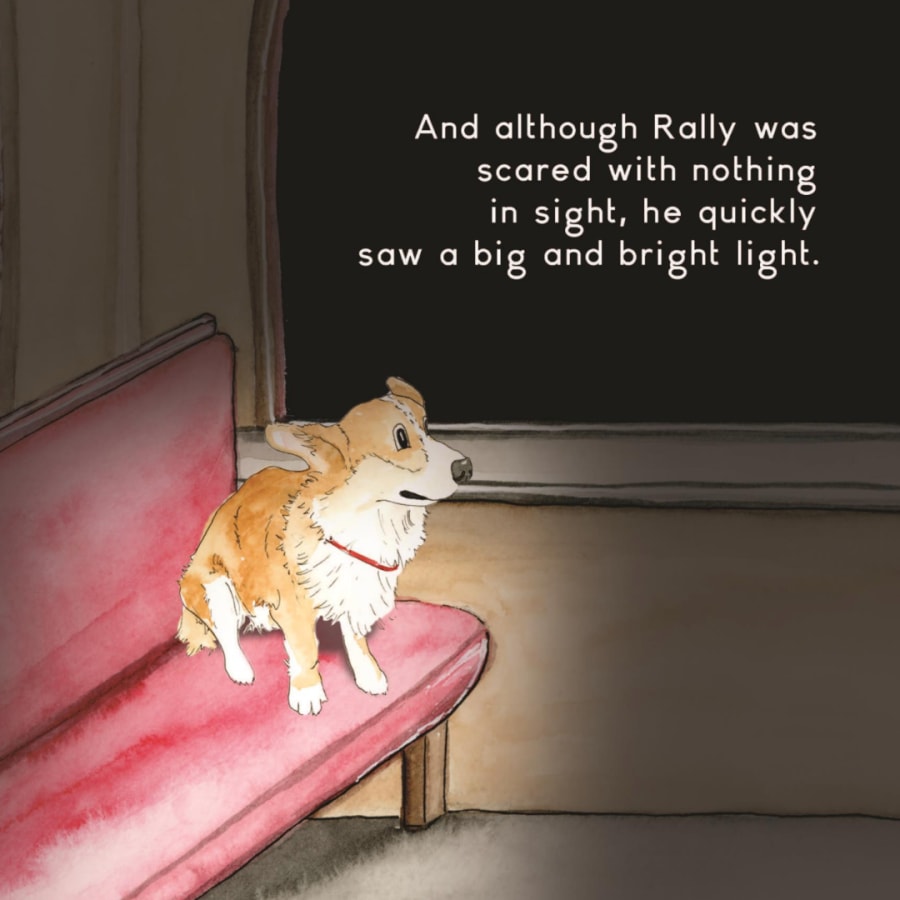
Using the book: On Day 1, show pages 11 and 12 and read the line about nothing in sight (about a minute) to raise the question. The book is not used on Days 2 and 3.
Day 1 40 minutes
- Show pages 11 and 12 and read the line about nothing in sight (about a minute; this is a look back, not a reread). Remind children the dark part is short and Rally is fine.
- Ask: when Rally was in the tunnel, were the seats and the tracks still there? Why couldn't he see them? Partners talk, then record every idea on a chart titled Our ideas about seeing in the dark, without correcting any.
- Put a toy train inside a closed tunnel box in front of the class and ask how we could find out.
- Give each group a tunnel box with the train already inside and one tunnel box observations page per child (2 minutes to settle).
- Look 1, lid and flap closed: each child looks through the peephole for a slow count of 10 and draws what they see in box 1.
- Look 2, flap open a little: look again and draw in box 2.
- Look 3, flap closed with a switched-on battery tea light inside (you place it at each table): look and draw in box 3.
- Each group agrees on one sentence about what they saw in each look.
Look for: Children who say they saw a little in Look 1. Check the box for light leaks, tape them, and have them look again.
- Groups share what they saw in each look, and you write their words first.
- Then name what they found: light from the room illuminates the train, the light bounces off it into our eyes, and we see it. The tea light is a light source: it gives off its own light.
- Go back to the Our ideas chart. Children decide which ideas the evidence supports and which it does not (looking longer did not help in the closed box).
- Write the class claim together: We can see things only when light shines on them or when they give off their own light.
Day 2 40 minutes
- Shine a flashlight on white paper taped to the wall and show the five materials: clear plastic, wax paper, cardboard, a safety mirror and foil. Ask what will happen to the light when each one is held in the beam.
- Agree on fair test rules: the flashlight stays the same distance from the wall every time, and the material is held halfway between.
- Children write or draw a prediction for each material in the I predict column, using the phrases in the top word bank. Read the phrases aloud first; children may copy just the first word (all, some, no, bounces).
- Move to tables (1 minute). Assign jobs: flashlight holder, material holder, wall watcher, recorder. Rotate after each material.
- For each material, the wall watcher reports what the wall shows: a bright spot, a dim or glowing spot, a shadow, or light bouncing somewhere else (check the ceiling and nearby walls).
- Everyone records the result on their own page.
- Clean up (2 minutes): materials back in the kit bag, flashlights off.
Look for: Groups that move the flashlight closer for some materials. Ask what would make the test fair.
- Make a four-column class chart. Each group places its materials where its results put them.
- Name each column after the sort: transparent (clear plastic), translucent (wax paper), opaque (cardboard), reflective (mirror and foil).
- Point out that the mirror and foil also left a shadow on the wall, because no light passed through; their light went somewhere else. Children write the science word in the last column of their table.
Day 3 35 minutes
- Show Rally at the window on the design page and pose the problem: passengers want to see the ocean, and on sunny afternoons the window needs a shade.
- Partners use their light test results to choose a material for each job, draw it and write why, naming a result from their test.
- Two pairs share. The class decides whether the test results back each choice.
- Each child writes the claim and one piece of evidence on the lines of their tunnel box page from Day 1.
- Pose a new case out loud: a cat sits in a closet with the door shut and no light at all. Can you see the cat? What would you need? Children draw and write one sentence on the back of the page.
- Confer with children whose Day 1 drawings or claim show a gap, and ask them to use the tunnel box to explain.
- Share (5 minutes): three children read their claims, and the class checks each against the Day 1 evidence.
Short on time? If you lose a day, keep Days 1 and 2 as written, since the tunnel box and the fair test carry both standards, and drop the Day 3 window design or move it to a center. Have children write their claim and evidence on the tunnel box page in a 15-minute block the next morning, without the closet cat case.
Finished early? Children test extra materials, such as tissue paper or a plastic cup, and add them to the class chart.
Optional museum extension: After Day 3, read the guide's description of Night Trains, when the house lights go down and the buildings, streetlights and lighted trains glow, and ask children which things are light sources. Open the Twin City Model Railroad Museum guide.
What to listen for
| If children say or do this | Try this |
|---|---|
| Our eyes just need time to get used to the dark. | Have the child look into the closed box for a slow count of 30. Nothing appears, because no light gets in. In a room at night, some light usually sneaks in from somewhere. |
| Things disappear in the dark. | Open the box: the train was there the whole time. Ask what changed, the train or the light. |
| The mirror lets light through because it is shiny. | Have the child look at the wall behind the mirror and find the shadow, then find the bright spot the mirror made somewhere else. |
Safety: Never look at the sun or straight into a flashlight, and never shine a flashlight in someone's eyes. Use acrylic safety mirrors, not glass, and fold over or tape sharp foil edges. Use a battery tea light, never a real candle. Keep room lights on during the tunnel box test.
Differentiation
Extra support
Test three materials only (clear plastic, wax paper, cardboard) and use picture cards for the results: a bright sun, a dim sun and a shadow. The child points to a card and an adult writes the word.
Multilingual learners
Teach light, dark, through, blocks and bounces with gestures and the flashlight, and give frames: "I can see the train when ___." "The ___ lets light through. The ___ blocks the light." Key language use: Explain.
Extension
Children test more materials (tissue paper, colored cellophane, a plastic cup, fabric) and sort them on a line from all light through to no light through. Then they design a tunnel box with a window that lets in just enough light to see the train dimly.
Check for understanding
Success criterion: Uses tunnel box observations as evidence that objects in darkness are seen only when illuminated, and records and explains the effect of different materials placed in a beam of light.
| Level | What you see |
|---|---|
| 3Meets (level 3) | States the claim with evidence from the tunnel box ("The train was there, but we saw it only when light came in"), records accurate results for each material, and uses them to choose and explain a window material. |
| 2Approaching (level 2) | Describes what happened in the tunnel box but does not yet connect it to a claim, or records results with one or two errors. |
| 1Beginning (level 1) | Says we cannot see in the dark because our eyes are closed or the object is gone, or records results without testing. |
Family connection
Send home the half-page note in the printables. The text is below so you can paste it into a newsletter or app.
English
Rally rides through a dark tunnel in our class book, and that tunnel started three science lessons. We looked into a closed shoebox tunnel and found that we can see things only when light shines on them or when they give off their own light. Then we tested which materials let light through, block it or bounce it, and designed a train window. At dusk, turn off one lamp and ask your child, "What can you still see? Where is the light coming from?" Free train museum guides: rallytakesthetrain.com/train-museums.
Español
Rally pasa por un túnel oscuro en nuestro libro de clase, y ese túnel dio inicio a tres clases de ciencias. Miramos dentro de una caja túnel cerrada y descubrimos que solo vemos las cosas cuando la luz las ilumina o cuando ellas dan su propia luz. Luego probamos qué materiales dejan pasar la luz, la bloquean o la reflejan, y diseñamos una ventana de tren. Al atardecer, apaguen una lámpara y pregúntele: "¿Qué todavía puedes ver? ¿De dónde viene la luz?" Guías gratis de museos de trenes: rallytakesthetrain.com/train-museums.
Teacher tips
- Many first graders believe their eyes just need time to adjust. The fully closed box is the evidence that changes this idea, so give every child a full turn at Look 1.
- Keep the room lights on during the tunnel box test. Children are only looking into a box, so nobody needs to sit in the dark.
Standards alignment
| Standard | Text |
|---|---|
| NGSS 1-PS4-2 (opens in a new tab) | Make observations to construct an evidence-based account that objects in darkness can be seen only when illuminated. |
| NGSS 1-PS4-3 (opens in a new tab) | Plan and conduct investigations to determine the effect of placing objects made with different materials in the path of a beam of light. |
Check codes against your state's version of these standards. How we build and review lessons.
Teach it with the real book
4.9 stars on Amazon
Rally Takes the Train is a rhyming, hand-painted picture book about a corgi's first train ride, from the big station stairs to a dark tunnel to the people waiting at the end of the line. Children ask for it again and again, and every unit here opens with it.
Questions teachers ask
Why show only the tunnel pages instead of rereading the story?
Children heard the whole book on Day 1 of the unit, so about a minute on pages 11 and 12, with the line about nothing in sight, is enough to raise the question: were the seats and tracks still there when Rally could not see them? Remind children the dark part is short and Rally is fine. The book is not used on Days 2 and 3.
How should a tunnel box be built and tested?
Use a shoebox with a lid, a peephole in one end, a flap in the lid that opens and closes, and a toy train or picture of Rally inside. Tape every edge. Before Day 1, look through each peephole with the flap shut: you should see nothing at all. If a child says they saw a little in Look 1, check for a leak, tape it and let them look again.
Do the room lights need to be off?
No. Keep the lights on for the whole tunnel box test. Children only look into a box, so nobody sits in the dark, and a well-taped box is still completely dark inside. That also helps children who are uneasy about the dark. Giving one of them the flashlight job on Day 2 is another easy way to keep everyone comfortable.
What happens to the Our ideas chart?
On Day 1, record every idea about seeing in the dark without correcting any. After the three looks, return to it and let children decide which ideas the evidence supports. The idea that looking longer helps does not hold up, because the closed box stays dark however long you look. Only then write the class claim: we can see things only when light shines on them or when they give off their own light.
Why are the mirror and the foil reflective, not transparent?
Many first graders think shiny means light goes through. In the beam, both leave a shadow on the wall because no light passes through; the light bounces somewhere else, often onto the ceiling or a nearby wall. Have the wall watcher look for that bright spot. On the class chart they go in the reflective column, while cardboard goes under opaque.
What keeps the light test fair?
The flashlight stays the same distance from the wall every time, and the material is held halfway between. Agree on both rules on the carpet before groups move. Watch for groups that move the flashlight closer for some materials, and ask what would make the test fair. Rotating the four jobs (flashlight holder, material holder, wall watcher, recorder) after each material keeps every child working.
When do the words transparent, translucent and opaque come in?
After the test, not before. Children predict and record with plain phrases from the word bank: all light passes, some light passes, no light passes, light bounces. In the Day 2 Explain phase, groups place their materials on a four-column class chart, and only then do you name the columns: transparent, translucent, opaque and reflective. Children copy the science word into the last column.
What does the train window design ask children to do?
Apply their results. Passengers want to see the ocean, and on sunny afternoons the window needs a shade. Partners choose a material for each job, draw it and write why, naming a result from their own test, such as clear plastic to see through and cardboard to block the sun. Two pairs share, and the class decides whether the test results back each choice.
What is the closet cat question on Day 3?
A new case for the final check. A cat sits in a closet with the door shut and no light at all: can you see the cat, and what would you need? Children draw and write one sentence on the back of their tunnel box page, after writing their claim and evidence on the front. It shows whether a child can use the claim beyond the box.
Our science block is 30 minutes. What changes?
The sessions are written for 40, 40 and 35 minutes. In a 30-minute block, end Day 1 after the Explore phase and begin Day 2 with the Explain phase, so the tunnel box results are named first thing the next day. Teach the sessions on close days so children remember what they saw, and keep both charts up all week.
Where does the Twin City Model Railroad Museum fit?
It is optional, after Day 3. Read the guide's description of Night Trains, when the house lights go down and the buildings, streetlights and lighted trains glow, and ask children which things are light sources. It is a quick check on whether children can tell things that give off their own light from things that are only lit by something else.
Related lessons
Rally's Feelings: Fear and Courage
A free, 25-minute kindergarten SEL circle about fear and courage.
Push the Train: Pushes, Pulls and a Ramp Design
A free kindergarten push and pull science lesson taught in two sessions (33 and 37 minutes).
Pull, Push, Stop: Balanced and Unbalanced Forces on a Train Car
A three-session 5E science sequence on balanced and unbalanced forces.
Teaching with Rally Takes the Train
Every lesson is free for classroom and homeschool use. Add the paperback to your classroom library, or review a lesson to earn a free copy if you are a credentialed teacher. Keep the journey going in about 650 free train museum guides, plan a visit with the field trip planner, or browse all lessons for educators.