
Gravity Lesson for 5th Grade: Ramps, Mountain Railroads and Evidence That Gravity Pulls Down
A two-session 5th grade science sequence for NGSS 5-PS2-1. Students first predict which way a ball falls for people standing all around a globe, then test toy cars on ramps and hang plumb lines. After the class explains what down means, they read how a real railroad climbs a mountain pass and write an argument with evidence.
- Grade
- 5th Grade
- Subjects
- Science, Physical science
- Time
- Two sessions: 45 and 45 minutes
- Structure
- 5E science sequence over two sessions
- Prep
- 20 minutes: set up one ramp station per group (a board or sturdy folder, a stack of books, a toy car or ball), tie a washer to a 30 cm string for each group, stick four paper people on a globe or ball (top, two sides, bottom), copy the three printables, and read the Tehachapi Depot Railroad Museum guide's history section
- Grouping
- Whole class for Engage and Explain, groups of three or four for Explore, partners for Elaborate, individual writing for Evaluate
- Book
- Not used in this lesson
- NGSS 5-PS2-1
 Need the book? Get the paperback on Amazon (opens in a new tab) or earn a free classroom copy.
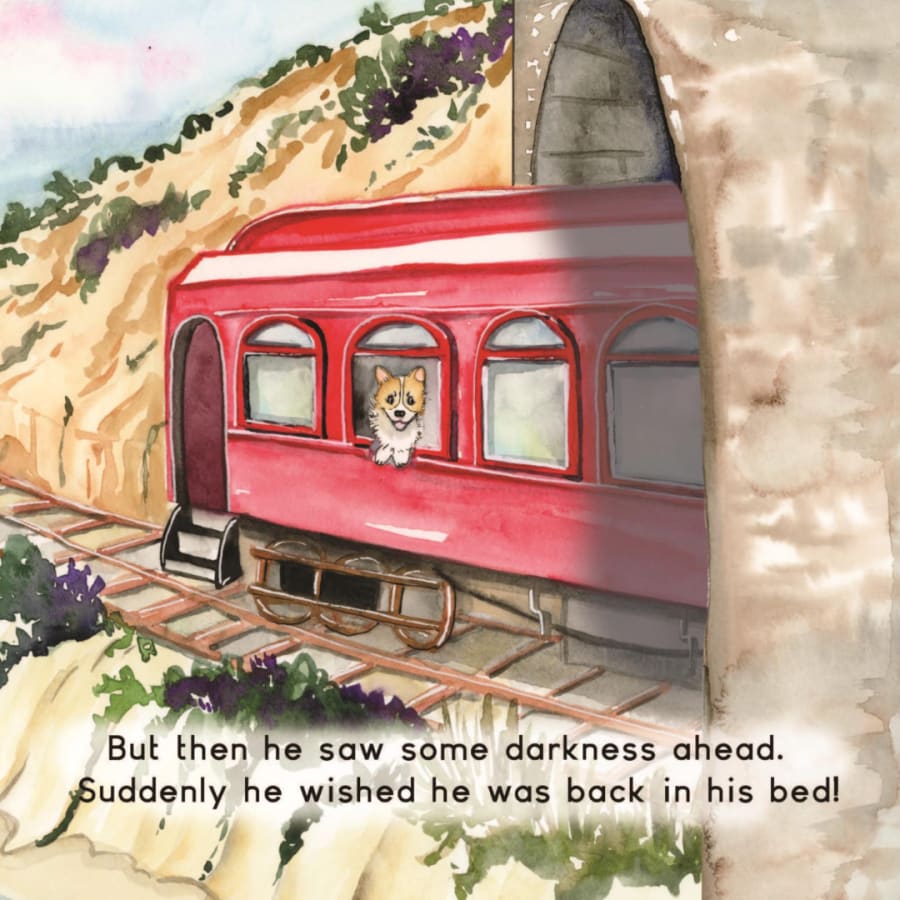
Days 6-7 of the 5th Grade train unit
Builds on: The math days (5C, 5D) had students work on a problem before anyone named the rule. This sequence does the same with evidence: students test first, and the explanation comes in Session 2.
Leads to: The claim, evidence and reasoning students write here comes back in the transcontinental railroad inquiry (5F) and the opinion piece (5B).
Learning objective
Students gather evidence from ramp tests, plumb lines and a real mountain railroad, explain that down means toward the center of the Earth, and write an argument with a claim, evidence and reasoning that the gravitational force exerted by Earth on objects is directed down.
I can use evidence from tests and a real railroad to argue that Earth's gravity pulls objects down, toward the center of the Earth.
Vocabulary to teach
Materials
- The Tehachapi Depot Railroad Museum guide (rallytakesthetrain.com/museums/tehachapi-depot-railroad-museum-california) on a projector
- Per group: a ramp (board or sturdy folder), a stack of books, a toy car or ball, a washer tied to a 30 cm string, and a soft object to drop (a paper ball or eraser)
- A globe or large ball with four small paper people taped on (top, left side, right side, bottom), and sticky notes
- Ramp lab printable (Session 1), one per student: a four-trial data table, two boxes to sketch plumb lines and two questions about the evidence
- Which way is down printable (Session 2), one per student: a short passage from the Tehachapi Depot Railroad Museum guide, a box to draw Earth with trains and gravity arrows, and a question
- Gravity argument printable (Session 2), one per student: a claim, evidence and reasoning organizer and a self-check list
- Chart paper titled What we observed
Before you teach
- Keep the Engage sticky notes. Students return to their own first drawing in Session 2 and revise it, which is the best evidence of learning you will get.
- In Session 1, hold back any explanation. If a student says gravity, write it on the board as a word to test, not as the answer.
- Ramps should sit low and steady on the floor or a table. Test that a car rolls the full length before class.
- Pre-read the Tehachapi passage on the which way is down page. The quick math (4,000 feet over about 46 miles) is about 87 feet per mile; decide whether students compute it or you do.
- Groups of three: one releases, one watches the direction, one records. Rotate jobs each trial.
Lesson plan
5E science sequence over two sessions. Students need to see cars roll the same way on a turned-around ramp and plumb lines hang the same way across the room before an explanation of down makes sense. Exploring comes first, the explanation builds on what they saw, and the written argument comes once they have evidence.
The book: The book is not used. The phenomenon is a globe with paper people standing all around it, and the railroad evidence comes from a museum guide.
The guide's account of the Tehachapi Loop is the Elaborate reading in Session 2 and one possible source of evidence for the argument. Or find a verified museum near your school in the field trip planner.
Session 1 45 minutes
- Set the globe where everyone can see the four paper people standing on the top, both sides and the bottom. Ask each student to draw, on a sticky note, the path of a ball each person drops.
- Collect a few sticky notes and put them on the board without comment. Point out where the class disagrees, usually the person on the bottom.
- Ask how we could gather evidence about which way Earth pulls things, without being able to stand on the bottom of the world. Record ideas.
Look for: Note students whose arrows all point to the bottom of the paper; check their sticky notes again in Session 2.
- Pass out ramp lab pages and send groups to stations (2 minutes).
- Groups run the four trials on the page: release at the top; turn the ramp to face the other way and release; place the car halfway and give a gentle push uphill; add two books and release. They record the direction each time.
- Each group hangs its plumb line in two places in the room and sketches the string and the floor both times.
- At each plumb line spot, one student drops the paper ball from shoulder height beside the string. The group notes whether the ball's path matches the string.
- Circulate and ask only what happened and what stayed the same, not why.
- Cleanup: ramps flat, cars and strings in the bin (2 minutes).
Look for: Watch Trial 2 closely. Students expect the car to keep going the same way; when it still rolls downhill, ask them to say what changed and what did not.
- Each group reports one observation. Record observations only on the What we observed chart, for example the car always rolled downhill, the string always pointed at the floor.
- Students answer the two questions at the bottom of the ramp lab page in their own words.
Session 2 45 minutes
- Reread the What we observed chart. Teach gravity and force with the vocab definitions: gravity is Earth's pull on every object.
- Hold a plumb line beside each paper person on the globe in turn. Ask students to point to where the string would hang for that person, then to where all the strings point together.
- Name the idea from their pointing: for every person, down is toward the ground under their feet, and all those arrows meet at the center of the Earth.
- Students take back their Engage sticky note and redraw the arrow if it needs to change.
- Project the Tehachapi Depot Railroad Museum guide and read the history passage with students following on the which way is down page: Southern Pacific had to lift its track roughly 4,000 feet in about 46 miles, and the Tehachapi Loop, completed in 1876, turned a punishing grade into a spiral of track.
- Partners discuss why engineers would build a spiral instead of a straight track up the mountain. Share: more track spreads the same climb over a longer distance, so each part is less steep.
- Work the average climb together: 4,000 feet divided by about 46 miles is about 87 feet for every mile.
- Partners draw Earth with a train on the top, both sides and the bottom, add gravity arrows, and answer the question about why a climbing train needs more power.
- Students write a claim about the direction of Earth's gravitational pull on the gravity argument page, with at least two pieces of evidence from different sources (a ramp trial, the plumb lines, a dropped object, the Tehachapi passage) and reasoning that links them.
- In the last 3 minutes, partners read each other's argument against the self-check list and point to the reasoning sentence.
Look for: Strong arguments explain why the evidence shows the direction, not just list observations.
Short on time? With one session instead of two, run Engage in 5 minutes, have groups do only Trials 1 and 2 plus one plumb line spot (about 15 minutes), then teach the Explain at the globe in 8 minutes, read the Tehachapi passage aloud in 5, and give 12 minutes for an argument with two pieces of evidence. The Earth diagram and partner self-check move to the next morning.
Finished early? Explain in writing why a long train on the Tehachapi Loop crosses above its own rear cars, or plan a fair test of whether ramp steepness changes how fast the car rolls.
What to listen for
| If children say or do this | Try this |
|---|---|
| Students draw every gravity arrow pointing to the bottom of the page, even for the person on the bottom of the globe. | Hold a plumb line beside that paper person and ask where the string points. Then ask what down would look like if you lived there. |
| Gravity only works on things that are falling or rolling. | Hang the plumb line from a still hand and ask what is pulling the washer. The track or table holds a still object up, but the pull is still there. |
| "Gravity is the air pushing things down." | Cover the hanging washer with an upside-down cup so no moving air reaches it. It still hangs straight down. Air can push things sideways in a breeze, but the pull toward the ground is Earth. |
Safety: Rail safety: the Tehachapi Depot's Train Park sits beside an active mainline. If your class visits any railroad, stay off tracks, cross only at marked crossings, and stop, look and listen. In class, release cars and balls instead of throwing them, drop only soft objects, and keep ramps low and steady.
Differentiation
Extra support
Give a word bank (gravity, down, center, pull, ramp, plumb line) and sentence frames for evidence and reasoning: When we ___, the object moved ___. This shows gravity pulls ___ because ___. Let students dictate reasoning before writing.
Multilingual learners
Act out up, down, push, pull and roll with the materials before the lab. Pair students with a partner who can model the trial directions, and accept labeled diagrams as evidence alongside sentences. Key language use: Argue.
Extension
Students explain in writing why the Tehachapi Loop crosses above its own rear cars, and how spreading a 4,000-foot climb over more track changes how steep each part is. Or design a fair test of whether ramp steepness changes the car's speed.
Check for understanding
Success criterion: Writes an argument that Earth's gravitational force on objects is directed down, toward the center of the Earth, supported by at least two pieces of evidence and reasoning that connects them.
| Level | What you see |
|---|---|
| 3Meets (level 3) | States the claim with the direction toward Earth's center, cites at least two different pieces of evidence (such as the ramp trials and the plumb line or the mountain railroad), draws correct arrows on the Earth diagram, and explains how each piece shows the direction of the pull. |
| 2Approaching (level 2) | States that gravity pulls down and gives evidence, but uses only one source, or draws arrows that point toward the bottom of the page instead of toward Earth's center. |
| 1Beginning (level 1) | Describes what happened in the trials without making a claim about direction, or gives a claim with no evidence. |
Family connection
Send home the half-page note in the printables. The text is below so you can paste it into a newsletter or app.
English
Which way does gravity pull for someone on the other side of the world? Your child spent two science sessions finding out. The class rolled toy cars on ramps, hung weighted strings, and read how a real California railroad built a giant spiral of track to climb a mountain pass. Then each student wrote an argument with evidence that Earth's gravity pulls everything toward its center. At home, try a 5-minute test: tilt a tray one way, then the other, and roll a ball on it. Ask what changed and what stayed the same. More mountain railroads are in the free guides at rallytakesthetrain.com/train-museums.
Español
¿Hacia dónde jala la gravedad a alguien al otro lado del mundo? Su hijo o hija pasó dos sesiones de ciencias averiguándolo. La clase hizo rodar carritos en rampas, colgó cuerdas con peso y leyó cómo un ferrocarril real de California construyó una enorme espiral de vías para subir una montaña. Luego cada estudiante escribió un argumento con pruebas de que la gravedad de la Tierra jala todo hacia su centro. En casa, prueben 5 minutos: inclinen una bandeja hacia un lado y luego hacia el otro, y hagan rodar una pelota. Pregunte qué cambió y qué siguió igual. Hay más trenes de montaña en las guías gratuitas de rallytakesthetrain.com/train-museums.
Teacher tips
- Trial 2, turning the ramp around, is the key trial. When the car still rolls downhill, students see that the ramp only changes the path while the pull stays down.
- Keep the arguments short. Two strong pieces of evidence with clear reasoning beat a long list of observations with no connection to the claim.
Standards alignment
| Standard | Text |
|---|---|
| NGSS 5-PS2-1 (opens in a new tab) | Support an argument that the gravitational force exerted by Earth on objects is directed down. |
Check codes against your state's version of these standards. How we build and review lessons.
Keep exploring
Pick a museum guide for a railroad that climbs hills or mountains. Find a clue that the train goes up or down a grade, and explain which way gravity pulls the train there.
Teach it with the real book
4.9 stars on Amazon
Rally Takes the Train is a rhyming, hand-painted picture book about a corgi's first train ride, from the big station stairs to a dark tunnel to the people waiting at the end of the line. Children ask for it again and again, and every unit here opens with it.
Questions teachers ask
Why is the gravity lesson split into two sessions?
It follows the 5E order, and students need evidence before an explanation makes sense. Session 1 is Engage and Explore: predicting with the globe, then ramps and plumb lines, with no explanation yet. Session 2 is Explain, Elaborate with the Tehachapi Loop, and Evaluate with a written argument. Each session is 45 minutes. Squeezing it into one period usually means telling students the answer before they have seen anything.
What is the globe with paper people for?
It is the phenomenon. Four small paper people stand on the top, both sides and the bottom of a globe, and each student draws on a sticky note the path of a ball each person drops. Disagreement usually centers on the person on the bottom. Keep the sticky notes: in Session 2 students take their own back and redraw the arrow, which is your clearest evidence of learning.
Why hold back the word gravity during Session 1?
If you explain early, students stop looking. When someone says gravity in Session 1, write it on the board as a word to test, not as the answer. While groups work, ask only what happened and what stayed the same, never why. The debrief records observations only on the What we observed chart, so the explanation in Session 2 rests on what students actually saw.
What are the four ramp trials?
Release the car at the top. Turn the ramp to face the other way and release. Place the car halfway and give it a gentle push uphill. Add two books and release. Groups record the direction each time. Trial 2 is the one to watch: students expect the car to keep going the same way, and when it rolls downhill again they see that the ramp changes the path but the pull stays down.
How does a plumb line count as evidence?
A plumb line is a washer tied to a 30 cm string. Each group hangs it in two places in the room and sketches the string and the floor, then drops a paper ball from shoulder height beside the string to see whether the paths match. In Session 2 you hold a plumb line beside each paper person on the globe, and students see that every string points toward Earth's center.
What does the Tehachapi Loop add to the argument?
It shows gravity at railroad scale. The verified Tehachapi Depot Railroad Museum guide explains that Southern Pacific had to lift its track roughly 4,000 feet in about 46 miles, and the Loop, completed in 1876, turned that grade into a spiral. Spreading the climb over more track makes each part less steep. Students can compute the average, about 87 feet per mile, or you can do it together.
What if a student says air pushes things down?
Test it. Cover a hanging washer with an upside-down cup so no moving air can reach it. The washer still hangs straight down. Air can push things sideways in a breeze, but the pull toward the ground comes from Earth. A related idea, that gravity only acts on falling or rolling things, gets the same treatment: hang the plumb line from a still hand and ask what pulls the washer.
What makes a gravity argument strong rather than a list of observations?
A strong argument claims that Earth's pull points toward its center, uses at least two pieces of evidence from different sources (a ramp trial, the plumb lines, a dropped object or the Tehachapi passage), and explains how each one shows direction. Check the Earth diagram too: arrows should point toward the center, not toward the bottom of the page. Two well-explained pieces beat a long list.
How should groups be set up at the ramp stations?
Groups of three: one releases, one watches the direction and one records, rotating jobs each trial. With a fourth student, add a second watcher. Ramps sit low and steady on the floor or a table, and you test before class that a car rolls the full length. Students release cars and balls rather than throwing them, and drop only soft objects such as a paper ball or eraser.
Where does this science sequence sit in the unit?
It comes right after the two math lessons (5C and 5D), where students worked on a problem before anyone named the rule. Here they test first and the explanation comes in Session 2. The claim, evidence and reasoning structure they write at the end returns in the transcontinental railroad inquiry (5F) and in the opinion piece (5B), so time spent on it pays off twice.
What can a student do after finishing the argument early?
Two choices. Explain in writing why a long train on the Tehachapi Loop crosses above its own rear cars, and how spreading a 4,000-foot climb over more track changes how steep each part is. Or plan a fair test of whether ramp steepness changes how fast the car rolls, naming the one thing they will change and what they will keep the same.
Related lessons
Energy in Motion: Speed, Energy and Collisions
A two-session 4th grade 5E science sequence.
Pull, Push, Stop: Balanced and Unbalanced Forces on a Train Car
A three-session 5E science sequence on balanced and unbalanced forces.
Plot the Route: Train Stations on the Coordinate Plane
A 57-minute problem-based 5th grade math lesson.
Teaching with Rally Takes the Train
Every lesson is free for classroom and homeschool use. Add the paperback to your classroom library, or review a lesson to earn a free copy if you are a credentialed teacher. Keep the journey going in about 650 free train museum guides, plan a visit with the field trip planner, or browse all lessons for educators.