
Missabe Railroad Historical Society in Duluth, Minnesota
Rail preservation groupA historical society and archive, not a walk-in museum
The Missabe Railroad Historical Society is a Duluth nonprofit of railfans, modelers and historians who collect and share the history of the Duluth, Missabe & Iron Range Railway and its predecessors, the railroads that carried Minnesota's iron ore to Lake Superior.
- Nonprofit 501(c)(3) society
- Quarterly magazine Ore Extra
- Online equipment rosters
- Building a Missabe archive
Missabe Railroad Historical Society at a glance
- Hours
- No public hours; contact the society by email
- Admission
- Not applicable; membership details from the society
- Best for
- Rail historians, modelers and former Missabe workers
Hours and prices as the museum posts them, checked October 19, 2026. Confirm before you go.
Contact and directions
- Address506 W. Michigan Street, Duluth, MN 55802(opens in a new tab)
- Emailmrhsweb@gmail.com
- Websitemissabe.com(opens in a new tab)
Follow Missabe Railroad Historical Society
Look inside the book
Taking the kids to Missabe Railroad Historical Society? Bring Rally along.
In Rally Takes the Train, a corgi's little legs can't manage the big train stairs, so Dad gives him a boost. It takes about five minutes to read, a good fit for the drive to Duluth.

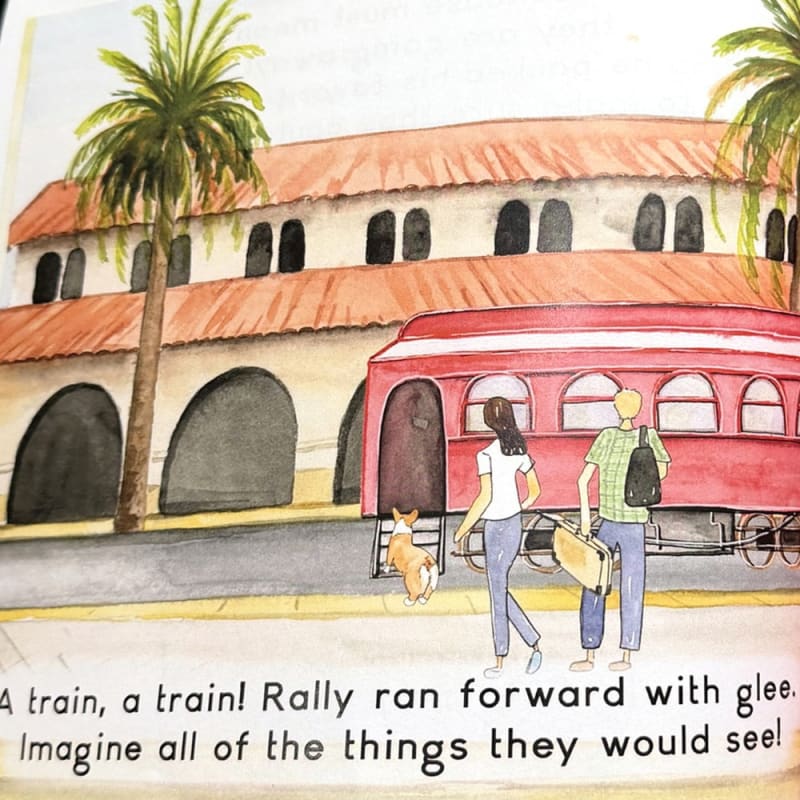


Rally Takes the Train
Eight pages from the book
Turn the page
That's 8 of 25 pages
See who’s waiting at the station
Grandmommy and Papa are at the last stop. Get the full hand-painted book, $13.99 on Amazon.
See the full bookPage 1 of 8

Like it so far? See the full book
25 hand-painted pages, paperback, $13.99 with fast shipping from Amazon.
Every page is real watercolor on paper, painted by hand by Leslie Dunn. Nothing in this book was made with AI.
Keeping the ore railroad's story together
The Duluth, Missabe & Iron Range Railway was formed by consolidation: in 1937 the Duluth, Missabe & Northern and the Spirit Lake Transfer Railway combined, and in 1938 the Duluth & Iron Range and the Interstate Transfer Railway were absorbed, with headquarters moving south to Duluth. The railroad's job was moving ore from Minnesota's iron ranges to docks at Duluth and Two Harbors, or to connecting lines at Superior, Wisconsin. Its first Baldwin 2-8-8-4 Yellowstone locomotives arrived in 1941, and University of Minnesota archivists note that by 2002 it was called the largest iron ore handling railroad in North America, with 212 miles of track.
The Missabe Railroad Historical Society brings together railfans, modelers and historians who share an interest in that railroad and its predecessors. It is an independent 501(c)(3) with no connection to the railroad company or its later owners. The society publishes the quarterly magazine Ore Extra, keeps detailed rosters of Missabe equipment, tracks available models in every scale, and is collecting photos, artifacts and memorabilia for a Missabe archive.
How the public can see the collection
The society does not run a museum with regular hours. Its rosters of steam, diesel, caboose, passenger, ore and work equipment are posted on its website, along with a corporate history and modeling guides. In 2025 the society announced that Missabe caboose C-25 is on display at the Gopher State Railway Museum near New Prague, where visitors can see it on open days.
Don’t miss
- Caboose C-25A Duluth, Missabe & Iron Range caboose the society reports is on display at the Gopher State Railway Museum.
- Ore ExtraThe society's quarterly magazine, shared with members, covering Missabe history and current events.
For older rail fans and modelers
There is no kids' space to visit. Young modelers may enjoy the society's lists of Missabe models in HO, O and N scales, and families can see Missabe caboose C-25 in person at the Gopher State Railway Museum.
Plan your visit: tips for Missabe Railroad Historical Society
- Email mrhsweb@gmail.com with questions or to offer photos and memorabilia.
- Order the society's 2027 calendar, announced in October 2026.
- See caboose C-25 at the Gopher State Railway Museum on its open days.
Railfans, modelers and historians
The society is made up of volunteers who share a passion for the Missabe. It welcomes input from anyone whose path crossed the railroad, and it seeks photos, artifacts and memorabilia by purchase or donation for its archive. Membership brings the Ore Extra magazine.
See Missabe country in person
In Duluth, the Lake Superior Railroad Museum and the North Shore Scenic Railroad share the society's Michigan Street address at the Depot. The Historic Soo Line Depot in Ashland, Wisconsin is about 59 miles away. For more, see Minnesota's train museums.
- Lake Superior Railroad MuseumDuluth, MN · same town
- North Shore Scenic RailroadDuluth, MN · same town
- Historic Soo Line DepotAshland, WI · about 59 mi
- Wisconsin Great Northern RailroadTrego, WI · about 64 mi
- Northern Pacific CenterBrainerd, MN · about 103 mi
- Ironhorse Central Railroad MuseumChisago City, MN · about 104 mi
Bring Rally along: a train book for the drive

Missabe trains rolled down to ore docks on Lake Superior, and I like to imagine the crews catching that first glimpse of the water. In our book, Rally has his own view: he presses his nose to an arched window, watches the ocean and says hello to a white bird, while Mom and Dad smile. Big water does that to all of us. You can read about the woman who imagined that scene on our story page.
Free for train families
Print the Rally coloring pages before you go
Watercolor coloring pages from the book, free to print. Tuck a few in a folder with crayons for the drive or the wait for the next train.
Get the free coloring pages
A train story for the ride homeRally Takes the Train is a five-minute rhyming picture book about a corgi's first train trip to see his grand-paw-rents. Hand-painted in real watercolor. $13.99 on Amazon, for ages 0 to 8.
Buy on Amazon (opens in a new tab)More for train families
- Train museums in Minnesota: every museum by town, with a map
- Train museums in every state: search by town or near you
- Christmas train rides in Minnesota
- Halloween train rides in Minnesota
- Every Amtrak route with kids
Work or volunteer at Missabe Railroad Historical Society?
We want this page to be the best introduction to your museum on the web. Send new hours, event dates, corrections or photos to kelsey@rallytakesthetrain.com and we will update it. You are welcome to share this page with your members.
Sources
- Missabe Railroad Historical Society official website(opens in a new tab)
- Missabe Railroad Historical Society on Facebook(opens in a new tab)
- Missabe Railroad Historical Society on YouTube(opens in a new tab)
- Missabe Railroad Historical Society on X(opens in a new tab)
Everything on this page comes from the museum’s own website and social pages and, for history, Wikipedia, checked October 19, 2026.
Duluth, Missabe & Iron Range collection: 20 questions
What is the Duluth, Missabe & Iron Range Railway historic collection?
It is the work of the Missabe Railroad Historical Society, a Duluth nonprofit of railfans, modelers and historians who collect and share the history of the Duluth, Missabe & Iron Range Railway and its predecessors. The society builds an archive, publishes a magazine and posts equipment rosters online.
Can you visit the Missabe Railroad Historical Society?
The society does not list public hours or a museum space to visit. Its mailing address is 506 W. Michigan Street in Duluth. The best way to reach it is by email at mrhsweb@gmail.com or through its Facebook page.
Where can I see Duluth, Missabe & Iron Range equipment in person?
The society reported in 2025 that Missabe caboose C-25 is on display at the Gopher State Railway Museum near New Prague, Minnesota, which is open the first Saturday of the month from May to October. Contact the society for other places to see Missabe equipment.
What was the Duluth, Missabe & Iron Range Railway?
It was the iron ore railroad of northeastern Minnesota, carrying ore from the iron ranges to docks at Duluth and Two Harbors and to connecting railroads at Superior, Wisconsin. University of Minnesota archivists note that in 2002 it was called the largest iron ore handling railroad in North America, with 212 miles of track.
When was the Duluth, Missabe & Iron Range Railway formed?
In 1937 the Duluth, Missabe & Northern and the Spirit Lake Transfer Railway were consolidated to form the DM&IR. In 1938 it absorbed the Duluth & Iron Range and the Interstate Transfer Railway, and the merged company moved its headquarters south to Duluth.
What were the Duluth, Missabe & Iron Range Yellowstone locomotives?
The Yellowstones were Baldwin 2-8-8-4 steam locomotives built for the DM&IR's heavy ore trains. The society's corporate history notes the first batch arrived in 1941 and a second batch in 1943. Details are in the society's steam rosters online.
Does the Missabe Railroad Historical Society have equipment rosters?
Yes. The society posts rosters on missabe.com for steam locomotives of the D&IR, DM&N and DM&IR, plus diesels, cabooses, non-revenue equipment, passenger cars, ore cars, freight cars, and hi-rails and speeders. A 1978 diagram book is also listed.
Is the Missabe Railroad Historical Society part of the railroad?
No. The society is an independent 501(c)(3) nonprofit and is not affiliated with the Duluth, Missabe & Iron Range Railway Company, the Great Lakes Transportation Company or Canadian National. It is run by people who share an interest in the railroad's history.
What is Ore Extra?
Ore Extra is the Missabe Railroad Historical Society's magazine, published quarterly for members. It covers Missabe history and current events, along with related topics such as mining operations, other mining railroads, local industry, Great Lakes shipping and connecting railroads.
How do I join the Missabe Railroad Historical Society?
The society shares its Ore Extra magazine with members, but it does not post full membership details on its main pages. Email mrhsweb@gmail.com to ask about joining, dues and back issues. Volunteers run the society, so allow some time for a reply.
Can I donate Missabe photos or artifacts?
Yes. The society is building a Missabe archive and welcomes photos, artifacts and memorabilia, by donation or purchase. It especially invites input from people whose paths crossed the railroad. Email mrhsweb@gmail.com to describe what you have.
Does the Missabe Railroad Historical Society sell a calendar?
Yes. In October 2026 the society announced that its 2027 MRHS calendar is available to order. Check the news section of missabe.com or email mrhsweb@gmail.com for ordering details. A calendar is also a simple way to support the society's archive and publishing work.
Are there Duluth, Missabe & Iron Range model trains?
Yes. The society keeps lists of Missabe models in HO, O, N and other scales, noting where manufacturers' models are or are not prototypical. It is a helpful guide for modelers building a Missabe layout, though it does not guarantee full accuracy.
Where are Duluth, Missabe & Iron Range Railway records kept?
Company records are held in public archives, including the Minnesota Historical Society and the University of Minnesota, which list DM&IR collections open for research. The Missabe Railroad Historical Society is also gathering its own archive of photos and memorabilia.
Is the Missabe Railroad Historical Society good for kids?
It is aimed at rail historians and modelers rather than young children, and it has no public exhibit space. Kids who love trains can see Missabe caboose C-25 at the Gopher State Railway Museum, where caboose train rides run on open days.
Does the Missabe Railroad Historical Society hold events?
The society keeps an events page on its website but has not posted current events there. Follow its Facebook page or YouTube channel, or email mrhsweb@gmail.com, to hear about meetings or gatherings. Its Facebook page is the most likely place for announcements.
When did passenger trains stop on the Missabe at Two Harbors?
According to the Lake County Historical Society, passenger service continued at the Two Harbors depot until July 15, 1961, when the final passenger train left for Duluth. The Missabe Railroad Historical Society's passenger car rosters cover the equipment.
What does the Missabe Railroad Historical Society study?
Its focus is the Duluth, Missabe & Iron Range Railway from a railfan and modeler's point of view, plus the industries around it: mining railroads, mining operations, local industry, Great Lakes shipping and interchange carriers.
How do I contact the Missabe Railroad Historical Society?
Email mrhsweb@gmail.com or write to 506 W. Michigan Street, Duluth, MN 55802. The society also posts on Facebook, YouTube and X, which are good places to follow news and ask questions. The society does not list a phone number online.
What railroad museums are near the Missabe Railroad Historical Society?
The Lake Superior Railroad Museum and the North Shore Scenic Railroad share the Depot at 506 W. Michigan Street in Duluth. The Historic Soo Line Depot in Ashland, Wisconsin is about 59 miles away, and the Wisconsin Great Northern Railroad in Trego about 64 miles.
Keep exploring
More family train guides from Rally
- DirectoryRailway Museum Directory650 train museums in all 50 states, with hours, tickets and train rides.
- HolidayChristmas Train RidesSanta trains and holiday light rides, sorted by state and town.
- OctoberHalloween Train RidesPumpkin trains and not-too-spooky rides for little ones, by state.
- NovemberThanksgiving Train RidesHoliday weekend train trips the whole family can share.
- AmtrakAmtrak With KidsWhich Amtrak routes work best with babies, toddlers and big kids.
- Plan a tripTrain Trips With KidsEvery Amtrak route, stop by stop, planned for families.