
Our Class Train Museum: A Pretend Museum Lesson for Preschool and Pre‑K
A free, 40-minute preschool and Pre-K/TK lesson where children build a pretend train museum. They compare Rally's red train car with a historic car from a real museum guide, choose toy trains and pictures to display, dictate museum labels, then take turns as junior docents telling visitors about one object.
- Grade
- Preschool & Pre-K
- Subjects
- Speaking and listening, Social studies, Dramatic play
- Time
- 40 minutes over one or two days (two short whole-group parts, then center time)
- Prep
- 10 minutes: choose a museum guide, clear a shelf or table for the museum, gather classroom toy trains and train pictures, and print docent badges and museum labels (a note asking families to lend a toy train or train picture is optional)
- Grouping
- Whole group, then small groups of 3 to 5 building and sharing
- Book pages
- 3, 11
- Head Start ELOF: Language and Communication: Receptive Language
- Head Start ELOF: Language and Communication: Expressive Language
 Need the book? Get the paperback on Amazon (opens in a new tab) or earn a free classroom copy.
Learning objective
Children listen to a real train museum guide and answer a question about it, choose an object for a class museum, and tell a visitor about it as a junior docent.
I can learn about a real museum and tell a visitor about my museum train.
Vocabulary to teach
Materials
- Rally Takes the Train by Kelsey Lizee Cecil: get the paperback on Amazon (opens in a new tab) or earn a free classroom copy
- Screen or printout of the Southern California Railway Museum guide, or a guide for a verified museum near you (see Discover)
- Toy trains, train cars and train pictures from the classroom, each toy too big to fit through a toilet paper tube opening (families may lend one, but no child needs to bring anything)
- A shelf or table covered with a cloth for the museum, plus a box or block to stand objects on
- Museum labels (printable): folding table-tent cards with a small picture of Rally's red train car and three write-in lines; at the top "This is ___.", under it "It is special because ___.", and a "Found by" name line. An adult writes each child's dictated words.
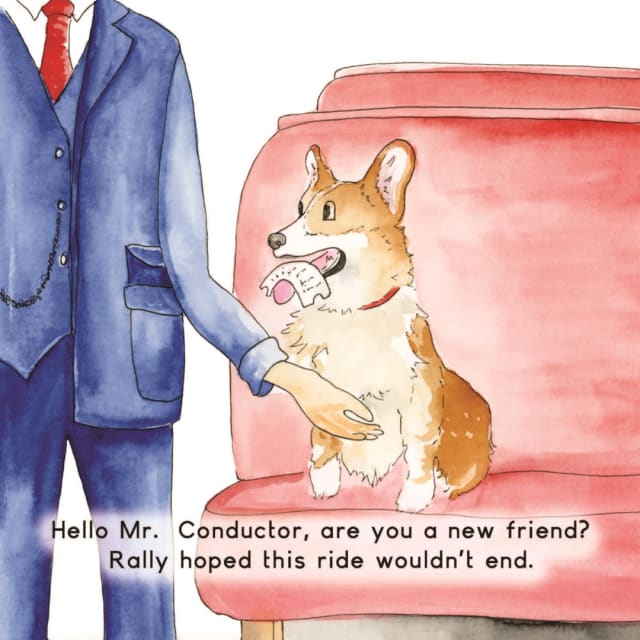
- Docent badges (printable): round badges that say "Junior Docent" with Rally in his seat looking out the window (page 8 art) and a name line; stick on with tape
- A "Class Train Museum" sign (it also says "Please look with your eyes") and a "Museum Open / Museum Closed" door hanger (on the museum labels printable)
- Masking tape for a "Please look with your eyes" line on the floor in front of the display
Lesson steps
Hold up the book. "Today we will learn about a museum. A museum is a place where special things are kept so people can come and look and learn. Some museums keep real trains! Let's look closely at Rally's train first."
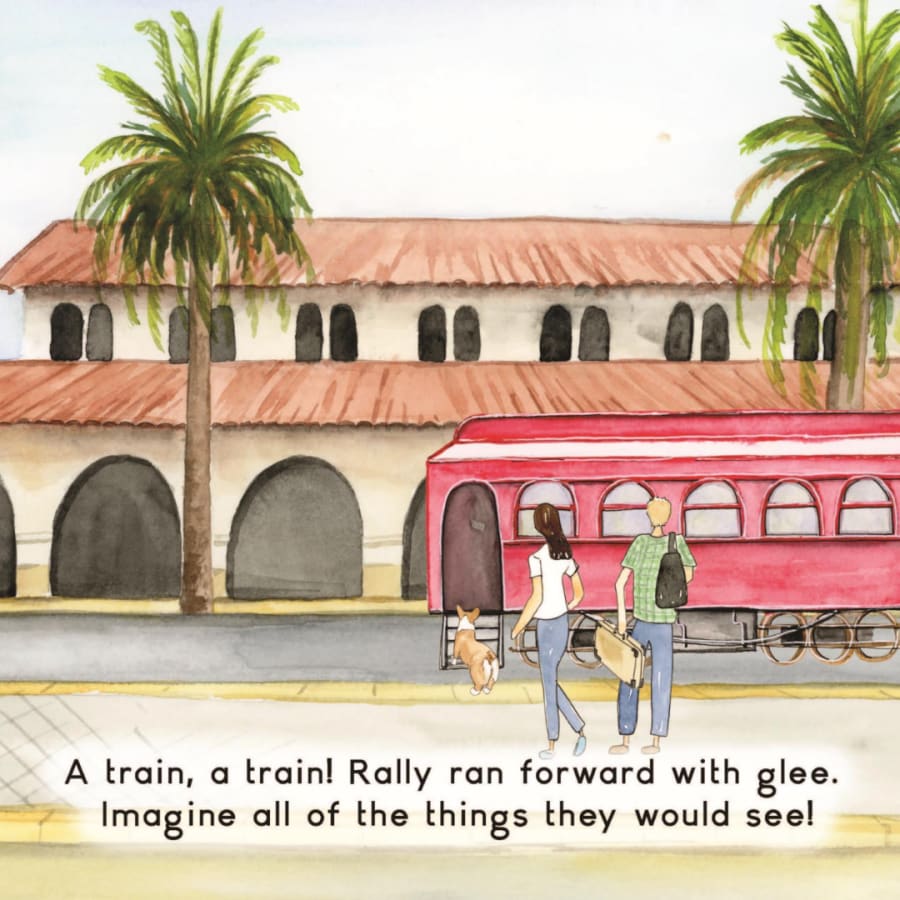
"Look at Rally's train car. What color is it?" (Red.) "What else do you see on it?" (Windows, steps, wheels.) Write their words on a chart labeled "Rally's train."
"Here is the red train car again, going into a tunnel. What do you notice about the windows and the wheels?" Add any new words to the chart.
- "If we made our own train museum, what would you want to put in it?" Take five or six ideas and sketch them quickly on a chart.
- Ask: "What do you wonder about real train museums?" Help children make questions with "Who," "What" or "Why" ("What do they keep there?" "Can you go inside the trains?"). Write two or three to answer during Discover. Stand and stretch before Discover, or teach Discover later in the day.
- Open the Southern California Railway Museum guide, or find a verified museum near your school in the field trip planner (rallytakesthetrain.com/lessons/train-museum-field-trips). The guides are written for adults, so choose two or three short sentences, read them aloud yourself and show the photos.
- Share what the guide says in kid words: "This museum is in Perris, California. Long ago, in 1956, young people who loved trains started it to save the Red Cars of Los Angeles. Red Cars were streetcars that carried people around the city. Now the museum keeps more than 200 railway vehicles. Historic means very old and important, like the old Red Cars." Answer the class questions the guide answers.
- Hold the book open to page 3 next to a Red Car photo from the guide. "How are they the same? How are they different?" Prompt with color, windows, wheels and size, and add answers to a two-column chart (Rally's car / Red Car).
Or find a verified museum near your school in the field trip planner.
- Each child chooses one toy train, train car or train picture from the class collection for the museum. An adult sits with small groups and writes each child's dictated label: "This is ___. It is special because ___."
- Together, children arrange the objects and labels on the museum table, hang the "Class Train Museum" sign and help tape the "Please look with your eyes" line flat on the floor.
- Open the museum. Children take turns wearing the Junior Docent badge and telling a visitor (a friend, a teacher, a stuffed animal) about their object: "This is my train. It is special because ___. Do you have a question?" Before each child's turn, ask one question about the guide, such as "What did the museum keep?"
- 3-year-olds: point to their object and say one word or a short phrase, with an adult asking "What color is it?" 4-year-olds and TK: tell two things about their object and answer one question from a visitor.
Safety: Materials safety: every object children handle must be too big to fit through a toilet paper tube opening, with no small loose parts. Keep heavy objects on low shelves, and tape the look line flat so no one trips. Rail safety reminder for any museum visit: "Real train tracks are only for trains. We never play on or near real tracks."
Differentiation
Extra support
Let the child hold their object while they share, and offer a choice question ("Is it big or small? Is it red or blue?"). An adult can stand beside the docent and point to the label while reading it aloud.
Multilingual learners
Write labels in English and the home language, and let docents share in either language. Show picture cards for museum, docent and label, and give the frame "This is ___." Pair with a peer who shares the home language when possible. Key language use: Inform.
Extension
Children sort the museum into sections (engines, cars, cabooses, pictures) and dictate a sign for each, or draw a museum "map" that shows where each section is.
Check for understanding
Success criterion: Answers a question about the museum guide, chooses a museum object and tells a visitor about it.
| Level | What you see |
|---|---|
| 3Meets (level 3) | Answers a question about the guide or its photos, tells a visitor two things about their object and answers a visitor's question. |
| 2Approaching (level 2) | Answers a question about the guide with a choice of two or by pointing to a photo detail, and tells one thing about their object with one prompt. |
| 1Beginning (level 1) | Chooses an object and shows it to a visitor, using gestures or single words with adult support; points to the guide photo when the teacher names a detail. |
Family connection
Send home the half-page note in the printables. The text is below so you can paste it into a newsletter or app.
English
Today your child helped build our Class Train Museum. We looked at a real train museum guide together, chose toy trains and pictures for our display, made museum labels, and took turns being "junior docents," museum helpers who tell visitors about the things there. Please come visit our museum! At home, pick one special object together and let your child tell you two things about it, just like a docent. Free Rally coloring pages are at rallytakesthetrain.com/coloring-pages.
Español
Hoy su hijo o hija ayudó a construir nuestro Museo de Trenes de la clase. Miramos juntos una guía de un museo de trenes real, escogimos trenes de juguete y dibujos, hicimos etiquetas y nos turnamos para ser "guías de museo", ayudantes que les cuentan a los visitantes sobre las cosas que hay. ¡Les invitamos a visitar nuestro museo! En casa, escojan juntos un objeto especial y deje que su hijo o hija le cuente dos cosas sobre él, como un guía. Hay páginas para colorear gratis de Rally en rallytakesthetrain.com/coloring-pages.
Teacher tips
- Invite families to a Museum Open House at pickup or drop-off. Send a short note a few days ahead, and let each child give a docent tour to a family member, another special grown-up or a teacher. Children who say little at circle time often talk freely when they are the expert.
- If families lend toys, put a name label on the bottom of each one and keep the museum behind a tape line. Everything goes home in the same shape it came in.
- Leave the museum open for a few days and let children rotate the docent badge during center time. Their talks get longer and more detailed each day.
Standards alignment
| Standard | Text |
|---|---|
| Head Start ELOF: Language and Communication: Receptive Language (opens in a new tab) | Preschool (36 to 60 months) sub-domain of the Head Start Early Learning Outcomes Framework. |
| Head Start ELOF: Language and Communication: Expressive Language (opens in a new tab) | Preschool (36 to 60 months) sub-domain of the Head Start Early Learning Outcomes Framework. |
Check codes against your state's version of these standards. How we build and review lessons.
Keep exploring
Museums save old trains so we can still see them. Find a guide with a very old train. What would you add to our class museum to help tell its story?
After the lesson, children can explore about 650 train and railway museums through our free guides, discovering the history, engineering and stories behind real trains. Read one together, then come back to the question.
Teach it with the real book
4.9 stars on Amazon
Rally Takes the Train is a rhyming, hand-painted picture book about a corgi's first train ride, from the big station stairs to a dark tunnel to the people waiting at the end of the line. Children ask for it again and again, and every lesson here is built on its pages.
Questions teachers ask
How do you make a pretend museum in a preschool classroom?
Clear a shelf or table, cover it with a cloth and let each child choose one object to display. An adult writes a short label for each object with the child's own words. Add a museum sign and a tape line for visitors, then let children take turns as docents who tell visitors about the objects.
What is a junior docent activity for preschool?
A junior docent is a child who acts as a museum helper and tells visitors about one object. Give the child a badge and a simple frame like "This is my train. It is special because..." Visitors can be classmates, teachers or families. It builds speaking confidence and listening skills in a playful way.
How do I teach preschoolers about museums before a field trip?
Read a short part of a museum guide aloud, show the photos and teach the words museum, docent and visitor. Then build a pretend museum in class so children practice looking carefully, asking questions and telling visitors about objects. Find a verified museum near you in the field trip planner (rallytakesthetrain.com/lessons/train-museum-field-trips) and read its guide yourself first.
Can families visit the class train museum?
Yes, and it is one of the best parts. Hold a short Museum Open House at pickup or drop-off and let each child give a docent tour of their object and label to a family member, another special grown-up or a teacher. Families can also lend a toy train or a train picture for the display, with a name label on each item, but it is optional.
What is a good social studies activity for preschool?
A class museum is a strong preschool social studies activity, because children learn what a museum is, what historic means and how people share objects with visitors. In Our Class Train Museum, children compare Rally's red train car with a historic car from a real museum guide, choose toy trains for a display, dictate labels and take turns as junior docents.
How do you explain history to preschoolers?
Use one clear word and a comparison children can see. Teach historic as "very old and important, from a long time ago," then hold the book open to Rally's red train car on page 3 next to a photo of a historic car from a museum guide. Ask "How are they the same? How are they different?" and record answers on a two-column chart.
How do you help preschoolers ask questions?
Give them question starters. Ask "What do you wonder about real train museums?" and help children turn ideas into questions that begin with Who, What or Why, such as "What do they keep there?" or "Can you go inside the trains?" Write two or three on a chart, then answer the ones the museum guide answers, so children hear that questions lead to answers.
What is a good show and tell alternative for preschool?
A junior docent talk works like show and tell with a clear structure. Each child chooses one object, an adult writes their dictated label, and the child tells a visitor "This is my train. It is special because ___. Do you have a question?" Children who say little at circle time often talk freely when they are the expert on one object.
How do you take dictation from preschoolers?
Sit with a small group, write the child's exact words, then read them back while pointing to each word. In this lesson each child dictates a museum label using the frame "This is ___. It is special because ___." Seeing their own words written down shows children that what they say can be written and read. Labels can be written in English and the home language.
How long is the class train museum lesson?
Plan about 40 minutes over one or two days: a 6-minute read-aloud, 4 minutes of wondering, a stretch, 6 minutes reading the museum guide, and about 24 minutes building the museum and taking docent turns. Prep takes about 10 minutes. You can build the museum on day one, open it on day two, and leave it open for a few days so docents rotate.
What is on the docent badge and museum label printables?
The museum labels are folding table-tent cards with Rally's red train car and write-in lines: "This is ___.", "It is special because ___." and a "Found by" name line for an adult to fill in. The docent badges say "Junior Docent" with Rally looking out the window from page 8. The set also has a Class Train Museum sign and an Open and Closed door hanger, in color, ink-saver and A4.
What materials do I need for a class train museum?
You need toy trains, train cars and train pictures from the classroom (families may lend some, but no child needs to bring anything), a shelf or table covered with a cloth, a box or block to stand objects on, and masking tape for a "Please look with your eyes" line on the floor. Add the printable labels, docent badges and sign, plus a train museum guide for Discover.
How do I support multilingual learners in a museum lesson?
Write labels in English and the home language, and let docents share in either language. Show picture cards for museum, docent and label, and give the frame "This is ___." Pair a child with a peer who shares the home language when possible, and accept gestures as a start. The WIDA key language use for this lesson is Inform.
How do I adapt the docent activity for 3-year-olds or a mixed-age class?
Let 3s point to their object and say one word or a short phrase, with an adult asking "What color is it?" They can hold the object while they share. 4s and TK tell two things about their object and answer one question from a visitor. For any child who needs support, including children with IEPs, an adult can stand beside the docent and read the label aloud.
How can 4-year-olds and TK go further with the class museum?
Children can sort the museum into sections, such as engines, cars, cabooses and pictures, and dictate a sign for each section. They can also draw a museum map that shows where each section is. Both tasks ask children to group objects and explain their thinking, and they give docents more to talk about on their tours.
How do I assess listening and speaking in the class museum lesson?
Use the 3-level check. Meets: answers a question about the guide, tells a visitor two things about their object and answers a visitor's question. Approaching: answers a guide question with a choice of two or by pointing to a photo, and tells one thing about their object with one prompt. Beginning: shows their object to a visitor, using gestures or single words with adult support.
How should I handle toys that families lend for a class museum?
Put a name label on the bottom of each lent toy and keep the museum behind a tape line, so everything goes home in the same shape it came in. Every toy children handle must be too big to fit through a toilet paper tube opening, with no small loose parts, and heavy objects go on low shelves. Lending is optional; the classroom collection is enough.
Is there a Spanish family note for the class train museum lesson?
Yes. The family note comes in English and Spanish and invites families to visit the class museum. It explains that children looked at a real train museum guide, chose toy trains for the display, made labels and took turns as junior docents. The 5-minute home idea is to pick one special object together and let the child tell two things about it, like a docent.
What is the Southern California Railway Museum?
The Southern California Railway Museum in Perris, California, was founded in 1956 by young rail fans who wanted to save the Red Cars and Yellow Cars, the streetcars of Los Angeles. It now has more than 200 railway vehicles to see, tour and ride. The grounds are free, and rides run on weekends. In this lesson children compare a Red Car photo from its guide with Rally's red train car.
What if there is no train museum near my school?
Bring the museum to your classroom with this lesson, then keep exploring. The Keep exploring section at the end of the lesson links to about 650 free train museum guides at rallytakesthetrain.com/train-museums, so children can discover museums far from home. To reach one, the field trip planner at /lessons/train-museum-field-trips lists more than 70 verified museums that have approved their own guides, and it writes a video visit request or a class letter for you.
Related lessons
All Aboard! Train Station Dramatic Play
A free, 35-minute preschool and Pre-K/TK lesson that turns your dramatic play area into a train station.
What's Inside a Train Museum? Reading a Museum Guide Together
A free, 40-minute kindergarten informational text lesson.
Ramp Races: What Makes a Train Go?
A free, 30-minute preschool and Pre-K/TK science lesson where children find out what makes a toy train go.
Teaching with Rally Takes the Train
Every lesson is free for classroom and homeschool use. Add the paperback to your classroom library, or review a lesson to earn a free copy if you are a credentialed teacher. Keep the journey going in about 650 free train museum guides, plan a visit with the field trip planner, or browse all lessons for educators.