
Multiplication Arrays and Area Lesson for 3rd Grade: Design a Train Car Floor Plan
A 60-minute problem-based 3rd grade lesson on arrays and area. After a minute with the rows of seats on page 5 of the book, students find seats in a train car with tiles, write equations with a letter for the unknown, then break apart a real 30 by 16 foot toy train layout to find its area.
- Grade
- 3rd Grade
- Subjects
- Mathematics, Multiplication and area
- Time
- One 60-minute math block
- Structure
- Problem-based math lesson
- Prep
- 15 minutes: bag about 40 square tiles per pair (or cut grid paper squares), mark page 5, copy the seat arrays page and the layout page for everyone and the floor plan page for early finishers, and open the Twin City Model Railroad Museum guide
- Grouping
- Whole class warm-up and syntheses on the carpet, partners with tiles at tables, independent cool-down
- Book
- Page 5
- CCSS 3.OA.A.3
- CCSS 3.MD.C.7
 Need the book? Get the paperback on Amazon (opens in a new tab) or earn a free classroom copy.
Day 7 of the 3rd Grade train unit
Builds on: 3C, the first problem-based math day. Students already know they try the problem before the class compares strategies.
Leads to: 3E, where a toy train car becomes the object in a forces investigation.
Learning objective
Students represent rows of train seats as arrays, write and solve multiplication and division equations with a letter for the unknown, find the area of a rectangle by tiling and by multiplying side lengths, and use an area model to break apart a larger rectangle.
I can use arrays and equations to solve seat problems, and I can find the area of a train car floor by tiling and by multiplying.
Vocabulary to teach
Materials
- Rally Takes the Train by Kelsey Lizee Cecil: get the paperback on Amazon (opens in a new tab) or earn a free classroom copy
- The Twin City Model Railroad Museum guide at https://www.rallytakesthetrain.com/museums/twin-city-model-railroad-museum-st-paul-minnesota on a projector
- Square tiles, about 40 per pair (or squares cut from grid paper), and a container to collect them
- Seat arrays page, one per student (printable): problems for Activity 1, practice and the cool-down
- Toy train layout page, one per student (printable, Activity 2): a tiling task, a short guide passage and space to break apart the 30 by 16 layout
- Floor plan grid (printable, for early finishers or a math center): a 12 by 10 square grid to design a train car
- Grid paper for sketching
Before you teach
- Count tiles into bags before class. Forty per pair covers every task in Activity 1 and Part A of Activity 2.
- Show page 5 on the document camera for one minute only. The book is not read today.
- Plan the Activity 2 synthesis: look for a pair that splits 16 into 10 and 6 and a pair that splits 30 into three 10s, and show them in that order.
- Write the 30 by 16 sentence from the guide on a strip so it can stay posted after the projector is off.
Lesson plan
Problem-based math lesson. Arrays and area connect when students see the same rows as both seats and square units. Giving them seats to count and then a floor too big to tile gives them a reason to multiply and to break a rectangle apart.
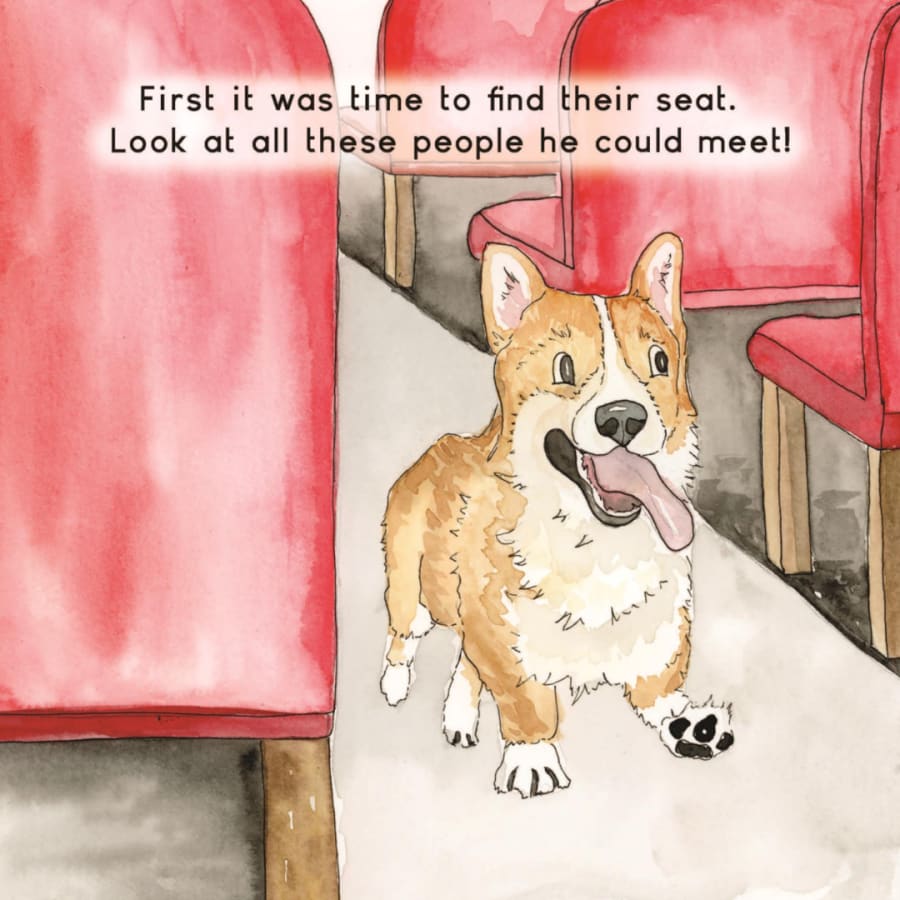
Using the book: Page 5 only, shown for about one minute in the warm-up. The rows of red seats are the array students notice.
Students need one fact from the guide for Activity 2: the toy train layout measures 30 by 16 feet. Show a photo from the guide and read that sentence aloud. Or find a verified museum near your school in the field trip planner.
- Put page 5 of Rally Takes the Train on the document camera with no introduction. Students look silently for 30 seconds.
- Collect noticings and wonderings with names. Steer toward the rows of seats and the aisle if no one mentions them.
- Ask how someone could count all the seats in a full train car quickly if every row had the same number. Record ideas, then put the book away.
- Launch (3 minutes): read problems 1 and 2 from the seat arrays page. Hand out tiles.
- Work time (9 minutes): pairs solve both with tiles, drawings or facts they know. Do not show an equation yet. Note who skip counts, who builds an array and who splits 7 rows into 5 and 2.
- Synthesis (6 minutes): show a tile array for problem 1 and a drawing for problem 2. Write 7 x 4 = s and 36 ÷ 4 = r, and explain that the letter stands for the number we do not know yet. Point out that one array shows both equations.
Look for: Pairs who build 4 rows of 7 for problem 1. Ask them to match one row of tiles to one row of seats in the picture.
- Part A (6 minutes): pass out the layout page. Pairs tile a floor 8 squares long and 3 wide, then answer how they could find the area without counting every tile. Teach area and square unit directly once they have counted.
- Part B launch (2 minutes): show the Twin City Model Railroad Museum guide and read the sentence about the 30 by 16 foot toy train layout. Ask how many square feet it covers, and point out there are not enough tiles in the school.
- Work time (8 minutes): pairs sketch the layout on the page and find its area. Expect splitting 16 into 10 and 6, splitting 30 into three 10s, or repeated addition.
- Synthesis (6 minutes): show the two pairs you planned. Record 30 x 10 = 300 and 30 x 6 = 180, so 300 + 180 = 480 square feet, then the other pair's 160 + 160 + 160 = 480. Ask why it is fair to add the parts (no gaps, no overlaps).
Look for: Students who multiply only the 30 by 10 part. Ask them to shade what is covered and what is still empty.
- Ask how a seat array and an area model are alike. Draw out that both are rows of equal groups and both can be solved by multiplying.
- Add three ways to find area to the anchor chart: tile and count, multiply side lengths, break apart and add.
- Have students name the unit for each answer today: seats, square units, square feet.
- Students solve problem 6 on the seat arrays page with an equation that uses a letter for the unknown.
- Collect tiles in the container and check that each bag is full before the next class uses them.
Short on time? Cut the warm-up to 3 minutes and the lesson synthesis to 3 minutes (units only), and replace Part A of Activity 2 with a 2-minute demonstration: build the 8 by 3 floor in tiles under the document camera, teach area and square units, then go straight to the 30 by 16 layout. Keep problems 1 and 2 and the cool-down, since they carry the equation evidence.
Finished early? Design a train car on the floor plan grid with seats in an array and an aisle, then find the seats and the floor area two ways.
What to listen for
| If children say or do this | Try this |
|---|---|
| Swaps rows and seats per row, writing 4 rows of 7 for 7 rows of 4. | Have the student trace one row with a finger and say how many seats are in it before writing. Both give 28, so ask which equation matches the car as drawn. |
| Adds the sides (8 + 3 + 8 + 3) when asked for area. | Ask the student to point to one square unit and count how many cover the floor. Area is the inside; adding the sides measures the edge. |
| Splits 16 into 10 and 6 but reports only 300 square feet. | Shade the two parts in two colors and ask what covers the rest of the layout. The whole floor needs both parts. |
Safety: Square tiles are small; collect them in a container after use. If you cut grid paper squares, review scissor safety first.
Differentiation
Extra support
Use square tiles for every problem and give the array already drawn for problem 1. In Part B, draw the dividing line at 10 on the layout sketch so students only multiply. Provide a multiplication chart for facts not yet known.
Multilingual learners
Teach row, aisle, seat and area with the page 5 picture and the tiles. Give frames: "There are ___ rows of ___ seats. ___ x ___ = ___." "The area is ___ square units." Key language use: Explain.
Extension
Find the area of the 30 by 50 foot O-scale layout by breaking 50 into five 10s, then explain how many 30 by 10 strips it holds.
Check for understanding
Success criterion: Writes and solves multiplication and division equations with a letter for the unknown for array problems, and finds the area of a rectangle by tiling, by multiplying side lengths and by breaking it apart.
| Level | What you see |
|---|---|
| 3Meets (level 3) | Solves problems 1, 2 and 6 with correct equations that use a letter for the unknown, finds the 8 by 3 area by tiling and by multiplying, and breaks apart the 30 by 16 layout to find 480 square feet. |
| 2Approaching (level 2) | Finds totals and areas correctly by counting or with tiles, but does not yet write equations with a letter for the unknown, or needs help adding the parts of the layout. |
| 1Beginning (level 1) | Counts seats one by one, confuses rows with seats per row, or gives area as the distance around or without square units. |
Family connection
Send home the half-page note in the printables. The text is below so you can paste it into a newsletter or app.
English
Egg cartons, muffin pans and train seats have something in common: they come in equal rows, which makes them arrays. In math today your child figured out how many seats fit in a train car, wrote equations with a letter for the number we did not know yet, and found area by covering a floor with squares. Then the class found the area of a real 30 by 16 foot toy train layout from a model railroad museum in St. Paul. For a 5-minute array hunt at home, find things in rows and say the multiplication fact each one shows.
Español
Los cartones de huevos, los moldes para muffins y los asientos de un tren tienen algo en común: vienen en filas iguales, y por eso son arreglos. Hoy en matemáticas su hijo o hija averiguó cuántos asientos caben en un vagón, escribió ecuaciones con una letra para el número que todavía no sabíamos y halló el área cubriendo un piso con cuadrados. Después calculamos el área de una maqueta de trenes real de 30 por 16 pies, de un museo de trenes a escala en St. Paul. Como búsqueda de 5 minutos en casa, encuentren cosas en filas y digan la multiplicación que muestra cada una.
Teacher tips
- Insist on units every time: seats for arrays, square units or square feet for area. It is the fastest way to show the difference between counting objects and measuring space.
Standards alignment
| Standard | Text |
|---|---|
| CCSS 3.OA.A.3 (opens in a new tab) | Use multiplication and division within 100 to solve word problems in situations involving equal groups, arrays, and measurement quantities, e.g., by using drawings and equations with a symbol for the unknown number to represent the problem. |
| CCSS 3.MD.C.7 (opens in a new tab) | Relate area to the operations of multiplication and addition. |
Check codes against your state's version of these standards. How we build and review lessons.
Keep exploring
Look through a museum guide for a photo of a train car, a building or a layout. Find something arranged in rows, like windows or seats, and write the multiplication fact it shows.
Teach it with the real book
4.9 stars on Amazon
Rally Takes the Train is a rhyming, hand-painted picture book about a corgi's first train ride, from the big station stairs to a dark tunnel to the people waiting at the end of the line. Children ask for it again and again, and every unit here opens with it.
Questions teachers ask
How is the 60-minute block divided?
A 7-minute notice and wonder warm-up looks at a picture of seat rows. Activity 1 (18 minutes) has partners find the number of seats in a train car with tiles before any equation is shown. Activity 2 (22 minutes) moves from tiling a small floor to a layout too big to tile. A 7-minute lesson synthesis connects arrays and area, and a 6-minute cool-down closes the block.
Why show page 5 for only about a minute?
Page 5 of Rally Takes the Train shows rows of red seats with an aisle, which is exactly the array students need to notice. Nothing else from the story matters to the math, so the picture goes on the document camera with no introduction, students look silently for 30 seconds, and you collect noticings. Once someone asks how to count a full car quickly, put the book away.
Why write 7 x 4 = s instead of just 28?
Standard 3.OA.A.3 asks students to write equations with a symbol for the unknown number. In the Activity 1 synthesis, after pairs have already found the answers with tiles, you write 7 x 4 = s and 36 ÷ 4 = r and explain that the letter stands for the number we do not know yet. Then point out that one array can show both the multiplication and the division.
Does it matter if a pair builds 4 rows of 7 instead of 7 rows of 4?
Both arrays hold 28 tiles, so the total is right, but the model no longer matches the train car in problem 1. Have the student trace one row with a finger and say how many seats are in it before writing. Then ask which equation describes the car as drawn. Matching one row of tiles to one row of seats is the habit that later keeps area models accurate.
Why tile the 8 by 3 floor before the big layout?
Part A gives students a rectangle small enough to cover and count, so area and square units have something concrete to attach to. Teach both words right after they count 24 tiles, then ask how they could find the area without counting every tile. The 30 by 16 layout in Part B is too big for that, which gives them a real reason to multiply and break the rectangle apart.
Which two strategies should I show for the 30 by 16 layout?
Plan the synthesis in advance. Look for a pair that splits 16 into 10 and 6 (30 x 10 = 300 and 30 x 6 = 180, so 480 square feet) and a pair that splits 30 into three 10s (160 + 160 + 160 = 480). Show them in that order, then ask why it is fair to add the parts. The answer you want is no gaps and no overlaps.
A student added the sides and called it the area. What next?
Adding 8 + 3 + 8 + 3 measures the edge of the floor, not the space inside. Ask the student to point to one square unit and count how many cover the floor. Then compare 22 with 24 and ask which number tells how much floor there is. Insisting on units every time (seats for arrays, square units or square feet for area) makes this difference easier to see.
What does the Twin City Model Railroad Museum add to the lesson?
One fact: the museum's toy train layout measures 30 by 16 feet. Show a photo from the guide, read that sentence aloud and write it on a strip that stays posted after the projector is off. A real layout gives the area problem a size students can picture, and fast finishers can try the museum's much larger 30 by 50 foot O-scale layout, which covers 1,500 square feet.
How many tiles are needed, and how do I keep them from disappearing?
Bag about 40 square tiles per pair before class. That covers both Activity 1 problems and the 8 by 3 floor in Activity 2. Squares cut from grid paper work if you do not have tiles; review scissor safety first. During the cool-down, collect tiles in a container and check that each bag is full, since the pieces are small and the next class needs them.
Where does this lesson sit in the unit?
It is Day 7, the second problem-based math day. Students already know from 3C that they try the problem before the class compares strategies, so launches can be shorter. Next, in 3E, a toy train car stops being something to count and measure and becomes the object in a forces investigation, as students ask what makes it move.
Related lessons
How Long Is a Train? Measure and Compare Lengths in Inches and Feet
A 55-minute problem-based math lesson.

Train Time: Elapsed Time on a Real Train Schedule
A 60-minute problem-based 3rd grade elapsed time lesson.
Pack the Boxcar: Volume with Unit Cubes and V = l × w × h
A 56-minute problem-based 5th grade volume lesson.
Teaching with Rally Takes the Train
Every lesson is free for classroom and homeschool use. Add the paperback to your classroom library, or review a lesson to earn a free copy if you are a credentialed teacher. Keep the journey going in about 650 free train museum guides, plan a visit with the field trip planner, or browse all lessons for educators.