
Minnesota Streetcar Museum in Minneapolis and Excelsior, Minnesota
Trolley and streetcar museumTrain ridesRides run on a posted yearly schedule at two lines; check before you go
The Minnesota Streetcar Museum keeps the Twin Cities streetcar era rolling on two heritage lines, the Como-Harriet Streetcar Line between Lake Harriet and Bde Maka Ska and the Excelsior Streetcar Line near Lake Minnetonka, using cars its volunteers rescued and rebuilt.
- Two heritage streetcar lines
- Six operable historic streetcars
- Car No. 1300 built in 1908
- Duluth car No. 78 from 1893
- Como-Harriet rides began in 1971
- Excelsior carbarn tour on every trip
Minnesota Streetcar Museum at a glance
- Hours
- Seasonal, check the museum's website before you go
- Admission
- Fares are posted on the museum's website; pay at the Linden Hills Station
- Train rides
- Streetcar rides on the Como-Harriet line (about every 20 minutes) and the Excelsior line, on the posted 2026 schedule
- Seasonal events
- Stories on a streetcar, Halloween streetcar rides, Rides with Santa
- Plan for
- About 1 hour, longer with time at the lake
- Best for
- Families and anyone who misses the streetcar era
- Best ages
- Ages 2 and up
- Parking
- Como-Harriet: $1 pay lot at W. 42nd St. or on-street parking across the tracks
- Accessibility
- The streetcars are historic and not wheelchair accessible; crews help riders board where possible, and the Linden Hills Station is accessible.
Hours and prices as the museum posts them, checked October 19, 2026. Confirm before you go.
Look inside the book
Taking the kids to Minnesota Streetcar Museum? Bring Rally along.
In Rally Takes the Train, a corgi's little legs can't manage the big train stairs, so Dad gives him a boost. It takes about five minutes to read, a good fit for the drive to Minneapolis and Excelsior.

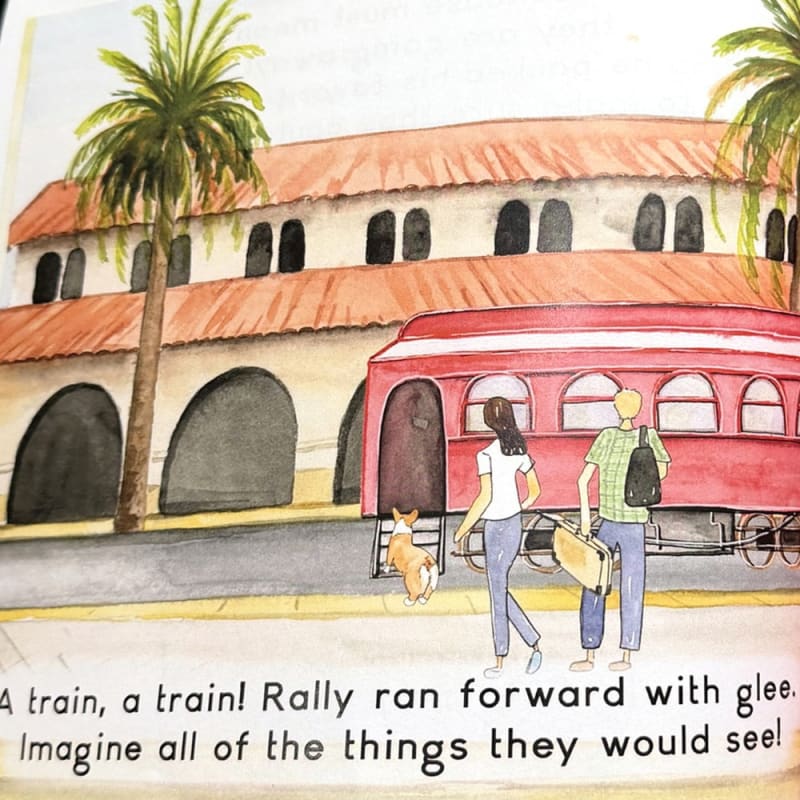


Rally Takes the Train
Eight pages from the book
Turn the page
That's 8 of 25 pages
See who’s waiting at the station
Grandmommy and Papa are at the last stop. Get the full hand-painted book, $13.99 on Amazon.
See the full bookPage 1 of 8

Like it so far? See the full book
25 hand-painted pages, paperback, $13.99 with fast shipping from Amazon.
Every page is real watercolor on paper, painted by hand by Leslie Dunn. Nothing in this book was made with AI.
Saving the streetcars the Twin Cities gave up
At its peak, the Twin City Rapid Transit system covered 523 miles with more than 1,000 streetcars, and the track between Lake Harriet and the lake now called Bde Maka Ska carried horse cars from 1884 and electric cars from 1891. In June 1954 the last streetcars gave way to buses. Car No. 1300, built at TCRT's Snelling Shops in 1908, was donated intact to the Minnesota Railfans Association that same month and spent years in storage before running again on yard tracks in 1963, powered by a generator towed behind on a trailer.
In August 1971 volunteers of the Minnesota Transportation Museum opened the Como-Harriet Streetcar Line on restored track at Lake Harriet, with No. 1300 as its first car. They later built a replica 1900 station at Queen Avenue and 42nd Street. In 1999 a second line opened in Excelsior near Lake Minnetonka, on the old Minneapolis and St. Louis Railway right-of-way, using Duluth Street Railway No. 78.
During the winter of 2004 and 2005, the Minnesota Transportation Museum reorganized and the Minnesota Streetcar Museum was created to own and run both lines. Its mission is to preserve and share the experience of Minnesota's electric street and interurban railways. Volunteers have rebuilt cars that had become cabins and storage sheds, scavenging trucks and wiring from other streetcars or making parts from scratch.
Two lines, two lakes and a working carbarn
On the Como-Harriet Streetcar Line, you start at the Linden Hills Station, browse the historic displays and gift shop, then ride a restored car through wooded parkland between Lake Harriet and Bde Maka Ska. Explore Minnesota describes it as a two-mile, fifteen-minute round trip, and your motorman shares stories about the car and Minnesota streetcar history. Cars run about every 20 minutes, and the line connects with Metro Transit's E Line at the Richfield Road platform.
The Excelsior Streetcar Line covers a half mile of track through historic Excelsior. Every trip stops at the museum's carbarn, where you can see a photo gallery of 1800s hotels, trains, paddlewheel boats and landmarks, pictures of TCRT in its heyday, other streetcars in the collection, and a vintage car being restored. The museum operates six historic streetcars across both lines and owns two more carbodies, a Fargo-Moorhead Birney car and a Mesaba Railway interurban.
Don’t miss
- TCRT No. 1300Built in 1908 for the fast St. Paul to Minneapolis line on University Avenue, it was the first restored car to run on the Como-Harriet line in 1971 and looks as it did in the early 1930s.
- Duluth Street Railway No. 78Built in 1893 and retired in 1911, it is the museum's oldest car and one of the oldest working streetcars in the country, a first-generation electric car that still looks like the horse cars it replaced.
- Duluth Street Railway No. 265Built in the Twin Cities in 1915 and sold to Duluth, it spent decades as a summer cabin in Solon Springs, Wisconsin before volunteers rebuilt it.
- The Excelsior carbarnEvery Excelsior ride stops here, so you can watch restoration work in progress on Winona No. 10.
- The Linden Hills StationA replica 1900 station at Lake Harriet with historic displays and the museum's gift shop, and the place to pay your fare.
A short ride, a big lake and a playground
A streetcar ride is short enough for small kids, and the clanging, open-feeling cars are a novelty for children who have only ridden buses. Special events include stories on a streetcar for the youngest children, a not-so-scary Halloween and rides with Santa. At Lake Harriet, the day can continue with a playground, picnic grounds, boat rentals, walking trails and the Roberts Bird Sanctuary.
Kids 5 to 17 who are hooked can join the Carbarn Club, which offers behind-the-scenes access and is free with a student, individual or family membership. The streetcars themselves are historic and not wheelchair accessible, so plan to lift strollers aboard or leave them on the platform.
Plan your visit: tips for Minnesota Streetcar Museum
- Take Metro Transit's E Line to the Bde Maka Ska Station and board at the Richfield Road platform; pay at Linden Hills.
- Use 4200 Queen Avenue South for GPS to the Linden Hills Station.
- Plan time at Lake Harriet or in the Linden Hills neighborhood after your ride.
- Call ahead if you have accessibility questions.
Both lines host special events through the year, from not-so-scary Halloween rides to magical trips with Santa. Event dates are posted separately for the Como-Harriet and Excelsior lines on the museum's Special Events page. For more seasonal ideas, see our guides to Halloween train rides in Minnesota and Christmas trains in Minnesota.
Volunteer motormen and restorers
The Minnesota Streetcar Museum is a volunteer museum. Volunteers operate the cars, staff the stations and restore the fleet in the Excelsior carbarn. You can become a member, train as an operator, try the Be a Motorman program, book a charter, or include the museum in your will. Reach the museum at info@trolleyride.org.
More Twin Cities rail outings
The Twin City Model Railroad Museum is about 7 miles away in St. Paul, and the Minnesota Transportation Museum, where the streetcar effort began, is about 11 miles off at the Jackson Street Roundhouse. The Gopher State Railway Museum in New Prague is about 28 miles south. See all of our Minnesota train museum pages for more.
- Twin City Model Railroad MuseumSt. Paul, MN · about 7 mi
- Minnesota Transportation MuseumSt. Paul, MN · about 11 mi
- Osceola & St. Croix Valley RailwayMinnesota / Wisconsin, MN · about 11 mi
- Gopher State Railway MuseumNew Prague, MN · about 28 mi
- Ironhorse Central Railroad MuseumChisago City, MN · about 37 mi
- Kandiyohi County Historical Society railroad exhibitsWillmar, MN · about 85 mi
Bring Rally along: a train book for the drive

The Como-Harriet cars roll through a wooded glen between two lakes, shady one moment and bright the next. That always makes me think of the tunnel page in our book, where everything goes dark for Rally, Mom and Dad, and then there is a big bright light and the whole car cheers. My mom loved that moment most. You can read about her and how the story came to be on our story page.
Free for train families
Print the Rally coloring pages before you go
Watercolor coloring pages from the book, free to print. Tuck a few in a folder with crayons for the drive or the wait for the next train.
Get the free coloring pages
A train story for the ride homeRally Takes the Train is a five-minute rhyming picture book about a corgi's first train trip to see his grand-paw-rents. Hand-painted in real watercolor. $13.99 on Amazon, for ages 0 to 8.
Buy on Amazon (opens in a new tab)More for train families
- Train museums in Minnesota: every museum by town, with a map
- Train museums in every state: search by town or near you
- Christmas train rides in Minnesota
- Halloween train rides in Minnesota
- Every Amtrak route with kids
Work or volunteer at Minnesota Streetcar Museum?
We want this page to be the best introduction to your museum on the web. Send new hours, event dates, corrections or photos to kelsey@rallytakesthetrain.com and we will update it. You are welcome to share this page with your members.
Sources
- Minnesota Streetcar Museum official website(opens in a new tab)
- Minnesota Streetcar Museum on Wikipedia(opens in a new tab)
Everything on this page comes from the museum’s own website and social pages and, for history, Wikipedia, checked October 19, 2026.
Minnesota Streetcar Museum: 20 questions riders ask
What is the Minnesota Streetcar Museum?
The Minnesota Streetcar Museum is a volunteer museum that preserves Minnesota's electric streetcar and interurban history by restoring and running historic cars. It operates two heritage lines: the Como-Harriet Streetcar Line in southwest Minneapolis and the Excelsior Streetcar Line near Lake Minnetonka. It became its own organization in 2004 and 2005.
What are the Minnesota Streetcar Museum hours?
Each line runs on its own posted schedule, which the museum updates every year on trolleyride.org. Rides are seasonal, so check the 2026 schedule for the Como-Harriet or Excelsior line before you go. When the Como-Harriet line is running, streetcars come about every 20 minutes.
How much are Minnesota Streetcar Museum tickets?
The museum posts fares for each line on its website rather than selling advance tickets for regular rides. On the Como-Harriet line you pay at the Linden Hills Station; if you board at the Richfield Road platform, you ride first and pay at Linden Hills before the return trip. Check trolleyride.org for current fares.
Where do you buy Como-Harriet Streetcar Line tickets?
Pay for your Como-Harriet ride at the Linden Hills Station at Queen Avenue South and West 42nd Street. Riders who arrive on the Metro Transit E Line can board at the Richfield Road platform without paying and settle up at Linden Hills before heading back. Charters are booked through the museum's website.
Where is the Como-Harriet Streetcar Line?
The line runs between Lake Harriet and Bde Maka Ska in southwest Minneapolis. The Linden Hills Station is at 2330 West 42nd Street, Minneapolis, MN 55410; for GPS, use 4200 Queen Avenue South. A second platform sits on Richfield Road south of West 36th Street.
Is the Como-Harriet Streetcar Line worth riding?
For families and history fans it is a simple, charming outing. Explore Minnesota describes a two-mile, fifteen-minute trip through parkland between the lakes on original streetcar right-of-way, with a motorman telling the story of the car. Afterward, Lake Harriet offers a playground, picnic grounds, trails and boats.
What is the Minnesota Streetcar Museum car barn?
The museum's carbarn is on the Excelsior Streetcar Line, and every Excelsior trip stops there. Riders see a photo gallery of 1800s hotels, trains, paddlewheel boats and landmarks, pictures of the Twin City Rapid Transit system, other streetcars in the collection, and restoration work in progress on Winona No. 10.
Where is the Excelsior Streetcar Line?
The Excelsior line runs along a half mile of track in historic Excelsior, near Highway 7 southwest of Minneapolis. It follows the former Minneapolis and St. Louis Railway right-of-way, now a Hennepin County bicycle trail. Check the Excelsior page on trolleyride.org for the boarding location and schedule.
Which streetcars does the Minnesota Streetcar Museum run?
The museum has six operable streetcars: three from Twin City Rapid Transit, including No. 1300, No. 322 and No. 1239, two from the Duluth Street Railway, No. 78 and No. 265, and Winona No. 10. It also owns a Fargo-Moorhead Birney car and a Mesaba Railway interurban awaiting restoration.
How old are the streetcars at the Minnesota Streetcar Museum?
The oldest is Duluth Street Railway No. 78, built in 1893 by the LaClede Car Company of St. Louis and one of the oldest working streetcars in the country. TCRT No. 1300 dates from 1908, and Duluth No. 265 was built in 1915 before being turned into a summer cabin after 1939.
Is the Minnesota Streetcar Museum good for kids?
Yes. The rides are short, and young children enjoy the motorman's stories and the old-style cars. Special events include stories on a streetcar for the youngest kids, Halloween rides and trips with Santa. Kids 5 to 17 can join the Carbarn Club for behind-the-scenes access, free with a membership.
Are the Minnesota Streetcar Museum streetcars wheelchair accessible?
No. The streetcars are historic vehicles that cannot be made accessible without damaging them, so they are exempt from the ADA. Crews will help riders with disabilities board where they can, and the Linden Hills Station is wheelchair accessible. The museum asks visitors with questions to contact it before visiting.
Where do you park for the Como-Harriet Streetcar Line?
From I-35W, take the West 46th Street exit, head west to East Lake Harriet Parkway, and follow it around the lake to West 42nd Street. There is a pay lot on the left, $1 per vehicle as posted, or you can cross the streetcar tracks to find on-street parking.
Can you get to the Como-Harriet Streetcar Line by bus?
Yes. Take Metro Transit's E Line to the Bde Maka Ska Station, cross Richfield Road and walk a block to the streetcar platform. The E Line runs about every 10 minutes on weekdays and connects with light rail at 5th and Hennepin downtown, about a 20-minute ride away.
Does the Minnesota Streetcar Museum do Halloween or Christmas rides?
Yes. Both lines host special events, including not-so-scary Halloween fun and magical rides with Santa. Each line posts its own 2026 event list on the museum's Special Events page, so check the Como-Harriet or Excelsior listing for dates.
How did the Minnesota Streetcar Museum start?
It grew from the Minnesota Transportation Museum, founded in 1962 to restore TCRT car No. 1300 after Twin Cities streetcars ended in 1954. That group opened the Como-Harriet line in 1971 and the Excelsior line in 1999. In 2004 and 2005 the streetcar operations became the separate Minnesota Streetcar Museum.
Can you rent a streetcar from the Minnesota Streetcar Museum?
The museum offers charters on its streetcars, with information and scheduling handled through the contact page on trolleyride.org. Use the web form to ask about charters, special historic tours or educational programs, or email info@trolleyride.org.
Is there a gift shop at the Minnesota Streetcar Museum?
Yes. The Linden Hills Station on the Como-Harriet line has historic displays and a shop with gifts and souvenirs. It is a good stop before or after your ride, and it is also where you pay your fare.
How can I volunteer with the Minnesota Streetcar Museum?
The museum runs on volunteers and offers an operator training program, a Be a Motorman program and other volunteer roles. You can also become a member or a corporate member, or support it through a planned gift. Use the contact form on trolleyride.org or email info@trolleyride.org.
What train museums are near the Minnesota Streetcar Museum?
The Twin City Model Railroad Museum in St. Paul is about 7 miles away, and the Minnesota Transportation Museum at the Jackson Street Roundhouse is about 11 miles. The Gopher State Railway Museum in New Prague is about 28 miles south, and the Ironhorse Central Railroad Museum in Chisago City about 37 miles north.
Keep exploring
More family train guides from Rally
- DirectoryRailway Museum Directory650 train museums in all 50 states, with hours, tickets and train rides.
- HolidayChristmas Train RidesSanta trains and holiday light rides, sorted by state and town.
- OctoberHalloween Train RidesPumpkin trains and not-too-spooky rides for little ones, by state.
- NovemberThanksgiving Train RidesHoliday weekend train trips the whole family can share.
- AmtrakAmtrak With KidsWhich Amtrak routes work best with babies, toddlers and big kids.
- Plan a tripTrain Trips With KidsEvery Amtrak route, stop by stop, planned for families.