
Golden Spike National Historical Park in Promontory Summit, Utah
Historic rail siteOutdoor areas open daily, sunrise to sunset
Golden Spike National Historical Park protects the high desert ground at Promontory Summit where the Central Pacific and Union Pacific met on May 10, 1869, and where working replicas of the Jupiter and No. 119 still face each other on rebuilt 1869 style track.
- Rails joined here May 10, 1869
- Replica Jupiter and No. 119
- 2,735 acres of historic grade
- Visitor center opened in 1969
- Outdoor areas open sunrise to sunset
- Run by the National Park Service
Golden Spike National Historical Park at a glance
- Hours
- Outdoor areas, roads and picnic areas open daily, sunrise to sunset; check the park site for visitor center hours
- Admission
- Park entrance fees apply; see the Fees and Passes page on nps.gov/gosp
- Seasonal events
- May 10 anniversary of the joining of the rails, Summer locomotive demonstrations, Winter visits
- Plan for
- About 2 to 3 hours, more to drive the slope landmarks
- Best for
- History lovers, rail fans and families with school-age kids
- Best ages
- Ages 4 and up
Hours and prices as the museum posts them, checked October 19, 2026. Confirm before you go.
Look inside the book
Taking the kids to Golden Spike National Historical Park? Bring Rally along.
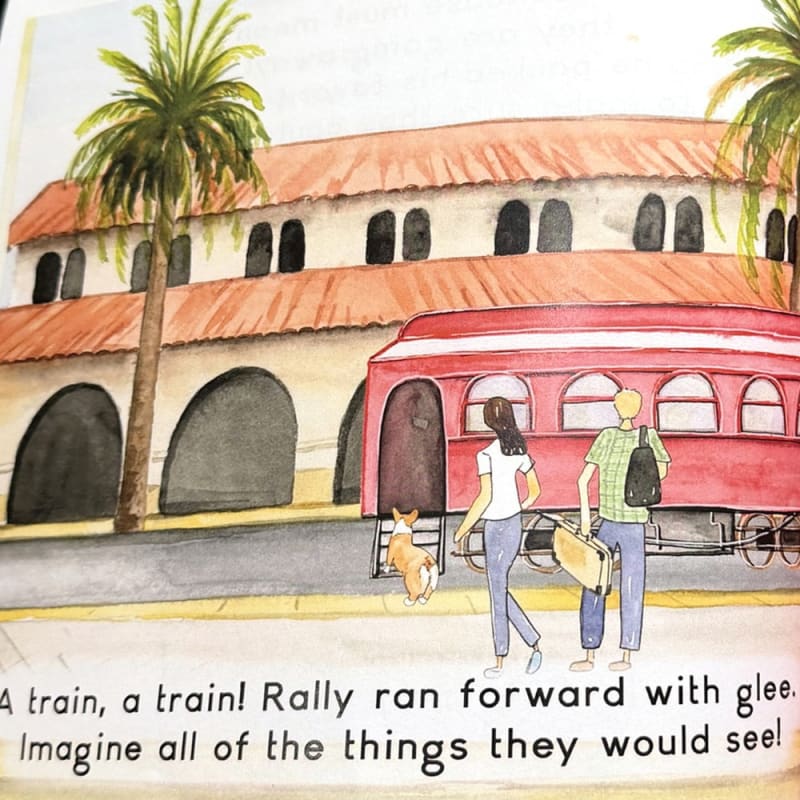
In Rally Takes the Train, a corgi's little legs can't manage the big train stairs, so Dad gives him a boost. It takes about five minutes to read, a good fit for the drive to Promontory Summit.



Rally Takes the Train
Eight pages from the book
Turn the page
That's 8 of 25 pages
See who’s waiting at the station
Grandmommy and Papa are at the last stop. Get the full hand-painted book, $13.99 on Amazon.
See the full bookPage 1 of 8

Like it so far? See the full book
25 hand-painted pages, paperback, $13.99 with fast shipping from Amazon.
Every page is real watercolor on paper, painted by hand by Leslie Dunn. Nothing in this book was made with AI.
From a desert meeting point to a national park
On May 10, 1869, crews of the Central Pacific building east and the Union Pacific building west met at Promontory Summit, north of the Great Salt Lake, and a ceremonial golden spike marked the joining of rails across the continent. The line through Promontory did not stay busy for long. It was bypassed by the Lucin Cutoff and abandoned in 1904, and in 1942 the original rails were pulled up for the war effort.
The memory of the place was kept alive by local people. Bernice Gibbs Anderson began writing about the area's history in 1926 and led the Golden Spike Association of Box Elder County, which staged its first reenactment of the joining of the rails on May 10, 1952, with local volunteers organized by Judge B.C. Call and a script by Marie Thorne Jepson. Her steady letters to state and federal officials helped win authorization of a National Historic Site in 1957, and Congress approved federal ownership in 1965.
For the centennial on May 10, 1969, about 28,000 people gathered at the summit, Anderson among them, and the new visitor center had just been finished. Borrowed Virginia and Truckee engines stood in for the Jupiter and No. 119 for the next decade, until functioning replicas of both locomotives arrived in time for the 110th anniversary in 1979.
The site grew from 7 acres to 2,735 acres, taking in long strips of the old grade on either side of the summit. In 2006 a limestone arch on the grounds was renamed Chinese Arch to honor the Chinese workers who built the Central Pacific, and in March 2019 the site became Golden Spike National Historical Park, just ahead of a 150th anniversary celebration that May.
Two locomotives, one summit and miles of hand-built grade
Most visits begin at the visitor center, where a seven-minute introduction movie sets the scene and the park bookstore sells reading on the railroad and its builders. Outside, about two miles of track have been rebuilt from the summit, where the two lines met, to the train storage building, laid to look like the rails of 1869. In summer the park says you can hear the roar, screech and whistles of its historic locomotive replicas every day.
Beyond the summit, the park follows the old railroad grade east and west. The west slope and east slope areas hold worker campsites, half-finished grades and cuts, and two landmarks: the place where the Central Pacific laid ten miles of track in one day, and the spot where the Big Fill and Big Trestle were completed. A concrete obelisk put up by the Southern Pacific around 1916 now stands near the visitor center, and Chinese Arch rises about 20 feet from the limestone nearby.
Don’t miss
- Jupiter and No. 119 replicasFunctioning replicas of the two locomotives that met nose to nose in 1869 have been at the park since 1979.
- The summit where the rails metThis is the exact meeting point of the Central Pacific and Union Pacific, the center of the whole park.
- Ten miles of track in one dayA landmark on the west slope marks where Central Pacific crews set a tracklaying record that still draws rail fans.
- The Big Fill and Big Trestle siteOn the east slope, this landmark shows how much earth and timber it took to carry the line across rough ground.
- Chinese ArchA 20-foot limestone arch renamed in 2006 to honor the Chinese railroad workers of the 19th century.
- The Southern Pacific obeliskThe first monument at the site, built around 1916 and now standing near the visitor center.
Big engines and wide open space for young rail fans
Kids who love steam engines get to see two of them up close, painted and polished the way they looked in 1869, and in summer the park says the locomotives run every day with plenty of whistle. The short introduction movie is a good way to give younger children the story before heading outside, and the open summit is an easy place to picture two trains meeting.
This is an outdoor, high desert site with long drives between the summit and the slope landmarks, so pack water, snacks and sun protection, and check current conditions and weather on the park website before you leave home.
Plan your visit: tips for Golden Spike National Historical Park
- Start with the seven-minute introduction movie at the visitor center.
- Visit in summer if you want to see the locomotive replicas in action.
- Check the park's reservations and timed entry page before special events.
- Corinne is the nearest town, about 23 miles away, so bring food and water.
- Look at the current conditions and weather page before you set out.
The park's special events are built around its history, and the anniversary of the joining of the rails on May 10 has drawn crowds since the first local reenactment in 1952, including about 28,000 people at the 1969 centennial. Check the park's calendar and reservations pages for current dates. For holiday rides elsewhere in the state, see our guide to Christmas train rides in Utah.
Rangers, volunteers and a community that never forgot
The National Park Service manages the park today, building on decades of work by the Golden Spike Association of Box Elder County and local volunteers who kept the reenactments going. The park lists volunteer opportunities on its website, and buying from the park bookstore or paying the entrance fee helps support the site.
More rail history south along the Wasatch Front
The Utah State Railroad Museum at Ogden Union Station is about 40 miles away and makes a natural second stop. The S&S Shortline Railroad Park and Museum in Farmington is about 55 miles, and the Historic Salt Lake City Union Pacific Depot is about 68 miles. You can browse every train museum in Utah to plan the rest of the trip.
- Ogden Union Station / Utah State Railroad MuseumOgden, UT · about 40 mi
- S&S Shortline Railroad Park & MuseumFarmington, UT · about 55 mi
- Historic Denver & Rio Grande Western DepotSalt Lake City, UT · about 68 mi
- Historic Salt Lake City Union Pacific DepotSalt Lake City, UT · about 68 mi
- Tooele Valley Railroad MuseumTooele, UT · about 76 mi
- Historic Evanston Roundhouse & RailyardsEvanston, WY · about 85 mi
Bring Rally along: a train book for the drive

Promontory Summit is a long drive from the nearest town, and I can already see my kids lining up snacks and water bottles the way Rally lines up his turtle toy, green bone and yellow ball before the trip in our book. Packing is half the fun for little ones. If you want something for the car ride, our coloring pages fold right into a bag.
Free for train families
Print the Rally coloring pages before you go
Watercolor coloring pages from the book, free to print. Tuck a few in a folder with crayons for the drive or the wait for the next train.
Get the free coloring pages
A train story for the ride homeRally Takes the Train is a five-minute rhyming picture book about a corgi's first train trip to see his grand-paw-rents. Hand-painted in real watercolor. $13.99 on Amazon, for ages 0 to 8.
Buy on Amazon (opens in a new tab)More for train families
- Train museums in Utah: every museum by town, with a map
- Train museums in every state: search by town or near you
- Christmas train rides in Utah
- Halloween train rides in Utah
- Every Amtrak route with kids
Work or volunteer at Golden Spike National Historical Park?
We want this page to be the best introduction to your museum on the web. Send new hours, event dates, corrections or photos to kelsey@rallytakesthetrain.com and we will update it. You are welcome to share this page with your members.
Sources
- Golden Spike National Historical Park official website(opens in a new tab)
- Golden Spike National Historical Park on Wikipedia(opens in a new tab)
Everything on this page comes from the museum’s own website and social pages and, for history, Wikipedia, checked October 19, 2026.
Golden Spike National Historical Park: 20 questions visitors ask
Where is Golden Spike National Historical Park?
Golden Spike National Historical Park is at Promontory Summit, north of the Great Salt Lake in Box Elder County, Utah. The listed street address is 6200 North 22300. The park's mailing address is P.O. Box 897, Brigham City, UT 84302, and the nps.gov/gosp site has a Directions page worth checking before you drive out.
Is Golden Spike National Historical Park near Corinne, Utah?
Yes. Corinne is the nearest town, about 23 miles east-southeast of the park. Because Promontory Summit is remote, many visitors plan the trip from Corinne or Brigham City and bring water, snacks and a full tank of gas. The park website has a Directions page and a current conditions page to check before leaving.
How do I get directions to Golden Spike National Historical Park?
Use the Directions page on nps.gov/gosp, which is the most reliable route guide for this remote site. The park sits at Promontory Summit north of the Great Salt Lake, roughly 23 miles from Corinne. If you get turned around, the visitor information line is (435) 471-2209, extension 429.
What are Golden Spike National Historical Park hours?
As of October 2026, the park says all outdoor features, including park roads, historic areas, restrooms, picnic areas and the landscape, are open seven days a week from sunrise to sunset. Visitor center hours and program times vary by season, so check the Hours and Seasons page on nps.gov/gosp or call (435) 471-2209, extension 429.
Do you need tickets or reservations for Golden Spike National Historical Park?
The park charges entrance fees and lists them on its Fees and Passes page, and it also has a page on reservations and timed entry. Requirements can change for special events, so check nps.gov/gosp before you go. For questions, call the visitor center at (435) 471-2209, extension 429, or use the park's email form.
What is at the Golden Spike visitor center?
The visitor center is the starting point for most visits. It shows a seven-minute introduction movie about the park and the transcontinental railroad, and the park runs a bookstore there. The building was finished just before the 1969 centennial, and the Southern Pacific's concrete obelisk from around 1916 now stands nearby.
Is there a gift shop at Golden Spike National Historical Park?
The park lists a bookstore, which is the place to look for books and souvenirs about the golden spike, the Central Pacific and the Union Pacific. Its stock and hours can vary by season, so check the bookstore page on nps.gov/gosp or ask at the visitor center when you arrive.
Can you see the Jupiter and No. 119 locomotives at Golden Spike?
Yes. Functioning replicas of the Central Pacific Jupiter and Union Pacific No. 119 came to the park in 1979, in time for the 110th anniversary of the joining of the rails. In summer the park invites visitors to hear the roar, screech and whistles of these historic locomotives every day.
Can you ride a train at Golden Spike National Historical Park?
The park does not advertise train rides. Its locomotives are replicas that run on about two miles of rebuilt track between the summit and the train storage building, and visitors watch them from the ground. For a ride in northern Utah, look at heritage railroads such as the Heber Valley Railroad.
What happened at Promontory Summit on May 10, 1869?
On May 10, 1869, the Central Pacific Railroad and the Union Pacific Railroad met at Promontory Summit, completing the first transcontinental railroad across the United States. A ceremonial golden spike marked the final joining of the rails. The park was created to remember that moment and the workforce who built the line.
When did Golden Spike become a national historical park?
It was authorized as a National Historic Site in 1957, placed under federal ownership by Congress in 1965, and redesignated Golden Spike National Historical Park in March 2019. The new name reflects that the park covers several landmarks spread across a larger district, not just the single meeting point at the summit.
Is there a map of Golden Spike National Historical Park?
Yes, the National Park Service publishes park information and maps on nps.gov/gosp, and the visitor center can help you plan a route. The park stretches about 15 miles along the old grade, with the summit in the middle and the west slope and east slope landmarks on either side.
What is the weather like at Golden Spike National Historical Park?
Promontory Summit is open, high desert country, so sun, wind and seasonal swings in temperature are part of a visit. The park keeps a Current Conditions and Weather page on its website and recommends checking it before you plan your trip. It also has pages on visiting in summer and in winter.
Can you visit Golden Spike National Historical Park in winter?
Yes. The park has a page on visiting in winter and says it offers unique and beautiful features during that season, and the outdoor areas stay open daily from sunrise to sunset. Programs and locomotive activity are more limited off season, so check the off-season planning page on nps.gov/gosp first.
What events are held at Golden Spike National Historical Park?
The park hosts special events through the year and lists them on its calendar. The anniversary of the joining of the rails on May 10 is the best known: the first local reenactment took place in 1952, about 28,000 people came in 1969, and a 150th anniversary celebration was held in 2019.
Where can I find photos of Golden Spike National Historical Park?
The park's Photos and Multimedia section on nps.gov/gosp has official images of the locomotives, the summit and the landscape. Popular subjects for visitors are the two replica locomotives facing each other on the rebuilt track, Chinese Arch and the old grade cutting across the desert.
Is Golden Spike National Historical Park worth visiting?
For anyone interested in railroads or American history, it is the place where the first transcontinental railroad was finished. The park sees roughly 48,000 to 64,000 visitors a year, and its mix of replica locomotives, rebuilt track, a short film and the old grade gives families plenty to see in a half day.
Who built the first transcontinental railroad at Golden Spike?
The Central Pacific built east from California and the Union Pacific built west, and they met at Promontory Summit. The park tells the story of a multinational workforce, and in 2006 a limestone arch on the grounds was renamed Chinese Arch to honor the 19th century Chinese workers who built the Central Pacific.
How can I volunteer at Golden Spike National Historical Park?
The park lists volunteer opportunities on its website under the Volunteer link. Local volunteers have been part of the site's story since the Golden Spike Association of Box Elder County began reenactments in 1952. Contact the park at (435) 471-2209, extension 429, or through its online email form.
What train museums are near Golden Spike National Historical Park?
The Utah State Railroad Museum at Ogden Union Station is about 40 miles away, the S&S Shortline Railroad Park and Museum in Farmington about 55 miles, and the two historic depots in Salt Lake City about 68 miles. The Historic Evanston Roundhouse and Railyards in Wyoming is about 85 miles away.
Keep exploring
More family train guides from Rally
- DirectoryRailway Museum Directory650 train museums in all 50 states, with hours, tickets and train rides.
- HolidayChristmas Train RidesSanta trains and holiday light rides, sorted by state and town.
- OctoberHalloween Train RidesPumpkin trains and not-too-spooky rides for little ones, by state.
- NovemberThanksgiving Train RidesHoliday weekend train trips the whole family can share.
- AmtrakAmtrak With KidsWhich Amtrak routes work best with babies, toddlers and big kids.
- Plan a tripTrain Trips With KidsEvery Amtrak route, stop by stop, planned for families.