
Historic Denver & Rio Grande Western Depot in Salt Lake City, Utah
Historic rail siteOwnership is passing to the University of Utah; check public access before visiting
The Historic Denver and Rio Grande Western Depot, known to most locals as the Rio Grande Depot, is one of Utah's grandest buildings: a 1910 station on the west edge of downtown Salt Lake City, built to win a railroad rivalry and still standing as a landmark.
- Built 1908 to 1910
- Cost $750,000 to build
- Designed by Henry Schlacks
- Amtrak station 1986 to 1999
- Blocks from the Union Pacific Depot
Historic Denver & Rio Grande Western Depot at a glance
- Hours
- Exterior viewable anytime; interior access depends on the building's current use
- Admission
- No admission posted
- Plan for
- About 30 minutes for the exterior and marker
- Best for
- Architecture and rail history fans
Hours and prices as the museum posts them, checked October 19, 2026. Confirm before you go.
Contact and directions
Look inside the book
Taking the kids to Historic Denver & Rio Grande Western Depot? Bring Rally along.
In Rally Takes the Train, a corgi's little legs can't manage the big train stairs, so Dad gives him a boost. It takes about five minutes to read, a good fit for the drive to Salt Lake City.

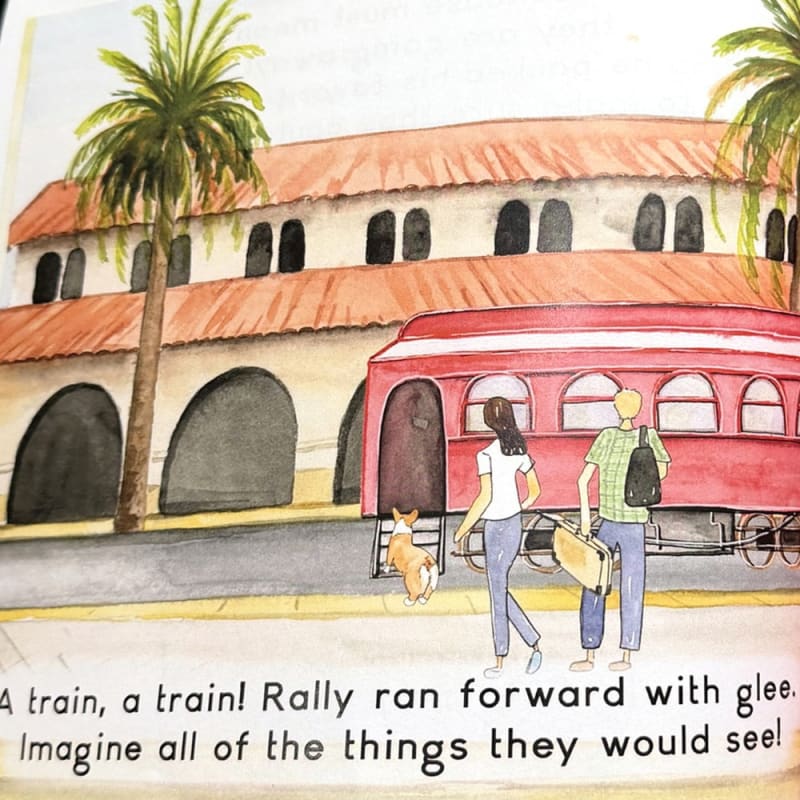


Rally Takes the Train
Eight pages from the book
Turn the page
That's 8 of 25 pages
See who’s waiting at the station
Grandmommy and Papa are at the last stop. Get the full hand-painted book, $13.99 on Amazon.
See the full bookPage 1 of 8

Like it so far? See the full book
25 hand-painted pages, paperback, $13.99 with fast shipping from Amazon.
Every page is real watercolor on paper, painted by hand by Leslie Dunn. Nothing in this book was made with AI.
A station built to win a railroad rivalry
At the turn of the 20th century, Salt Lake City was a battleground for rival railroads. The Denver and Rio Grande Western, backed by George Gould, was locked in a bitter contest with E. H. Harriman's Union Pacific, and each line wanted the finer station. The Rio Grande answered with this depot, designed by architect Henry Schlacks, built between 1908 and 1910 for $750,000, and placed just a few blocks from the Union Pacific Depot. It served both the Denver and Rio Grande and the Western Pacific.
The building has had its ups and downs since, including at least one close call when its future looked doubtful. From 1986 to 1999 it took over as Salt Lake City's Amtrak station, replacing the Union Pacific Depot. In later years it housed state history offices, the Utah History Research Center, the Rio Gallery and the Rio Grande Cafe. In April 2026 the University of Utah was set to purchase the depot at 300 South Rio Grande Street through a state appropriations bill, a move that drew public concern from the advocacy group Friends of the Rio Grande. What the building will hold next is still unclear, so check before planning a visit inside.
Seeing the Rio Grande Depot today
The depot stands at 300 South Rio Grande Street on the western edge of downtown, and its exterior and setting can be seen from the street at any time. A historical marker on the site tells the story of the station. Access to the interior, including the gallery and research center spaces it has held, depends on the building's current use, so confirm before you go.
Don’t miss
- The depot's facadeBuilt to outshine the rival Union Pacific station, the exterior is the clearest way to see what $750,000 bought a railroad in 1910.
- The historical markerA marker on site notes that the station was built from 1908 to 1910 for the Denver and Rio Grande and the Western Pacific.
- The walk to the Union Pacific DepotThe rival station is only a few blocks away, so you can see both sides of the Gould and Harriman contest in one short walk.
A big building with a big story
This is a historic building rather than a hands-on museum, so it works best as a short stop for older kids who like stories about rival railroads and big old stations. Pair it with the Union Pacific Depot a few blocks away so they can compare the two.
Plan your visit: tips for Historic Denver & Rio Grande Western Depot
- Walk a few blocks to the Historic Union Pacific Depot to see the rival station.
- Read the historical marker on site for the building's dates and railroads.
- The building's ownership is changing, so do not count on interior access without checking first.
Who looks after the depot
The depot has long been home to state history programs, and its ownership is now passing to the University of Utah. Friends of the Rio Grande, a local advocacy group, has spoken up for the building's future, and people who care about the station can follow that group's work.
Rail history around Salt Lake City
The Historic Salt Lake City Union Pacific Depot, the Rio Grande's old rival, is just a few blocks away. The S&S Shortline Railroad Park and Museum is about 16 miles north, and the Heber Valley Railroad, which runs on old Rio Grande Western track, is about 30 miles away. See our list of Utah train museums for more.
- Historic Salt Lake City Union Pacific DepotSalt Lake City, UT · same town
- S&S Shortline Railroad Park & MuseumFarmington, UT · about 16 mi
- Tooele Valley Railroad MuseumTooele, UT · about 26 mi
- Heber Valley RailroadHeber City, UT · about 30 mi
- Ogden Union Station / Utah State Railroad MuseumOgden, UT · about 32 mi
- Historic Evanston Roundhouse & RailyardsEvanston, WY · about 60 mi
Bring Rally along: a train book for the drive

For thirteen years, Amtrak passengers boarded here, and I like to think some child pressed a nose to the glass as the train pulled away, the way Rally does in our book when he spots the ocean and a white bird outside his arched window. Our train is the Pacific Surfliner, but that first look out the window feels the same anywhere.
Free for train families
Print the Rally coloring pages before you go
Watercolor coloring pages from the book, free to print. Tuck a few in a folder with crayons for the drive or the wait for the next train.
Get the free coloring pages
A train story for the ride homeRally Takes the Train is a five-minute rhyming picture book about a corgi's first train trip to see his grand-paw-rents. Hand-painted in real watercolor. $13.99 on Amazon, for ages 0 to 8.
Buy on Amazon (opens in a new tab)More for train families
- Train museums in Utah: every museum by town, with a map
- Train museums in every state: search by town or near you
- Christmas train rides in Utah
- Halloween train rides in Utah
- Every Amtrak route with kids
Work or volunteer at Historic Denver & Rio Grande Western Depot?
We want this page to be the best introduction to your museum on the web. Send new hours, event dates, corrections or photos to kelsey@rallytakesthetrain.com and we will update it. You are welcome to share this page with your members.
Rio Grande Depot in Salt Lake City: 20 questions
Where is the Historic Rio Grande Depot in Salt Lake City?
The Historic Denver and Rio Grande Western Depot is at 300 South Rio Grande Street on the western edge of downtown Salt Lake City, Utah. It is only a few blocks from the Historic Union Pacific Depot, its old rival, so the two are easy to see on one walk.
When was the Rio Grande Depot built?
The depot was built between 1908 and 1910 and is usually dated to 1910. It was constructed to serve the Denver and Rio Grande Railroad and the Western Pacific Railroad, and a historical marker on the site records those dates.
Who designed the Rio Grande Depot?
The depot was designed by architect Henry Schlacks. It cost $750,000 to build, a large sum at the time, because the Denver and Rio Grande Western wanted a station that would outshine the nearby Union Pacific Depot.
Why were two big train stations built in Salt Lake City?
Around 1900 Salt Lake City was a battleground for rival railroads. The Denver and Rio Grande Western, linked to George Gould, and the Union Pacific, led by E. H. Harriman, were in a bitter contest, and the Rio Grande built its depot to surpass the Union Pacific station a few blocks away.
Was the Rio Grande Depot an Amtrak station?
Yes. From 1986 to 1999 the Rio Grande Depot served as Salt Lake City's Amtrak station, replacing the Union Pacific Depot in that role. After 1999 passenger trains moved elsewhere, and the building took on other public uses.
What is inside the Rio Grande Depot now?
In recent years the depot has housed state history offices, the Utah History Research Center, the Rio Gallery and the Rio Grande Cafe. Its ownership is now passing to the University of Utah, so what is open inside may change. Check current access before planning a visit.
Is the University of Utah buying the Rio Grande Depot?
Yes. In April 2026 the University of Utah was set to purchase the depot through a last-minute addition to HB 2, a state appropriations bill. The university's plans for the building were not yet clear, and the advocacy group Friends of the Rio Grande raised public concerns about the purchase.
Can you go inside the Rio Grande Depot?
Historically, the public could visit spaces such as the Rio Gallery, the Utah History Research Center and the cafe. With ownership changing to the University of Utah, interior access is not posted, so check before you go. The building's exterior and historical marker can be seen from the street.
Is the Rio Grande Depot a museum?
Not in the usual sense. It is a historic former train station rather than a railroad museum with locomotives. It has housed the state's history offices and research center and an art gallery, and its architecture and story are the main draw for rail fans.
How much does it cost to visit the Rio Grande Depot?
There is no posted admission for the Rio Grande Depot. Seeing the building and its historical marker from outside is free. Any events or exhibits inside would be set by whoever is using the building, so check current listings before you go.
What are the Rio Grande Depot hours?
No current public hours are posted for the Rio Grande Depot while its ownership changes. The exterior can be viewed anytime from the street. Check Visit Salt Lake listings or University of Utah announcements for any interior hours before planning a visit.
Is the Rio Grande Depot good for kids?
It is best as a short stop for older children who enjoy architecture and history. There are no posted hands-on exhibits or trains to climb. Families with young kids may enjoy combining it with a ride at the Heber Valley Railroad or a visit to the Ogden museum.
What railroads used the Rio Grande Depot?
The depot was built for the Denver and Rio Grande Western Railroad and also served the Western Pacific Railroad. Much later, from 1986 to 1999, Amtrak used it as Salt Lake City's passenger station, taking over from the Union Pacific Depot a few blocks away.
Is the Rio Grande Depot on the historical marker database?
Yes. A Denver and Rio Grande Railroad Station historical marker in Salt Lake City notes that the station was built between 1908 and 1910 to serve the Denver and Rio Grande and the Western Pacific. It is worth reading when you visit.
Was the Rio Grande Depot ever at risk?
Yes. Local history writers describe the building as having had its ups and downs, including a close call in which it nearly did not survive. It went on to serve as the Amtrak station and as home to state history programs, and its future now rests with new ownership.
Who is Friends of the Rio Grande?
Friends of the Rio Grande is an advocacy group that has voiced public concern about the depot's sale to the University of Utah in 2026. People who care about the building's preservation and public use can look for the group's updates.
Is there parking at the Rio Grande Depot?
No parking information is posted for the depot. It is on the western edge of downtown Salt Lake City, so expect city street parking or nearby lots. Check current conditions before visiting, especially with the building's change in ownership.
How far is the Rio Grande Depot from the Union Pacific Depot?
The two stations are only a few blocks apart on the west side of downtown Salt Lake City. That closeness was the point: the Rio Grande built its grand depot to compete directly with the Union Pacific station during their rivalry.
How long should I spend at the Rio Grande Depot?
Plan about 30 minutes to view the exterior, read the marker and take photos. If interior spaces are open on your visit, allow more time. Many visitors pair it with the Historic Union Pacific Depot a few blocks away for an hour of rail history.
What train museums are near the Rio Grande Depot?
The Historic Union Pacific Depot is a few blocks away. The S&S Shortline Railroad Park and Museum is about 16 miles, the Tooele Valley Railroad Museum about 26 miles, the Heber Valley Railroad about 30 miles, and Ogden Union Station about 32 miles.
Keep exploring
More family train guides from Rally
- DirectoryRailway Museum Directory650 train museums in all 50 states, with hours, tickets and train rides.
- HolidayChristmas Train RidesSanta trains and holiday light rides, sorted by state and town.
- OctoberHalloween Train RidesPumpkin trains and not-too-spooky rides for little ones, by state.
- NovemberThanksgiving Train RidesHoliday weekend train trips the whole family can share.
- AmtrakAmtrak With KidsWhich Amtrak routes work best with babies, toddlers and big kids.
- Plan a tripTrain Trips With KidsEvery Amtrak route, stop by stop, planned for families.