
Fillmore Historical Museum, California
Depot museumOpen Wednesday to Saturday
The Fillmore Historical Museum is a volunteer-run historical park built around the 1887 Southern Pacific depot, the building that marks the arrival of the railroad that created the town of Fillmore.
- 1887 Southern Pacific depot
- Founded in 1970
- 1919 Rancho Sespe Bunkhouse
- 1905 Hinckley House
- Volunteer run, no paid staff
- Open Wednesday to Saturday
Fillmore Historical Museum at a glance
- Hours
- Wednesday to Friday 9 am to noon and 1 pm to 4 pm; Saturday 10 am to 3 pm
- Admission
- Not posted online; call (805) 524-0948
- Plan for
- About 1 to 2 hours
- Best for
- Local history fans and school-age kids
- Best ages
- Ages 6 and up
Hours and prices as the museum posts them, checked October 19, 2026. Confirm before you go.
Contact and directions
- Address340 Main Street, Fillmore, CA 93015(opens in a new tab)
- Phone(805) 524-0948
- Emailfillmore.museum@gmail.com
- Websitefillmorehistoricalmuseum.org(opens in a new tab)
Follow Fillmore Historical Museum
Look inside the book
Taking the kids to Fillmore Historical Museum? Bring Rally along.
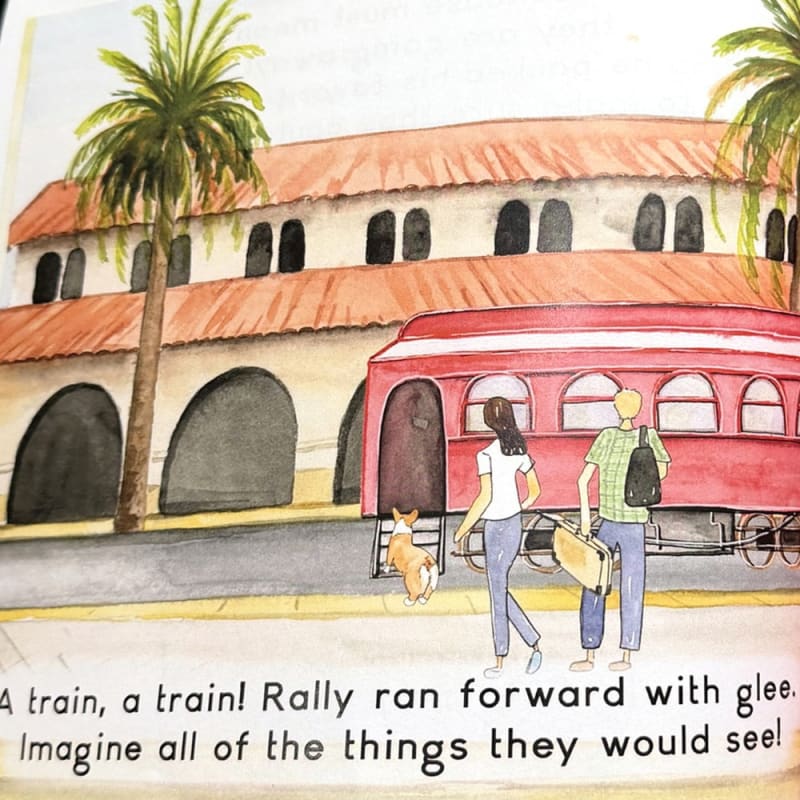
In Rally Takes the Train, a corgi's little legs can't manage the big train stairs, so Dad gives him a boost. It takes about five minutes to read, a good fit for the drive to Fillmore.



Rally Takes the Train
Eight pages from the book
Turn the page
That's 8 of 25 pages
See who’s waiting at the station
Grandmommy and Papa are at the last stop. Get the full hand-painted book, $13.99 on Amazon.
See the full bookPage 1 of 8

Like it so far? See the full book
25 hand-painted pages, paperback, $13.99 with fast shipping from Amazon.
Every page is real watercolor on paper, painted by hand by Leslie Dunn. Nothing in this book was made with AI.
The depot that came before the town
Before the Southern Pacific arrived in 1887, there was no Fillmore, only a few farms and cattle and sheep operations along the Santa Clara River. The railroad changed that quickly. New settlers came from Midwestern states such as Kansas, Iowa, Nebraska and Missouri, along with many immigrants from Germany. At first the Southern Pacific left just a boxcar to serve as depot and office, but by the end of 1887 a real station stood beside the tracks.
That depot arrived on a flatbed rail car as a set of flat panels, a standard kit that could be assembled in several sizes. Fillmore received the smallest version; nearby Santa Paula got a larger one with an apartment for the agent. At first it was simply a freight room and a small office. By 1911 the railroad had added a waiting room, ticket window, restrooms and a telephone, and a ticket to Los Angeles cost $1.70.
The museum itself began in 1970 with Edith Moore Jarrett, a Fillmore native who studied at USC, came home to teach Spanish and co-wrote the two-volume Spanish textbook El Camino Real. Under her leadership the museum acquired and restored the depot and gathered other buildings around it. One of them, a 1919 bunkhouse from Rancho Sespe, was donated by the James P. Finch family and moved in the middle of the night along Highway 126.
Today the museum is a 501(c)(3) nonprofit overseen by an 11-member board. It has no paid staff. Its president and executive director handles daily operations, and docents and volunteers keep the doors open four days a week, build the photo and memorabilia displays, and lead tours for schoolchildren and guests.
A depot, a ranch bunkhouse and a Craftsman home
The grounds work as a small historical park. The 1887 Southern Pacific depot is the centerpiece, telling the story of how the railroad brought Fillmore to life. Nearby, the 1905 Hinckley House, a Craftsman-style home, shows how a local family lived in the early 1900s, and an early post office from the Bardsdale, Piru and Sespe communities adds another stop.
The 1919 Rancho Sespe Bunkhouse #2 once housed single ranch workers in 28 small rooms, each about 7 by 13 feet. Today those rooms hold the museum office and gift shop and a run of themed displays: vintage clothing, Native American artifacts, a School Room with dolls and toys, a Pioneer Family exhibit, vintage cameras, Music in the Valley, local disasters, the history of the Fillmore Insectary, and a room on movies and TV shows filmed in the area. A garage holds a 1930 Model A pickup that local high school students restored.
Don’t miss
- 1887 Southern Pacific depotThe smallest size of the railroad's prefabricated depot kit, and the building that marks the start of Fillmore.
- 1911 ticket pricesA ticket to Los Angeles in 1911 cost $1.70 and one to San Francisco $12.45, a fun detail to read aloud to kids.
- Rancho Sespe Bunkhouse #2A 28-room 1919 dormitory for ranch workers, moved overnight along Highway 126 and now full of exhibits.
- The movies and TV roomA list of films and shows made around Fillmore, a reminder of how often Hollywood came to this valley.
- 1930 Model A pickupRestored by local high school students and kept in the museum's garage.
A schoolroom, toys and a real depot to explore
This is a history museum more than a hands-on train attraction, so it suits school-age kids who like stories and old things. The School Room with its dolls and toys, the vintage cameras and the Native American artifacts give children plenty to look at, and the depot's 1911 ticket prices make a good conversation starter about how travel has changed.
Volunteers lead tours for local schoolchildren, and school and other groups can book tours by appointment.
Plan your visit: tips for Fillmore Historical Museum
- The museum closes from noon to 1 pm on weekdays, so plan around the lunch break.
- It is closed Sunday, Monday and Tuesday.
- Book school and group tours in advance by appointment.
- The gift shop is inside the Rancho Sespe Bunkhouse.
Docents and volunteers, four days a week
The museum has no paid staff. An 11-member board oversees it, its president and executive director runs the day-to-day work, and docents and volunteers open the buildings, build the exhibits and guide visitors. The museum also hosts history talks by Zoom. A stop at the gift shop, a donation or an offer to volunteer all help this 501(c)(3) keep going.
More rail stops beyond the Santa Clara River Valley
The Fillmore & Western Railway page covers the town's other rail story, about a mile away. About 40 miles southeast in Los Angeles, Travel Town Museum and the Los Angeles Live Steamers Railroad Museum make a good day trip for train-loving kids. For more ideas, browse California's train museums.
- Fillmore & Western Railway historic collectionFillmore, CA · about 1 mi
- Los Angeles Live Steamers Railroad MuseumLos Angeles, CA · about 40 mi
- Walt Disney's Carolwood BarnLos Angeles, CA · about 40 mi
- Travel Town MuseumLos Angeles, CA · about 40 mi
- Griffith Park & Southern RailroadLos Angeles, CA · about 40 mi
- Lomita Railroad MuseumLomita, CA · about 54 mi
Bring Rally along: a train book for the drive

In 1911 a ticket from Fillmore to Los Angeles cost $1.70, and I like imagining the families on that little platform with their bags at their feet. Rally packs carefully too: his turtle toy, his green bone and his yellow ball, the things that make anywhere feel like home. My mom gave him that suitcase in her version of the story. You can read how it all started on our story page.
Free for train families
Print the Rally coloring pages before you go
Watercolor coloring pages from the book, free to print. Tuck a few in a folder with crayons for the drive or the wait for the next train.
Get the free coloring pages
A train story for the ride homeRally Takes the Train is a five-minute rhyming picture book about a corgi's first train trip to see his grand-paw-rents. Hand-painted in real watercolor. $13.99 on Amazon, for ages 0 to 8.
Buy on Amazon (opens in a new tab)More for train families
- Train museums in California: every museum by town, with a map
- Train museums in every state: search by town or near you
- Christmas train rides in California
- Halloween train rides in California
- Every Amtrak route with kids
Work or volunteer at Fillmore Historical Museum?
We want this page to be the best introduction to your museum on the web. Send new hours, event dates, corrections or photos to kelsey@rallytakesthetrain.com and we will update it. You are welcome to share this page with your members.
Sources
- Fillmore Historical Museum official website(opens in a new tab)
- Fillmore Historical Museum on Facebook(opens in a new tab)
- Fillmore Historical Museum on Instagram(opens in a new tab)
Everything on this page comes from the museum’s own website and social pages and, for history, Wikipedia, checked October 19, 2026.
Fillmore Historical Museum: 20 visitor questions
What is the Fillmore Historical Museum?
The Fillmore Historical Museum is a nonprofit museum and historical park in Fillmore, California, that preserves the history of Fillmore and the nearby Bardsdale, Sespe and Piru communities. It has restored three local buildings: the 1887 Fillmore depot, the 1905 Hinckley House and the 1919 Rancho Sespe Bunkhouse, which hold photos, memorabilia and themed exhibits.
What are the Fillmore Historical Museum hours?
As of October 2026, the museum is open Wednesday through Friday from 9 am to noon and 1 pm to 4 pm, and on Saturday from 10 am to 3 pm. It is closed Sunday, Monday and Tuesday. Note the one-hour lunch break on weekdays when planning your arrival.
Where is the Fillmore Historical Museum?
The museum is at 340 Main Street in Fillmore, California, in Ventura County's Santa Clara River Valley. Its mailing address is P.O. Box 314, Fillmore, CA 93016. Some listings give 350 Main Street, so if your map app disagrees, look for the depot and historic buildings along Main Street.
How much does the Fillmore Historical Museum cost?
The museum does not post an admission price on its website. Call (805) 524-0948 or email fillmore.museum@gmail.com to ask about entry fees or suggested donations before you go. The museum is a volunteer-run 501(c)(3), so donations and gift shop purchases help support it.
Is the Fillmore Historical Museum the same as the Fillmore Historical Society?
The Fillmore Historical Museum is the nonprofit that preserves and shares Fillmore's history, and it is what most people mean when they search for the local historical society. For railroad history specifically, the museum's website also points visitors to the Santa Clara River Valley Railroad Historical Society, a separate group.
Is this the Fillmore County Historical Museum?
No. The Fillmore Historical Museum is in the city of Fillmore in Ventura County, California. It is not connected to any museum in a county named Fillmore. If you are looking for the California museum with the 1887 Southern Pacific depot, you are in the right place.
Where can I see photos and reviews of the Fillmore Historical Museum?
The museum's website has a photo gallery of its buildings, including historic images of the depot in 1910 and 1943. It also shares updates on Facebook and Instagram, and Yelp carries visitor reviews and photos. The Ventura County museums site and Visit Ventura also describe the historical park.
What is the history of the Fillmore depot?
The Southern Pacific reached the area in 1887, before Fillmore existed. The railroad first left a boxcar as a depot, then shipped a prefabricated station on a flatbed car later that year. Fillmore got the smallest model. By 1911 it had a waiting room, ticket window, restrooms and a telephone.
Who founded the Fillmore Historical Museum?
Edith Moore Jarrett founded the museum in 1970. A Fillmore native, she studied at USC, returned home to teach Spanish, and co-wrote the two-volume Spanish textbook El Camino Real with Beryl J. M. McManus. Under her leadership the museum acquired and restored the town's Southern Pacific depot.
What is in the Rancho Sespe Bunkhouse?
The 1919 bunkhouse once housed single ranch workers in 28 small rooms. Today it holds the museum office and gift shop, vintage clothing, Native American artifacts, a School Room with dolls and toys, a Pioneer Family exhibit, vintage cameras, Music in the Valley, local disaster history, the Fillmore Insectary story and a room on movies filmed nearby.
How did the bunkhouse get to the Fillmore Historical Museum?
The James P. Finch family, who bought the Rancho Sespe headquarters parcel, donated Bunkhouse #2 to the museum. It was moved in the middle of the night along Highway 126 from the ranch, about four miles west of Fillmore. Rancho Sespe had been owned by the Hull and Spalding family from 1895 to 1961.
Is the Fillmore Historical Museum good for kids?
It works best for school-age kids who enjoy history and stories. The School Room with dolls and toys, the vintage cameras and the depot's old ticket prices give children plenty to talk about. Toddlers may move through quickly, since this is a museum of rooms and displays rather than climbable trains.
Can schools and groups tour the Fillmore Historical Museum?
Yes. Volunteers give tours of the historic buildings to local schoolchildren, residents and guests, and the museum is available for school and other group tours by appointment. Call (805) 524-0948 or email fillmore.museum@gmail.com to arrange a date.
How long should I spend at the Fillmore Historical Museum?
Plan on about one to two hours to see the depot, the Hinckley House and the many rooms of the Rancho Sespe Bunkhouse. A guided tour with a docent can add depth. Weekday visitors should allow for the noon to 1 pm closure in the middle of the day.
Are there trains to see at the Fillmore Historical Museum?
The museum focuses on the 1887 Southern Pacific depot and the story of how the railroad created Fillmore, rather than a collection of locomotives. The museum does not list any rolling stock on display. Rail fans will find the depot's history, photos and details such as its 1911 ticket prices most rewarding.
Does the Fillmore Historical Museum have a gift shop?
Yes. The gift shop is inside the 1919 Rancho Sespe Bunkhouse, alongside the museum office. Purchases support the museum, which has no paid staff and relies on volunteers. Shop hours follow the museum's posted hours, Wednesday through Saturday.
Does the Fillmore Historical Museum host events?
Yes. The museum hosts local history talks by Zoom, with recent topics including the first grammar schools of the Piru area. Its special events page lists upcoming talks and links to videos of past ones. Check the website or Facebook page for the current lineup.
Who runs the Fillmore Historical Museum?
The museum is a 501(c)(3) nonprofit overseen by an 11-person board of directors. Its president and executive director handles daily operations, and there is no paid staff. Docents and volunteers keep the museum open to the public four days a week and develop its displays.
How can I volunteer at the Fillmore Historical Museum?
The museum depends entirely on docents and volunteers, who staff the buildings, lead tours and build exhibits. To offer your time, call (805) 524-0948, email fillmore.museum@gmail.com, or use the contact form on its website. Donations to the nonprofit are another way to help.
What train museums are near the Fillmore Historical Museum?
The Fillmore & Western Railway collection is about a mile away. About 40 miles away in Los Angeles are Travel Town Museum, the Griffith Park & Southern Railroad, the Los Angeles Live Steamers and Walt Disney's Carolwood Barn. The Lomita and Goleta railroad museums are each about 54 miles away.
Keep exploring
More family train guides from Rally
- DirectoryRailway Museum Directory650 train museums in all 50 states, with hours, tickets and train rides.
- HolidayChristmas Train RidesSanta trains and holiday light rides, sorted by state and town.
- OctoberHalloween Train RidesPumpkin trains and not-too-spooky rides for little ones, by state.
- NovemberThanksgiving Train RidesHoliday weekend train trips the whole family can share.
- AmtrakAmtrak With KidsWhich Amtrak routes work best with babies, toddlers and big kids.
- Plan a tripTrain Trips With KidsEvery Amtrak route, stop by stop, planned for families.