
The most useful thing you can say during a picture book might be nothing: ask one question, then count to five. Good questions to ask toddlers when reading are short and match their age: “Where's the dog?” at 18 months, “What's he doing?” at 2, “Why is he scared?” at 3, and “What happens next?” at 4 and up. Below are 40 questions by age, the five question types teachers use, and a word-for-word script.
The short version
- Match the age: “Where's the dog?” at 18 months, “What's he doing?” at 2, “Why?” at 3, “What happens next?” at 4 to 5.
- Read a new book straight through first. Add questions on the second and third reads.
- Ask about one question every page or two, then wait a full five seconds.
- Build on every answer: they say “Dog!”, you say “Dog! A fluffy dog on a train.”
- No answer? Answer it yourself cheerfully, or offer a choice: “Is he happy or sad?”
Why ask questions while reading to a toddler?
When you read straight through, your toddler listens. When you stop and ask, your toddler talks. That switch is the whole point.
The approach has a name: dialogic reading. The adult asks, listens and builds on the child's answer, and over many reads the child becomes the storyteller.
You don't need training. You need a book, a few questions in your back pocket, and the patience to wait.
How many questions should you ask per book?
- First read, just read. Let a new story carry them. Save questions for the second and third time through.
- One question every page or two. More than that starts to feel like a quiz.
- Fewer at bedtime. Daytime reading is for chatting. At night, ask one or two soft questions and let the book wind down.
- Follow their energy. If they're talking a lot, slow down. If they want the story, give them the story.
Questions to ask toddlers by age: 40 ideas
18 months to 2 years: point and name
- Where's the dog?
- What's that?
- Can you find the ball?
- What does a train say?
- Who's that? Is that a baby?
- Where are his ears? Where are your ears?
- Can you turn the page?
- Where's the bird going?
2 to 3 years: what, where and finish the line
- What's he doing?
- What color is the train?
- Where is everybody going?
- What's in the suitcase?
- What's he eating?
- Is he happy or sad?
- (Pause before the last rhyming word and let them finish it.)
- Who do you see waiting?
- How many balls can you count?
- What would you pack?
3 to 4 years: why, how and feelings
- Why do you think he's scared?
- How do you think he feels now?
- What do you think will happen next?
- Why did Dad need to help him?
- How do you know he's excited?
- What would you do if you were him?
- What happened at the beginning?
- What was your favorite part? Why?
- What helps you when you feel scared?
- Who would you want waiting for you?
4 to 5 years: predict, connect and retell
- Can you tell me the story, using the pictures?
- What would happen if he missed the train?
- Is this like something that happened to you?
- What do you think the conductor does all day?
- How is his trip like our trip to Grandma's?
- What would you change about the story?
- What happens after the last page?
- If you wrote the next page, what would it say?
- What's a word that rhymes with “train”?
- Why do you think the author wrote this book?
- Which picture would you hang on your wall?
- What would the bird say if it could talk?
What are the 5 types of reading questions?
Dialogic reading programs often teach five prompt types, remembered as CROWD. You don't need the acronym. It just helps to rotate past “what's that?”
| Type | What it sounds like | Best age |
|---|---|---|
| Completion | “Twinkle, twinkle, little...” (pause) | 2 and up |
| Recall | “What did he pack in his suitcase?” | 3 and up |
| Open-ended | “Tell me about this picture.” | 3 and up |
| Wh- questions | “Where’s the bird? Who is that?” | 18 months and up |
| Distancing | “Have you ever been in a tunnel?” | 3 and up |
Rhyming books are made for completion questions, because the rhyme hands a toddler the clue. More on why rhyming books help toddlers learn to talk and read.
How do you respond to a toddler's answers?
The question is half of it. What you do with the answer is where the learning happens. Use this four-step loop, often called PEER:
- Prompt. Ask one question, then count to five in your head.
- Evaluate. Respond warmly. A point or a single word is a real answer: “Yes!”
- Expand. Repeat it with one more word. They say “Dog!” You say “Dog! A fluffy dog on a train.”
- Repeat. Invite them to say the longer version, then turn the page.
There are no wrong answers at story time. If they call the corgi a cat, try: “It does look a bit like a cat! It's a dog called a corgi. See his short legs?”

A book with a question on every pageRally Takes the Train has a suitcase to unpack, a conductor to wave at, a dark tunnel and a bright light. Rhyming, five minutes, made for the second, third and thirtieth read.
Buy on AmazonWhat does it sound like? A word-for-word script
Here's one page of a train book for toddlers we know well, Rally Takes the Train, read with a 3-year-old. It's the page where the train goes into a dark tunnel.
Script: the tunnel page
- You: “Uh oh. Where is Rally now?” (Count to five.)
- Child: “Dark.”
- You: “Yes, it's dark! He's in a tunnel. How do you think Rally feels?”
- Child: “Scared.”
- You: “Scared. Rally feels scared in the dark tunnel. Can you say that?”
- Child: “Rally scared in the tunnel.”
- You: “What helps you when you feel scared?”
- Child: “My blanket.”
- You: “Your blanket helps. Turn the page and see what Rally finds.” (Read: “And although Rally was scared with nothing in sight, he quickly saw a big and bright light.”)
Questions for every page of one book
Use the same idea with any book on your shelf. Here's a question for each page of Rally's ride:
- Early morning: “What did Rally pack? What would you pack?”
- The station: “The stairs are big. How will Rally get up?”
- The aisle: “What are the kids saying?” (Let them shout “Oh, look a corgi!”)
- The window: “What do you think the bird is saying?”
- The pretzel: “What snack would you bring on a train?”
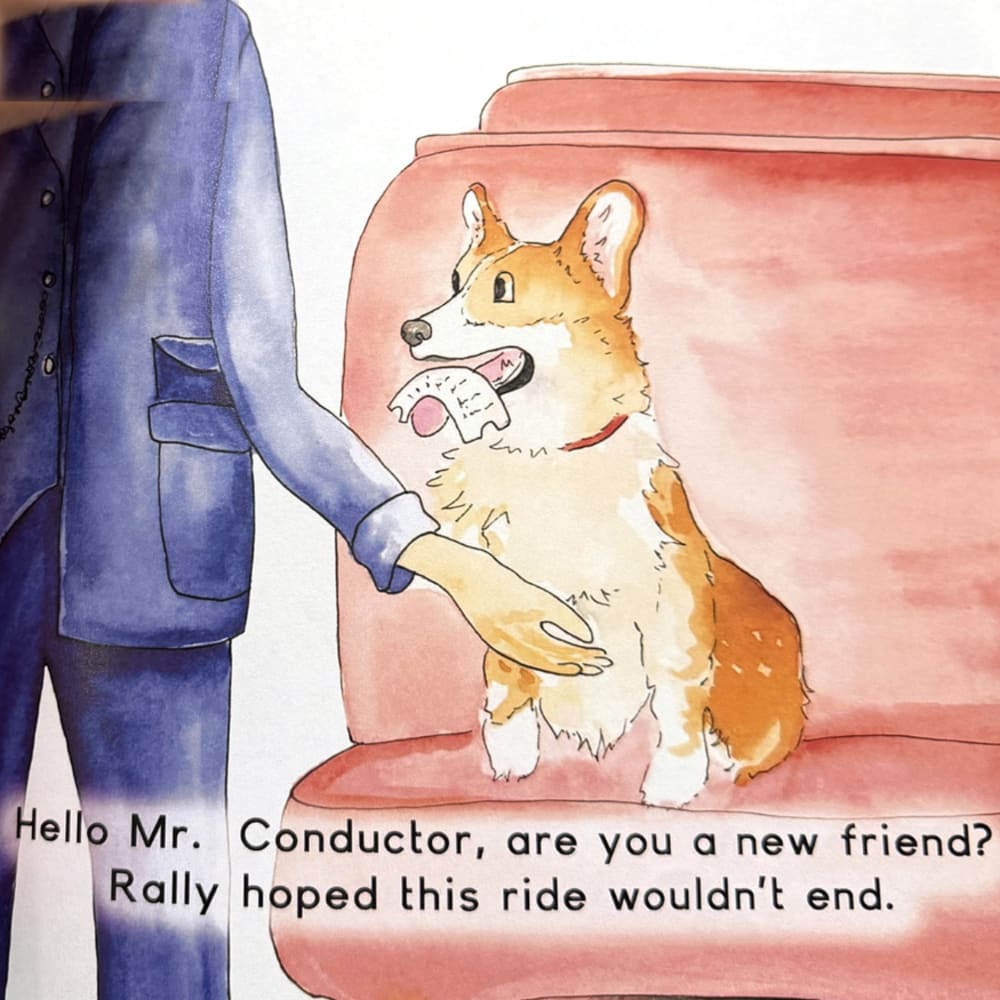
- Mr. Conductor: “What does a conductor do?” For a full lesson, see our train conductor community helpers activities.
- The arrival: “Who's waiting for Rally? Who would be waiting for you?”
What if my toddler won't answer questions?
- Answer it yourself, cheerfully. “Where's the bird? There it is!” You're modeling, and next time they may beat you to it.
- Ask easier. Swap a why question for a point-and-name one.
- Offer a choice. “Is he happy or sad?” is easier than “How does he feel?”
- Ask fewer. Some toddlers need to hear a book many times before they talk about it.
- Make it physical. “Can you make the train sound?” or “Show me a scared face.”
If sitting still is the bigger problem, try our guide to getting a toddler to sit for a story. Got a baby too? Reading to a baby runs on the same idea, with more pointing.
For teachers
These questions work at circle time too. Our picture book activities for preschool lesson plan builds on them. US teachers can request a free classroom copy of Rally Takes the Train, and the free activity pack has a “write the next page” sheet.
Tonight, try the tunnel pageAsk “How does Rally feel?” in the dark, then turn to the bright light together. A real corgi, a coastal train and grandparents waiting at the end. Hand-painted, rhyming, $13.99.
Get it on AmazonQuestions parents ask
What is dialogic reading?
Dialogic reading is a way of reading aloud where the adult asks questions, listens, and builds on the child's answers, so the child gradually does more of the talking. It turns story time into a conversation instead of a performance. It works well with toddlers and preschoolers, especially on the second or third read of a familiar book.
Should I ask questions the first time we read a book?
Usually it is better to read a new book straight through the first time, so your child can enjoy the story and the rhythm. Add questions on the second and third reads, when they already know what happens and can think about the pictures, the feelings and what comes next. Familiar books invite the most talk.
At what age can a toddler answer questions about a story?
Many toddlers answer by pointing well before they can say the words, often from around 18 months, when you ask “Where's the dog?” One-word answers to simple what and where questions usually come next, and why and how questions tend to work better from about age 3. Every child moves at their own pace, so follow yours.
Is it bad to ask too many questions while reading?
It can be: if every page becomes a quiz, the story loses its pull and some children stop wanting to read. About one question every page or two is plenty for most toddlers. Watch your child: if they lean in and talk, keep going, and if they push the book away, read straight through for a while.
What are good questions to ask after reading a book?
Try “What was your favorite part?”, “What happened at the beginning?”, “How did he feel at the end?” and “What do you think happens next?” For older preschoolers, ask them to retell the story using the pictures. Keep it to two or three questions so the book ends on a happy note.
How do I ask questions at bedtime without winding my toddler up?
Keep bedtime questions soft and few, one or two per book, and choose calm ones like “Who's sleeping?” or “Where's the moon?” Save the silly, active questions, such as making animal sounds, for daytime reading. Lower your voice as the book goes on so the questions help your toddler settle.
What are wh- questions for toddlers?
Wh- questions are the who, what, where, when and why questions, like “Where's the bird?” or “Who is that?” Most toddlers answer what and where first, often by pointing, and who comes soon after. Why and when are harder and tend to work better closer to age 3 or later. Start with the easy ones on most pages and save a single why for the end.
Can asking questions during reading help a late talker?
Shared reading is a gentle way to give a late talker more chances to try words. Keep questions easy, offer choices like “Is it a dog or a cat?”, wait a full five seconds, and repeat their attempt back with one word added. Reading is a support, not a fix, so if you are worried about your child's speech, talk with their pediatrician about an evaluation.
What questions should you ask before reading a book to a toddler?
Start with the cover. Ask “What do you see?”, “Who do you think this story is about?” or “Where do you think he's going?” For a train book, try “Have you ever been on a train?” One or two questions is enough before the first page; the point is to warm up curiosity, not to quiz. Then read the title out loud together and begin.
What is a picture walk, and can you do one with a toddler?
A picture walk means paging through a book and talking about the pictures before reading the words. It works well with toddlers from about age 2, especially with a new book. Point, name things and let them guess what is happening, then go back and read the story. Afterward, let them color a favorite scene from our free coloring pages and tell you about it.