
Picture Book Activities for Preschool: 1 Book, 5 Days, 6 Centers
Preschoolers often get more from the third reading of a book than the first. By then they are saying the lines before you do. So these picture book activities for preschool use one book for a whole week: a picture walk, a read-aloud with a job for every child, and six centers. They cover literacy, math, fine motor, dramatic play, feelings and art.
The short version
- Read one book five times in five days. Day one is for fun, day three is for feelings, and Friday is the retell.
- Before reading: one question (“Where do you think this dog is going?”) and four words: suitcase, station, conductor, tunnel.
- During reading: every child gets a job, like shouting “Oh, look a corgi!”, and you stop at only two points.
- Centers use what you have: a paper suitcase, cotton-ball “corgi glitter” for counting, a cereal-box tunnel and a chair train.
- US teachers can request a free classroom copy of Rally Takes the Train, and the activity pack is free to print.
What does a 5-day picture book lesson plan look like?
Here is the whole week on one page. Print it, tape it by your reading chair, and you are done planning.
| Day | The read | Talk about | Center |
|---|---|---|---|
| Monday | First read, just for fun | Picture walk, one prediction, four new words | Pack Rally’s suitcase |
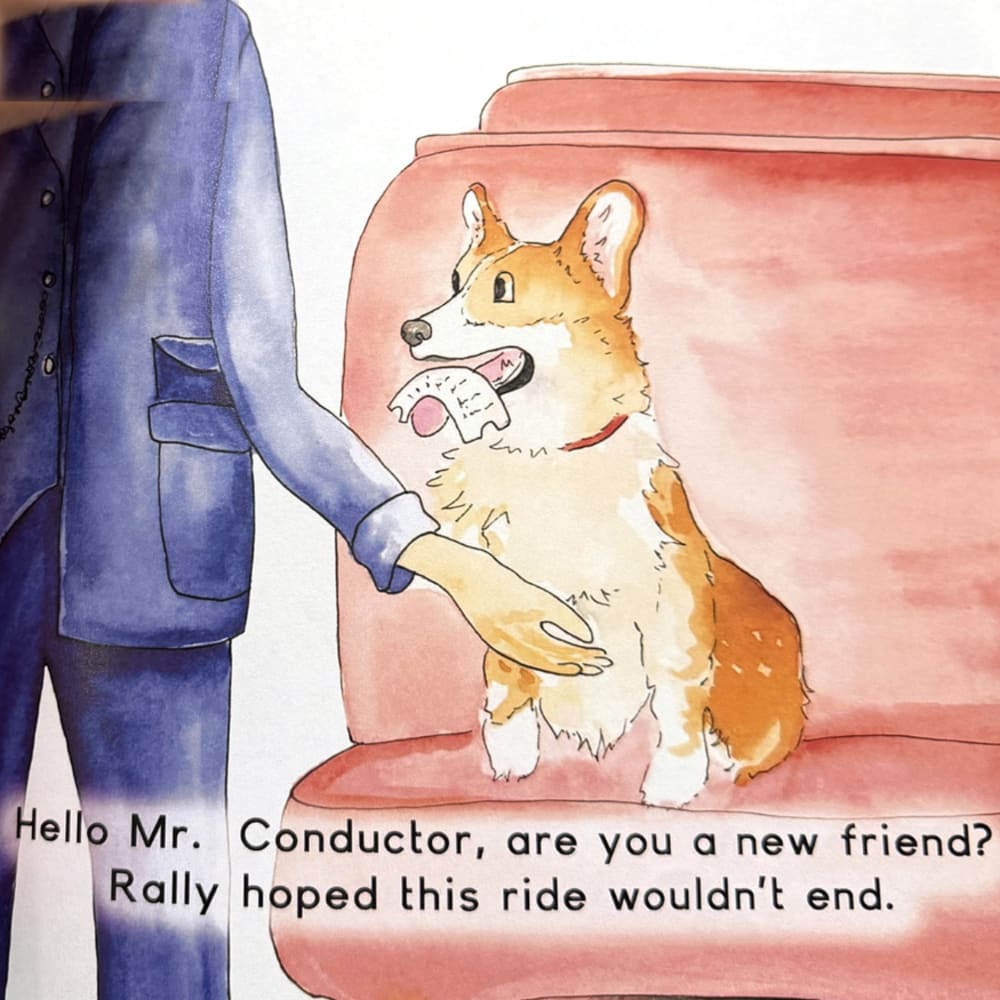
| Tuesday | Second read, for noticing | Spot Mr. Conductor’s blue uniform and the white bird | Count the corgi glitter |
| Wednesday | Third read, the tunnel | Dim the lights; how does Rally feel? | Make a tunnel, plus the feelings circle |
| Thursday | Act it out | Children say the lines before you do | The chair train with a conductor |
| Friday | Retell | Order the story: wake, pack, steps, tunnel, grandparents | The view from my window |
For US teachers
You can request a free classroom copy of Rally Takes the Train for your room. The coloring pages and activity pack are free to print for every child.
Gather this on Sunday night
- One copy of the book, plus printed coloring pages
- A real bag or backpack, a toy turtle, something green and a ball
- Paper, crayons, glue sticks and a few cereal boxes or paper plates
- Cotton balls or pom-poms and one large die
- Chairs for the train, paper tickets, and a blue shirt or paper hat for the conductor
Why read the same picture book all week?
The first read is for enjoying. The second is for noticing. By the third, children are saying lines before you do, and that is when retelling and new words click.
A good book for this has a clear sequence, a small problem, a feeling to talk about and pictures worth a second look. Our example has all four. A corgi wakes early, packs, needs a boost up the train steps, meets a conductor, gets scared in a tunnel, and finds his grandparents waiting.
It reads aloud in about five minutes, and the rhyme helps children join in. Mr. Conductor also makes it an easy bridge into a community helpers unit.
Before reading: how to do a picture walk
Hold up the cover and let children look before you say anything. Then ask one open question: “Where do you think this dog is going?”
Take a few answers. Flip through the first pages without reading, and let them spot the suitcase, the palm trees and the big red train.
Four words to teach first
- Suitcase: a bag you pack for a trip. Bring in a real one if you can.
- Station: where people wait for the train.
- Conductor: the person who helps run the train and takes care of passengers.
- Tunnel: a long hole through a hill that a train can ride through.
Pack a real bag in front of them: a toy turtle, something green, a ball. Ask, “What would you pack?” You have them before page one.
During reading: give every child a job
Preschoolers listen best with a part to play. Before you start, say: “Every time we see Rally, we say ‘Oh, look a corgi!’ just like the kids on the train.” Give one table the train whistle.
Two stopping points
- The train steps. Rally's legs are short and the stairs are big. Ask, “How could Rally get up?” Then turn the page and see Dad give him a boost.
- The tunnel. Dim the lights and lower your voice. Ask, “How does Rally feel right now?” Read the line about the big bright light and flip the lights back on.

Keep the rest moving. Two stops is plenty for a first read.
After reading: one quick question
Close the book and ask, “What was your favorite part?” Take three or four answers, then move on. Save “Who helped Rally?” for Thursday, when the chair train makes the answer obvious.

Plan Monday around one bookRally Takes the Train has a clear sequence, a conductor, a brave moment and a happy ending, in about five minutes. Hand-painted watercolor, ages 0 to 8.
Buy on Amazon6 picture book center activities for preschool
Each center uses supplies most rooms already have. Run one or two a day.
Literacy: Pack Rally’s suitcase
Fold a paper suitcase and hand out picture cards. Children pack what Rally packs: the turtle, the green bone and the yellow ball. Older children sort by first sound (b for bone and ball, t for turtle and train), with a silly bathtub card for giggles.
Math: Count the corgi glitter
Tape a long paper aisle on the table and set out cotton balls for Rally's “furry corgi glitter.” Children roll a die and add that many tufts. Count to five with younger ones, and ask older ones how many more make ten.
Fine motor: Make a tunnel
Cut an arch from a cereal box or fold a paper plate in half. Children color the inside dark, glue a yellow circle at one end for the light, and drive a toy through it saying, “Goodbye tunnel! You caused us no trouble.”
Dramatic play: The chair train
Line chairs up two by two and make paper tickets. One child plays Mr. Conductor in a blue shirt or paper hat and checks everyone's ticket. A sturdy step becomes the train stairs, where friends practice giving a boost like Dad does.
Feelings circle: Brave like Rally
Show the tunnel page and ask how Rally feels and what helps him. Children draw one thing that feels a little scary and one thing that helps, like a hug or a night light. Keep it light and optional; the goal is naming feelings.
Art: The view from my window
Rally watches the ocean and says hello to a white bird. Give each child a paper window frame to draw what they would see from a train. Then talk about near and far, and what a train would pass in your town.
What to observe: a quick checklist
If you document learning, watch for these during centers and Friday's retell:
- Retells the story with a beginning, middle and end.
- Uses a new word (suitcase, station, conductor, tunnel) unprompted.
- Names a feeling for Rally and says what helped.
- Counts objects one-to-one during the glitter game.
- Takes turns and offers help on the chair train.
How to adapt it for twos, pre-K, or any picture book
For twos and young threes
Skip the stopping questions on the first read and enjoy the rhythm. Keep centers to one sensory activity, like the corgi glitter. Our tips on getting a toddler to sit for a story work for a wiggly circle, too.
For pre-K
Add sequencing cards (wake up, pack, steps, tunnel, grandparents) and have children put them in order. Ask them to draw and dictate their own train trip. Pair it with our train books for a preschool transportation unit for a second week.
For any picture book
Find the book's object, its problem, its feeling and its ending. Here those are the suitcase, the steps, the tunnel and the arrival. Build one center from each, and the plan works with almost any story on your shelf.
Corgi-loving classes can add our kids' guide to corgis as a nonfiction pairing. For a dress-up day, our no-sew corgi costume scales to a whole room. More is on our classroom page.
A read-aloud for transportation and community helpers weekA rhyming train story with Mr. Conductor, a tunnel and grandparents at the end. Sturdy enough for five reads in five days.
See it on AmazonQuestions teachers ask
What makes a picture book good for a preschool read-aloud?
Look for a clear sequence children can retell, a small problem to solve, a feeling worth naming and pictures with details to find on the second read. Rhyme or a repeated line helps children join in. A book that takes about five to ten minutes to read leaves time for talk without losing the group.
How long should a preschool read-aloud be?
For many preschool groups, a story that takes about five to ten minutes to read, plus a little talk, fits well at circle time. Younger groups often do better with shorter books and fewer interruptions. If children are getting restless, finish quickly and save the discussion for the second reading later in the week.
What vocabulary words can you teach with a train book?
Good starter words include suitcase, station, ticket, conductor, passenger, track, tunnel and whistle. Teach three or four at a time with a picture or real object, then point them out during the read-aloud. Children remember words they can see, touch and act out, so add them to the dramatic play area too.
How do picture book activities connect to preschool learning goals?
Most early learning frameworks include listening and comprehension, vocabulary, early math, fine motor skills and social-emotional growth. A week of activities built around one book touches all of them: retelling, new words, counting, cutting and gluing, and talking about feelings. Check your own state or program standards for the exact wording you need to document.
Can teachers get a free copy of Rally Takes the Train?
Yes. Teachers in the United States can request a free classroom copy of Rally Takes the Train through the free book for teachers page on rallytakesthetrain.com. The coloring pages and activity pack are also free to download and print, so every child in the class can have their own copy.
Is Rally Takes the Train good for a transportation or community helpers unit?
Yes. It is a rhyming picture book about a corgi's first train ride, with a station, train steps, a conductor and a tunnel, and it reads aloud in about five minutes. Mr. Conductor in his blue uniform fits a community helpers unit, and Rally's trip to see his grandparents fits a family unit too.
How do you teach preschoolers to retell a story?
Start with three parts: beginning, middle and end. After a few readings, hold up two or three picture cards from the story and ask, “What happened first? What happened next? How did it end?” Props help a lot: a bag, a toy, a paper ticket. Let children act it out before asking them to say it, and accept short answers. Retelling grows with every reread.
How do you teach feelings with a picture book in preschool?
Pause at one moment where a character's feelings change and ask, “How does he feel right now? How can you tell?” Point to the face and body in the picture. Then ask what helped. Keep it to one or two feelings per read, use simple words like scared, happy and proud, and let children share their own examples only if they want to.
What is a picture book companion activity?
It is a hands-on activity built from a specific book, so children revisit the story through play. A good companion pulls from something concrete in the book: an object to sort, a scene to build, a character to act out, or a feeling to talk about. Simple supplies like paper, cotton balls and a cereal box are usually enough. See our classroom page for more on using Rally Takes the Train.
How can preschool teachers connect a picture book to families at home?
Send home a short note naming the book, two of the new words, and one question to ask, like “What did Rally pack?” A printed page from our free coloring pages and activity pack gives children something to show and talk about at dinner. Families can also ask their library for the same book so children can retell it at home.