
El Paso Streetcar, Texas
Trolley and streetcar museumTrain ridesRestored PCC streetcars returned in 2018; check current service before you go
The El Paso Streetcar brings the city's own restored PCC streetcars back to work on a 4.8-mile route through Downtown and the University of Texas at El Paso, continuing a streetcar story that began with mule-drawn cars in 1881.
- Restored PCC streetcar fleet
- Streetcars first ran in 1881
- Service returned November 9, 2018
- 4.8-mile route in two loops
- Once crossed the border to Juárez
El Paso Streetcar at a glance
- Hours
- Check current service before you go
- Admission
- Check the current fare before riding
- Train rides
- Restored PCC streetcars on a 4.8-mile two-loop route between Chihuahuita and Kern Place
- Best for
- Families, transit history fans and visitors exploring Downtown and UTEP
- Best ages
- All ages
Hours and prices as the museum posts them, checked October 19, 2026. Confirm before you go.
Look inside the book
Taking the kids to El Paso Streetcar? Bring Rally along.
In Rally Takes the Train, a corgi's little legs can't manage the big train stairs, so Dad gives him a boost. It takes about five minutes to read, a good fit for the drive to El Paso.

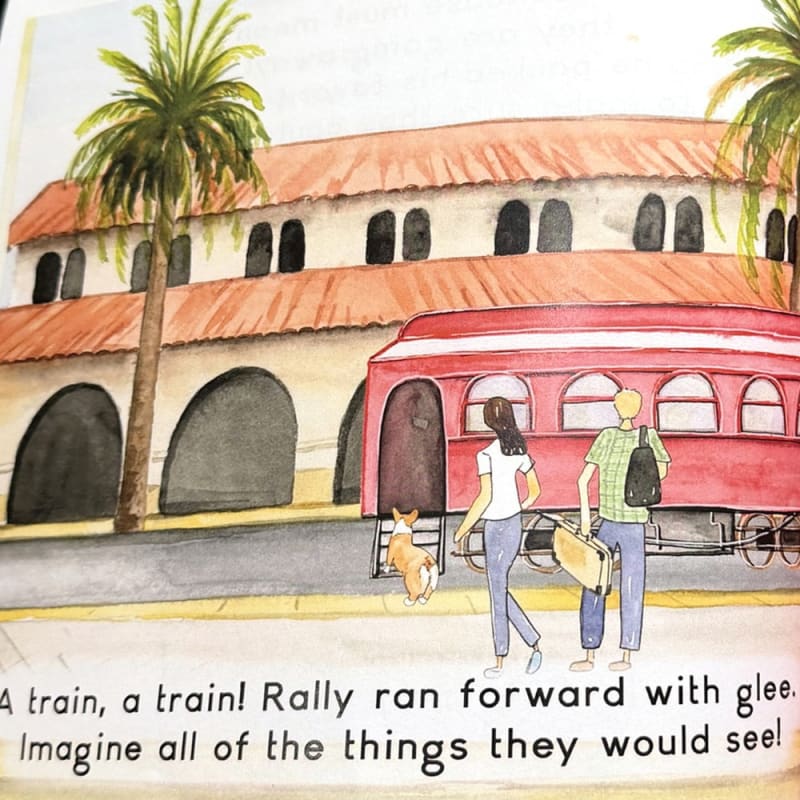


Rally Takes the Train
Eight pages from the book
Turn the page
That's 8 of 25 pages
See who’s waiting at the station
Grandmommy and Papa are at the last stop. Get the full hand-painted book, $13.99 on Amazon.
See the full bookPage 1 of 8

Like it so far? See the full book
25 hand-painted pages, paperback, $13.99 with fast shipping from Amazon.
Every page is real watercolor on paper, painted by hand by Leslie Dunn. Nothing in this book was made with AI.
From Mandy the mule to the PCC cars' return
El Paso's streetcars started in 1881 with mule-drawn cars, and the best-remembered mule, Mandy, was known more for stubbornness than for keeping to schedule. Four mule car companies once worked the Paso del Norte region, and they built and maintained their own international bridges, charging tolls. In 1902 electric cars replaced the mules, and the first electric streetcar left for Juárez on January 11 of that year, carrying about four times as many riders as a mule car.
The system grew fast. The Ysleta Interurban opened in 1913, and by 1920 lines reached Downtown, Sunset Heights, Kern Place, Segundo Barrio, Fort Bliss, Juárez and more. That year was the peak: 103 cars on 64 miles of track carried 19 million passengers. Texas Highways describes it as the only international streetcar system in the world.
Buses then took over route after route. In 1943 El Paso City Lines ended every streetcar route except the El Paso to Juárez line and bought PCC cars built in 1937 from the City of San Diego. Streetcar service finally stopped in 1974, but the PCC cars were not forgotten. After decades of attempts to restart service, the Camino Real Regional Mobility Authority was tasked in 2015 with bringing streetcars back, and on November 9, 2018 the restored PCC fleet that had served the old system returned to El Paso's streets.
Two loops through Downtown and Kern Place
Today's streetcar covers a 4.8-mile round trip in two loops running from Chihuahuita to Kern Place. Along the way it links an international bridge, the baseball park, government buildings, historic neighborhoods, hospitals, shops and restaurants, and the University of Texas at El Paso.
The cars themselves are the collection. The fleet is made up of restored PCC streetcars, the art deco design created after the Electric Railway Presidents' Conference Committee formed in 1929 to build a quieter, more modern streetcar. Riding one is the simplest way to see a piece of El Paso's transit history still doing the job it was built for.
Don’t miss
- The restored PCC streetcarsThese art deco cars served El Paso's earlier system before 1974 and were restored for the 2018 return.
- The Downtown loopPasses an international bridge, the ballpark and government buildings, a reminder that El Paso's streetcars once crossed into Juárez.
- The uptown loop to Kern PlaceServes the University of Texas at El Paso and Kern Place, one of the neighborhoods the old lines reached by 1920.
- ChihuahuitaThe route's southern end, in one of El Paso's historic neighborhoods near the border.
Riding a streetcar with a story
For children, a ride in a rounded art deco PCC car is the main event, and the two loops let you choose a shorter trip around Downtown or a longer one up to UTEP and Kern Place. Before you go, tell them about Mandy, the famously stubborn streetcar mule of the 1880s, then compare that to the electric car they are riding.
The route stops near the ballpark and restaurants, so a ride is easy to fit around lunch or a game. Fares, schedules and accessibility details can change, so check current service information before you head out.
Plan your visit: tips for El Paso Streetcar
- Confirm the current streetcar schedule and fares before you plan a ride.
- Pick the loop that fits your day: Downtown for the ballpark and border area, uptown for UTEP and Kern Place.
- Read the Camino Real Regional Mobility Authority's streetcar history page with kids before you ride.
The agency that brought the streetcars back
The Camino Real Regional Mobility Authority was tasked in 2015 with overseeing the return of streetcars to El Paso, after decades of attempts to restart service, and it shares the system's history on its website. Riding the streetcar and spreading the word about its long story are the simplest ways visitors can support it.
More Texas rail history
No other rail museums with pages on this site are close to El Paso, so the streetcar is the main rail stop in the area. For the rest of the state, browse every train museum in Texas, or see the full list of train museums by state.
Bring Rally along: a train book for the drive

I was surprised to learn that some of El Paso's PCC streetcars were bought from San Diego, because that is where the train in our book starts. Rally rides the Pacific Surfliner and looks out an arched window at the ocean, greeting a white bird. In El Paso the view would be mountains and a border city instead, but the window would still be the best seat. You can color Rally's window scene on our coloring pages.
Free for train families
Print the Rally coloring pages before you go
Watercolor coloring pages from the book, free to print. Tuck a few in a folder with crayons for the drive or the wait for the next train.
Get the free coloring pages
A train story for the ride homeRally Takes the Train is a five-minute rhyming picture book about a corgi's first train trip to see his grand-paw-rents. Hand-painted in real watercolor. $13.99 on Amazon, for ages 0 to 8.
Buy on Amazon (opens in a new tab)More for train families
- Train museums in Texas: every museum by town, with a map
- Train museums in every state: search by town or near you
- Christmas train rides in Texas
- Halloween train rides in Texas
- Every Amtrak route with kids
Work or volunteer at El Paso Streetcar?
We want this page to be the best introduction to your museum on the web. Send new hours, event dates, corrections or photos to kelsey@rallytakesthetrain.com and we will update it. You are welcome to share this page with your members.
Sources
Everything on this page comes from the museum’s own website and social pages and, for history, Wikipedia, checked October 19, 2026.
El Paso Streetcar: 20 questions about the PCC cars and route
What is the El Paso Streetcar?
The El Paso Streetcar is a streetcar system in El Paso, Texas, that uses a fleet of restored PCC streetcars which served the city's earlier system until it closed in 1974. It opened for service on November 9, 2018, and runs a 4.8-mile route through Downtown and the University of Texas at El Paso area.
Where does the El Paso Streetcar run?
The streetcar covers a 4.8-mile round trip in two loops from Chihuahuita to Kern Place, serving Downtown El Paso and the University of Texas at El Paso. The loops connect an international bridge, a baseball park, government buildings, historic neighborhoods, hospitals, businesses and restaurants.
When did the El Paso Streetcar reopen?
The El Paso Streetcar opened for service on November 9, 2018. The Camino Real Regional Mobility Authority had been tasked in 2015 with overseeing the return of streetcars, after decades of attempts to restart service that had ended in 1974.
What are the El Paso Streetcar hours?
Streetcar service times can change, so check the Camino Real Regional Mobility Authority or Visit El Paso for the latest schedule before you plan a ride. Confirming the day's service ahead of time helps you avoid waiting at a stop with a train-loving child.
How much does the El Paso Streetcar cost?
Check with the Camino Real Regional Mobility Authority or El Paso's transit information before your trip for current fares and payment options, since fares can change. Visit El Paso's streetcar page is another good place to look before you ride.
What kind of streetcars does El Paso use?
El Paso uses restored PCC streetcars. The PCC design came from the Electric Railway Presidents' Conference Committee, formed in 1929 by transit leaders who wanted a more modern, quieter streetcar. The result was the art deco PCC car, and El Paso's fleet is made up of cars that served its earlier system.
Were El Paso's PCC streetcars from San Diego?
In 1943, after taking over El Paso's streetcars, El Paso City Lines purchased a number of PCC cars built in 1937 from the City of San Diego. They ran on the El Paso to Juárez line, the only streetcar route the company kept after ending all the others.
When did streetcars first run in El Paso?
El Paso's first streetcars began service in 1881, pulled by mules. Four mule car companies operated in the Paso del Norte region, and they even built and maintained their own international bridges, charging tolls for foot and private vehicle traffic.
Who was Mandy the El Paso streetcar mule?
Mandy is the most widely recognized of El Paso's streetcar mules from the 1880s. The Camino Real Regional Mobility Authority notes she was known more for her stubborn streak than her timeliness, which makes her a fun part of the story to share with kids before a ride.
Did El Paso streetcars go to Juárez?
Yes. From the start, streetcars helped people cross the border into Juárez, and the first electric streetcar left for Juárez on January 11, 1902. Texas Highways describes El Paso's as the only international streetcar system in the world, and the El Paso to Juárez line was the last route to survive.
When did electric streetcars start in El Paso?
The El Paso Electric Railway Company formed in 1901 and began laying track. In 1902 electric streetcars replaced the mule cars, and they could carry roughly four times as many passengers. Operators needed special licenses and training to run the new electric cars.
How big was El Paso's streetcar system at its peak?
Streetcar use peaked in 1920, when 103 cars ran on 64 miles of track and carried 19 million passengers. Lines reached Downtown, Sunset Heights, Kern Place, Segundo Barrio, Highland Park, Fort Bliss, Ysleta, Juárez and several other neighborhoods.
Why did El Paso's original streetcars stop running?
Buses gradually replaced most lines: the Ysleta line ended in 1925, and by 1940 only three lines remained. In 1943 El Paso City Lines ended every route except the El Paso to Juárez line, and streetcar service was finally discontinued in 1974.
What was the Ysleta Interurban?
The Ysleta Interurban opened in 1913, connecting El Paso to Ysleta by electric rail. It ran until 1925, when it ended because more people were riding buses. The El Paso Electric Railway Company also changed its name to El Paso Electric Company that year.
Who runs the El Paso Streetcar?
The Camino Real Regional Mobility Authority was tasked in 2015 with overseeing the return of streetcars to El Paso's streets, and it publishes the streetcar's history online. Check its streetcar page and El Paso transit information for current operations and rider details.
Is the El Paso Streetcar good for kids?
Yes. Riding in a restored art deco streetcar is a treat for young train fans, and the two loops let you choose a shorter or longer ride. The route passes the ballpark and restaurants, so it fits easily into a family day Downtown or near UTEP.
Is the El Paso Streetcar wheelchair accessible?
Ask about accessibility before you ride. If you or someone in your group uses a wheelchair or needs step-free boarding, contact El Paso's transit providers or the Camino Real Regional Mobility Authority before your trip to ask about boarding.
Does the El Paso Streetcar stop near UTEP?
Yes. One of the streetcar's two loops serves the University of Texas at El Paso and continues to Kern Place, a neighborhood that was already on the streetcar map by 1920. It is a convenient way to travel between campus and Downtown.
Did women operate El Paso streetcars during World War II?
Yes. During World War II, gas rationing pushed up bus ridership, and women drivers handled a number of El Paso's bus and streetcar routes. Abandoned streetcars were also sent to wartime scrap drives in those years.
Are there other train museums near El Paso?
No other train museums with pages on this site are close to El Paso, which makes the streetcar the main rail history stop in the area. For more ideas across the state, browse this site's Texas train museum page, which lists every rail museum and heritage line we cover.
Keep exploring
More family train guides from Rally
- DirectoryRailway Museum Directory650 train museums in all 50 states, with hours, tickets and train rides.
- HolidayChristmas Train RidesSanta trains and holiday light rides, sorted by state and town.
- OctoberHalloween Train RidesPumpkin trains and not-too-spooky rides for little ones, by state.
- NovemberThanksgiving Train RidesHoliday weekend train trips the whole family can share.
- AmtrakAmtrak With KidsWhich Amtrak routes work best with babies, toddlers and big kids.
- Plan a tripTrain Trips With KidsEvery Amtrak route, stop by stop, planned for families.