
Charleston & Savannah Railway historical exhibits, South Carolina
Rail preservation groupNo exhibit hall; the railroad's story lives in archives, maps and roadside markers
The Charleston and Savannah Railroad ran about 120 miles between Charleston and Savannah, tying together two of the most important ports in the antebellum Southeast, and its history is preserved in archives, maps and historical markers along the route.
- About 120 miles, port to port
- Built to 5-foot gauge
- Operations began in 1861
- Defended near Coosawhatchie in 1862
Charleston & Savannah Railway historical exhibits at a glance
- Hours
- No public exhibit hall; archives and markers are viewable on their own schedules
- Admission
- No admission; online records and roadside markers are free to view
- Best for
- Civil War and early railroad history readers
- Best ages
- Ages 9 and up
Hours and prices as the museum posts them, checked October 19, 2026. Confirm before you go.
Contact and directions
Look inside the book
Taking the kids to Charleston & Savannah Railway historical exhibits? Bring Rally along.
In Rally Takes the Train, a corgi's little legs can't manage the big train stairs, so Dad gives him a boost. It takes about five minutes to read, a good fit for the drive to Charleston.

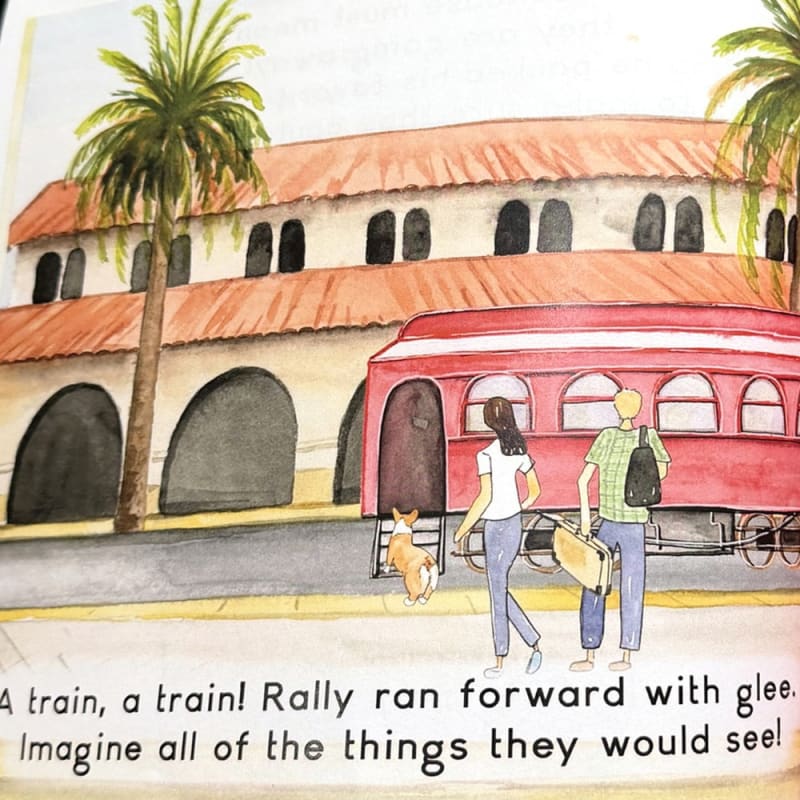


Rally Takes the Train
Eight pages from the book
Turn the page
That's 8 of 25 pages
See who’s waiting at the station
Grandmommy and Papa are at the last stop. Get the full hand-painted book, $13.99 on Amazon.
See the full bookPage 1 of 8

Like it so far? See the full book
25 hand-painted pages, paperback, $13.99 with fast shipping from Amazon.
Every page is real watercolor on paper, painted by hand by Leslie Dunn. Nothing in this book was made with AI.
A rail link between two Southern ports
The Charleston and Savannah Railroad was chartered in the 1850s to connect Charleston, South Carolina, with Savannah, Georgia. A Library of Congress map dates the charter to December 20, 1853, while other accounts give 1854. The line ran about 120 miles across the tidewater country between the two cities, built to 5-foot gauge, and its main line began operating in 1861, with service to other places south and west of Charleston.
The railroad's timing put it in the middle of the Civil War. On October 22, 1862, Confederate troops fought running engagements near Coosawhatchie, Frampton's Plantation and Pocotaligo to defend the Charleston to Savannah line against a Union force of 4,448 men from Hilton Head. After the war, under pressure from bondholders, the board agreed in January 1867 to transfer the company's property, and the line was reorganized as the Savannah and Charleston Railroad. There is no dedicated museum for the line today, so visitors explore it through records, maps and markers.
Where to find the Charleston and Savannah story
The South Carolina Digital Library holds a collection of Charleston and Savannah Railroad records. The Library of Congress keeps a May 1856 map of the located line through the tidewater, with red and blue lines showing the chosen route and experimental surveys. Out on the road, the General Robert E. Lee and Fighting Near Coosawhatchie historical marker tells the story of the 1862 fighting along the railroad.
Don’t miss
- The 1856 survey mapThe Library of Congress map shows the located line in red and experimental routes in blue, a rare look at how the railroad was planned.
- Fighting Near Coosawhatchie markerThis roadside marker explains how Confederate troops defended the railroad against a Union attack force in October 1862.
- The railroad records collectionThe South Carolina Digital Library collection documents the company's operations and its post-war transfer.
A history story for older kids
With no exhibit building or trains to climb, this story suits older kids who like maps and history. Pull up the 1856 map together and trace the route from Charleston to Savannah, then visit a museum with real equipment, such as the Best Friend Train Museum in Charleston, to make it hands-on.
Plan your visit: tips for Charleston & Savannah Railway historical exhibits
- Start with the South Carolina Digital Library's Charleston and Savannah Railroad Records.
- Look up the Library of Congress map from May 1856 to see the planned route.
- Pair the story with a visit to the Best Friend Train Museum in Charleston for something kids can see in person.
Keeping the records
No single museum or society runs a Charleston and Savannah exhibit. The railroad's memory is kept by archives such as the South Carolina Digital Library and the Library of Congress, and by the historical marker programs that mark the Civil War sites along its route. Visiting those collections and markers is the best way to support the story.
See trains in person near Charleston
In Charleston itself, the Best Friend Train Museum displays a replica of the city's first locomotive. At the other end of the old line, about 83 miles away in Savannah, the Georgia State Railroad Museum and the Savannah History Museum railroad exhibits tell more of the story. Browse train museums across South Carolina for more stops.
- Charleston Best Friend of Charleston historic locomotive exhibitCharleston, SC · same town
- Georgia State Railroad MuseumSavannah, GA · about 83 mi
- Savannah History Museum railroad exhibitsSavannah, GA · about 83 mi
- South Carolina Cotton Museum railroad-related exhibitsBishopville, SC · about 101 mi
- Aiken Train MuseumAiken, SC · about 116 mi
- South Carolina Railroad MuseumWinnsboro, SC · about 127 mi
Bring Rally along: a train book for the drive

This old line ran through the low tidewater country between two port cities, and I picture travelers looking out at marsh and water. In our book Rally presses his nose to an arched window, watches the ocean roll by and says hello to a white bird. My mom dreamed up that bird. For kids who like to draw their own trains, our coloring pages are a good start.
Free for train families
Print the Rally coloring pages before you go
Watercolor coloring pages from the book, free to print. Tuck a few in a folder with crayons for the drive or the wait for the next train.
Get the free coloring pages
A train story for the ride homeRally Takes the Train is a five-minute rhyming picture book about a corgi's first train trip to see his grand-paw-rents. Hand-painted in real watercolor. $13.99 on Amazon, for ages 0 to 8.
Buy on Amazon (opens in a new tab)More for train families
- Train museums in South Carolina: every museum by town, with a map
- Train museums in every state: search by town or near you
- Christmas train rides in South Carolina
- Halloween train rides in South Carolina
- Every Amtrak route with kids
Work or volunteer at Charleston & Savannah Railway historical exhibits?
We want this page to be the best introduction to your museum on the web. Send new hours, event dates, corrections or photos to kelsey@rallytakesthetrain.com and we will update it. You are welcome to share this page with your members.
Charleston and Savannah Railway: 20 history questions
Is there a Charleston and Savannah Railway museum I can visit?
There is no dedicated museum building for the Charleston and Savannah Railway. Its history is kept in archives and on the landscape: the South Carolina Digital Library holds railroad records, the Library of Congress has an 1856 route map, and a roadside marker near Coosawhatchie tells the story of Civil War fighting along the line.
What was the Charleston and Savannah Railroad?
It was a railroad built to connect Charleston, South Carolina, with Savannah, Georgia, two of the most important port cities of the antebellum Southeast. The line ran about 120 miles across the tidewater, built to 5-foot gauge, and later became the Savannah and Charleston Railroad after a post-war reorganization.
When was the Charleston and Savannah Railroad chartered?
Accounts differ slightly. A Library of Congress map records the charter date as December 20, 1853, while other histories say the line was chartered in 1854. Either way, the company was formed in the mid-1850s, and its survey map of the located route was drawn in May 1856.
When did the Charleston and Savannah Railroad begin operating?
The main line of the Charleston and Savannah Railroad Company began operations in 1861, according to the South Carolina Digital Library's description of its records. Trains ran between Charleston and Savannah, with service to other locations south and west of Charleston, just as the Civil War was beginning.
How long was the Charleston and Savannah Railroad?
The line ran about 120 miles, or roughly 190 kilometers, between Charleston and Savannah. The track was built to 5-foot gauge, and the route crossed the low tidewater country between the two coastal cities. The 1856 Library of Congress map shows the planned route.
What happened to the Charleston and Savannah Railroad in the Civil War?
The railroad was a military target. On October 22, 1862, Confederate troops fought running engagements near Coosawhatchie, Frampton's Plantation and Pocotaligo and successfully defended the line and the interior of South Carolina against a Union force of 4,448 men that came from Hilton Head.
Where is the Fighting Near Coosawhatchie historical marker?
The General Robert E. Lee and Fighting Near Coosawhatchie marker stands near Coosawhatchie in the South Carolina Lowcountry, along the old Charleston to Savannah route. The Historical Marker Database lists it with its full text, which is the best place to find exact directions before you drive out to see it.
What happened to the railroad after the Civil War?
In January 1867, under pressure from bondholders, the company's board agreed to transfer its property rights and privileges. The Library of Congress notes that the line was reorganized in 1866 as the Savannah and Charleston Railroad. The archival records describe that transition in more detail.
Where can I see Charleston and Savannah Railroad records?
The South Carolina Digital Library hosts a collection called the Charleston and Savannah Railroad Records, which describes the company's main line and its post-war transfer. It is the best starting point for researchers, genealogists and rail fans who want to read the company's own history from primary documents.
Is there an old map of the Charleston and Savannah Railroad?
Yes. The Library of Congress holds a map titled Map showing the location of the Charleston and Savannah R.R., dated May 1856. It covers the tidewater between Charleston and Savannah, with a red line for the located route and blue lines for the main experimental routes that surveyors considered.
Can you ride the Charleston and Savannah Railway today?
No passenger excursions run under the Charleston and Savannah name. For a real train ride in South Carolina, the South Carolina Railroad Museum in Winnsboro runs seasonal trips on its own line, and the Georgia State Railroad Museum in Savannah is the closest place at the southern end of the route to see historic equipment.
Is the Charleston and Savannah story good for kids?
It works best for older kids who enjoy maps and history, since there are no trains to climb. Tracing the 1856 map from Charleston to Savannah together, then visiting the Best Friend Train Museum in Charleston to see a real locomotive replica, makes the story more hands-on for younger children.
How much does it cost to explore Charleston and Savannah Railway history?
Nothing. There is no admission because there is no exhibit hall. The South Carolina Digital Library collection and the Library of Congress map can be viewed online, and roadside historical markers are free to visit, though you will need your own transportation to reach the Lowcountry sites.
What towns did the Charleston and Savannah Railroad pass near?
Its route crossed the tidewater between the two port cities. Places tied to the line in the historical record include Coosawhatchie, Pocotaligo and Frampton's Plantation, where fighting took place in 1862. The 1856 Library of Congress map shows the full located route between Charleston and Savannah.
Why did Charleston want a railroad to Savannah?
Charleston and Savannah were two of the most important port cities in the antebellum southeastern United States, and a rail line between them connected their trade. The route also offered service to other locations south and west of Charleston, which is part of why it mattered so much during the Civil War.
Was Robert E. Lee involved with the Charleston and Savannah Railroad?
A historical marker near Coosawhatchie is titled General Robert E. Lee and Fighting Near Coosawhatchie, and it describes the October 1862 defense of the railroad. The marker's full text, listed in the Historical Marker Database, explains the Lee connection to the site.
Where can I see a real locomotive near Charleston?
The Best Friend Train Museum on Ann Street in downtown Charleston displays a 1928 replica of the Best Friend of Charleston, the first locomotive built entirely in the United States. Admission is free, and it is the easiest way to pair the Charleston and Savannah story with a train kids can see.
Are there railroad museums in Savannah?
Yes. About 83 miles from Charleston, at the southern end of the old line, Savannah has the Georgia State Railroad Museum and the Savannah History Museum, which has railroad exhibits. Both have their own pages on this site with hours and visiting details.
Who preserves the history of the Charleston and Savannah Railroad?
No single society or museum is dedicated to it. Its history is kept by archives, including the South Carolina Digital Library and the Library of Congress, and by historical marker programs that mark sites along the route. Rail history writers have also published accounts of the line.
What other train museums are in South Carolina?
South Carolina's rail stops include the Best Friend Train Museum in Charleston, the South Carolina Railroad Museum in Winnsboro with seasonal rides, the Aiken Train Museum in a rebuilt depot, and smaller exhibits in Anderson and Bishopville. The state page on this site lists them all.
Keep exploring
More family train guides from Rally
- DirectoryRailway Museum Directory650 train museums in all 50 states, with hours, tickets and train rides.
- HolidayChristmas Train RidesSanta trains and holiday light rides, sorted by state and town.
- OctoberHalloween Train RidesPumpkin trains and not-too-spooky rides for little ones, by state.
- NovemberThanksgiving Train RidesHoliday weekend train trips the whole family can share.
- AmtrakAmtrak With KidsWhich Amtrak routes work best with babies, toddlers and big kids.
- Plan a tripTrain Trips With KidsEvery Amtrak route, stop by stop, planned for families.